10 Moments in French History That Changed Paris Forever
Paris looks continuous from a postcard, yet the places in that image belong to different decisions and moments. A fortress became a palace, a palace opened to collections, and a railway station acquired another public life. These ten turning points offer a selective introduction to changes whose traces still help visitors read the city. They are starting points for investigation rather than a claim that ten dates can explain everything Paris has become.
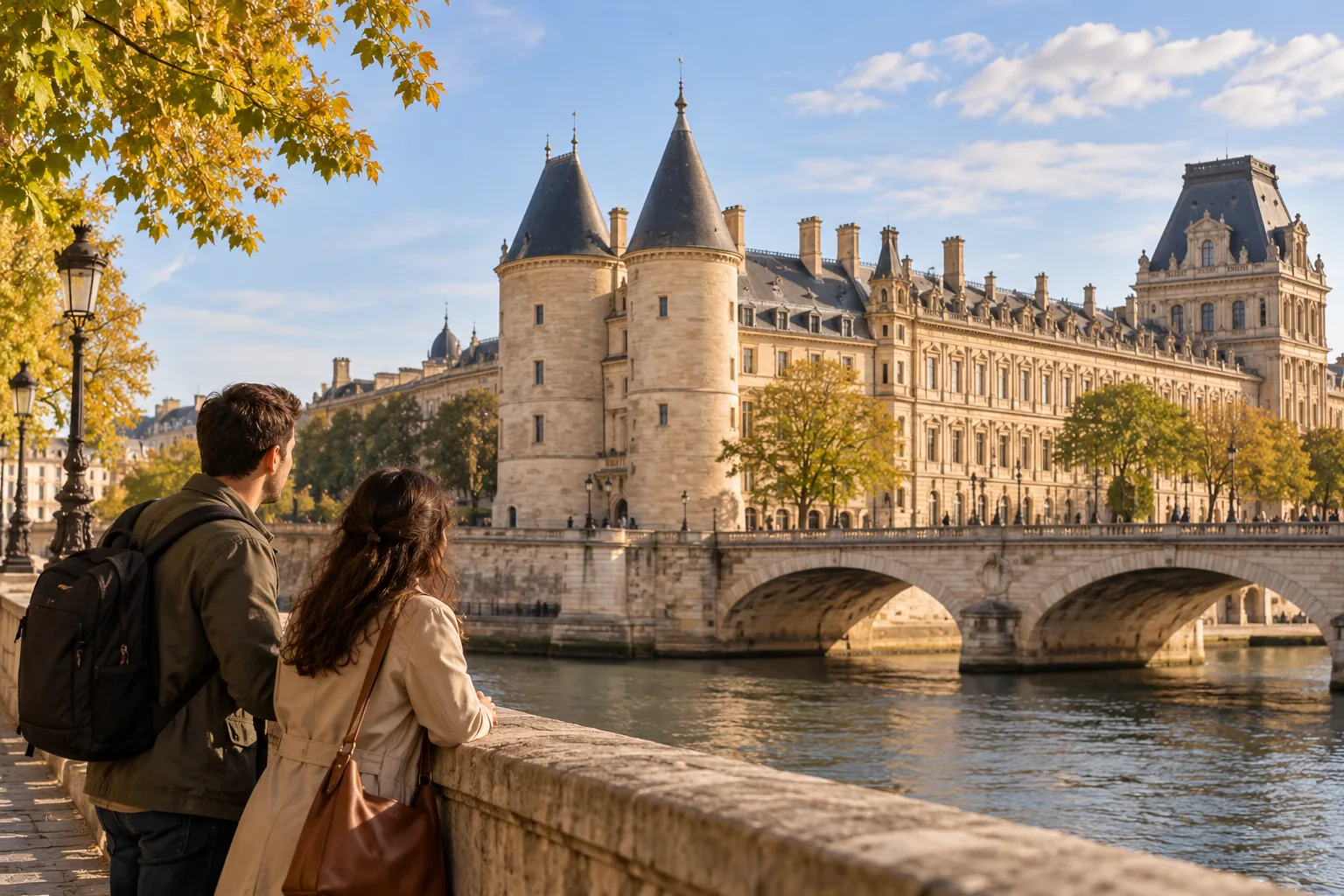
Moments 1–3: fortification, relics, and the movement of royal power
First, the Louvre castle appeared under Philippe Auguste in 1190, placing a fortified structure where visitors now expect a museum. Its later transformation makes the building's original purpose an important part of the story. Second, Louis IX acquired the Crown of Thorns in 1239, before commissioning Sainte-Chapelle to house prestigious relics. The chapel connects sacred possession with the royal palace, giving visitors a concrete way to investigate medieval patronage.
Third, Versailles became the headquarters of government in 1682, while Paris remained the official capital. Royal power did not disappear from Paris, but the court's principal setting shifted outside it. Our guide to Paris for history lovers helps keep that distinction visible when a Versailles visit enters the plan. The date introduces a question about where a ruler chooses to govern and stage public authority.
Moments 4–6: revolution, collections, and an imperial project
Fourth, the Bastille was stormed on July 14, 1789, and its later demolition changed the site's physical story. The column now occupying the square belongs to remembrance of the July Revolution of 1830, so the visible monument requires its own chronology. Fifth, the Louvre opened as a museum in 1793, changing the public role of a former royal setting. Our guide to history through places and evidence helps distinguish an event from what survives to represent it.
Sixth, construction of the Arc de Triomphe began in 1806 as an imperial project that was not completed until 1836. Later governments continued and reshaped its public meaning. This makes the monument a useful example of ambition that outlasted its original political moment. A visitor can ask which part of the story belongs to Napoleon's initiative and which belongs to the regimes that followed him.
Moments 7–8: a larger city and a new skyline
Seventh, Montmartre was annexed to Paris in 1860, a dated change documented by the neighborhood's museum. Today's Paris districts should not be projected backward as though the city always had the same boundaries. Eighth, the Eiffel Tower was built for the world's fair of 1889, giving the city a new structure through which to display engineering ambition. Our guide to Paris beyond its most familiar landmark helps turn that recognizable view into a starting point rather than the whole itinerary.
These two moments concern different kinds of transformation, one administrative and one architectural. A boundary change and a new monument do not affect every resident or neighborhood in an identical way. Compare the institutional account with the particular place you visit instead of assuming a single citywide experience. The useful question is how the change altered a setting and what evidence remains available to investigate it.
Moments 9–10: arrival, reuse, and a new museum entrance
Ninth, the Orsay railway station opened for the world's fair of 1900, long before its later use as the Musée d'Orsay. Tenth, I. M. Pei's Louvre Pyramid was inaugurated in 1989, adding a modern architectural layer to a building with a much longer history. Each place shows how public needs and architectural choices continue to change familiar settings. A visit can investigate the relationship between those layers without treating the most recent one as an interruption that does not belong.
Use the Immmersiv map to choose a practical area to explore rather than attempt all ten moments in a single route. Explore the character themes and read the performance format if a portrayed perspective connects with your question. Check the selected product's actual status, suitability, language, availability, and practical requirements. A professional actor's interpretation can add a viewpoint while the chronology remains grounded in historical sources.
These ten moments make Paris visible as a city of decisions rather than a finished collection of monuments. Choose one or two changes that interest you and examine their traces closely. Keep the date of an event separate from a later rebuilding, reuse, or memorial. The outline becomes useful when it helps you see more in the next place you visit, not when every date has been crossed off a list.
Discover an Immmersiv Experience
For an artistic perspective on Montmartre, investigate The Impressionists of Montmartre, with a professional actor embodying Père Tanguy. Read the actual premise as one viewpoint on the neighborhood rather than a complete history of the city. Confirm suitability, language, availability, and practical requirements before booking. The encounter can open a question to follow through collections and documented accounts afterward.