From Textbook to Adventure: Experiencing History in Paris
A name that appeared on a classroom page can feel different when a family stands in a place connected with its wider story. The city adds scale, materials, and the practical reality of moving through a landscape. Yet being there does not automatically explain what happened or establish every story attached to the location. The richest historical adventure connects the feeling of a place with questions and evidence, leaving imagination a clear role of its own.
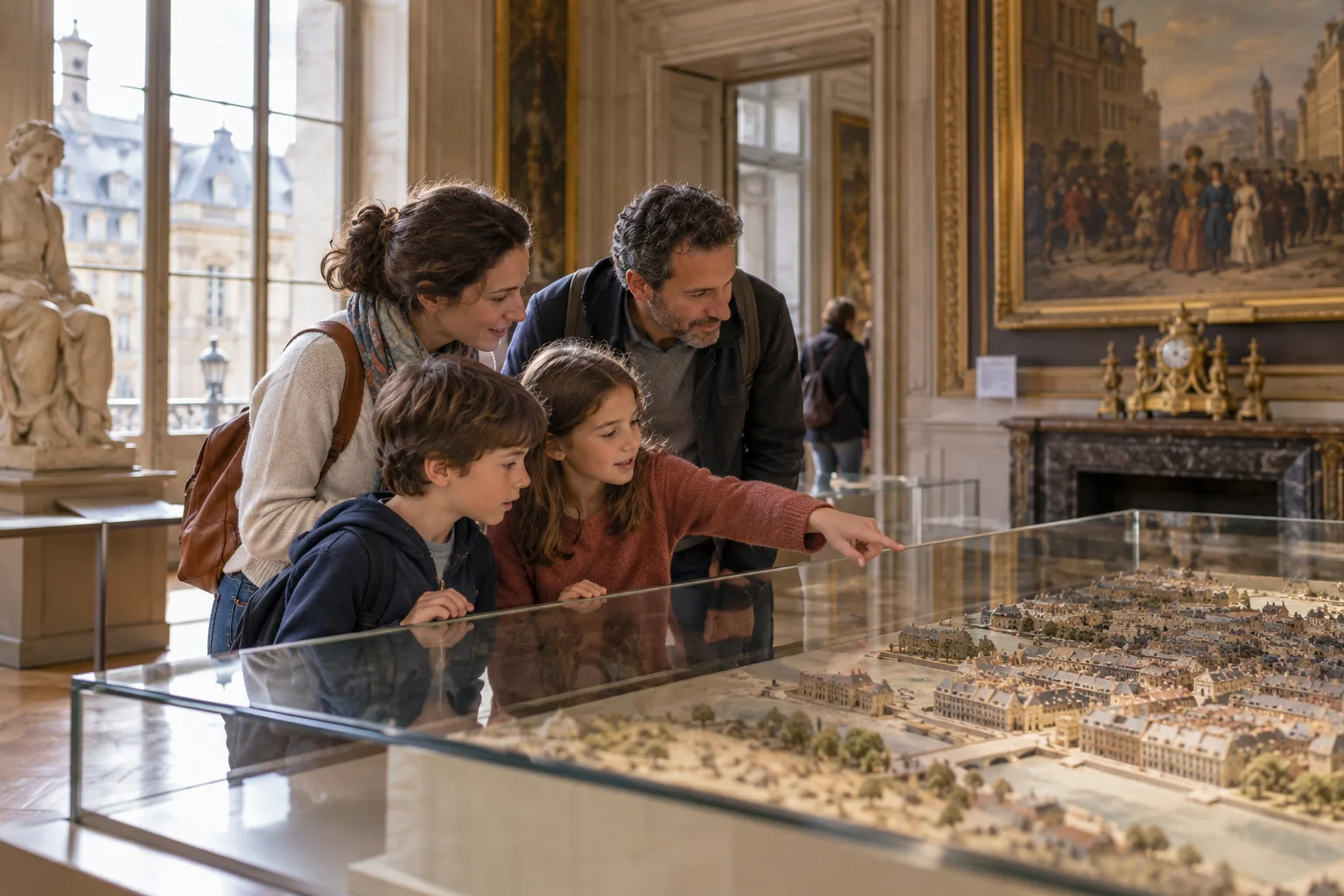
Bring a classroom question into the city
Ask your child which subject from school they would like to understand more clearly, if any comes to mind. Choose a manageable question connected with a Paris collection or place rather than trying to reproduce an entire curriculum on vacation. A museum object may make work, daily life, or representation easier to discuss than a broad summary of political events. Our guide to making French history approachable offers a way to prepare that question without turning the visit into an assignment.
At Carnavalet, collections devoted to Paris and its inhabitants provide material for investigating how city life has changed. Consult the museum's collection and family information before deciding which subjects fit your route. Explain what the chosen object can establish and what would need another kind of source. A child can find a strong connection with school even when the museum adds a perspective that did not appear in the textbook.
Use the physical place without making it prove too much
Look at the size of a room, the materials of a building, or the arrangement of a street before adding historical claims. These observations can lead to useful questions about movement, work, and everyday conditions, but they do not automatically tell you what an individual thought. Check whether the feature you are discussing belongs to the period in question or has changed since then. Our article on making history fun keeps that exploration connected with things a family can actually notice.
Invite a child to describe an imagined possibility only after marking it as imagination. You might ask how they would approach an unfamiliar city without suggesting that a particular historical person made the same decision. Then compare that possibility with the facts established by labels or institutional information. The adventure becomes more interesting when observation, evidence, and speculation each have a distinct place in the conversation.
Give the visit a route that leaves enough attention for those distinctions to matter. A sequence of rushed landmarks can produce impressive photographs while making every explanation blur together. Choose a small number of connected discoveries and protect the time between them for questions and breaks. Our guide for history lovers can help adults find a broader context to pursue without requiring children to absorb it all in one day.
Let a performed character add a narrative viewpoint
The Immmersiv character themes offer ways to explore personalities through a story connected with a place. Read the format guide to understand the portrayal as an interpretation, rather than a documentary record of everything spoken or enacted. The Père Tanguy experience is one artistic subject to investigate when it matches your family's question. Confirm the selected encounter's age suitability, language, availability, and practical conditions before planning around it.
After an encounter, ask which viewpoint the performance brought into focus and what you would investigate through another source. A museum object might provide a useful comparison, while a new question may send you back to institutional collection information. Let the child enjoy the story without requiring them to deliver a formal analysis at the end. A relaxed conversation can still make clear that feeling present within a narrative differs from verifying a historical event.
Paris can add texture to history that once felt confined to a page. An object, a place, and a performed interpretation each contribute something different to that discovery. Keep the connections accurate, make the route manageable, and allow curiosity to change the question along the way. The adventure lies in exploring more closely, rather than pretending the past has returned unchanged.