Medieval Paris for Teenagers
A teenager looks up at a chapel window and wonders who decided which story should fill the wall. Medieval Paris becomes more approachable when its buildings answer questions about power, faith, and the boundaries of a city. You do not need to supply a complete royal genealogy before beginning. Choose a few surviving places and ask what they were intended to do, while recognizing that restoration and later storytelling shape the way visitors encounter them now.
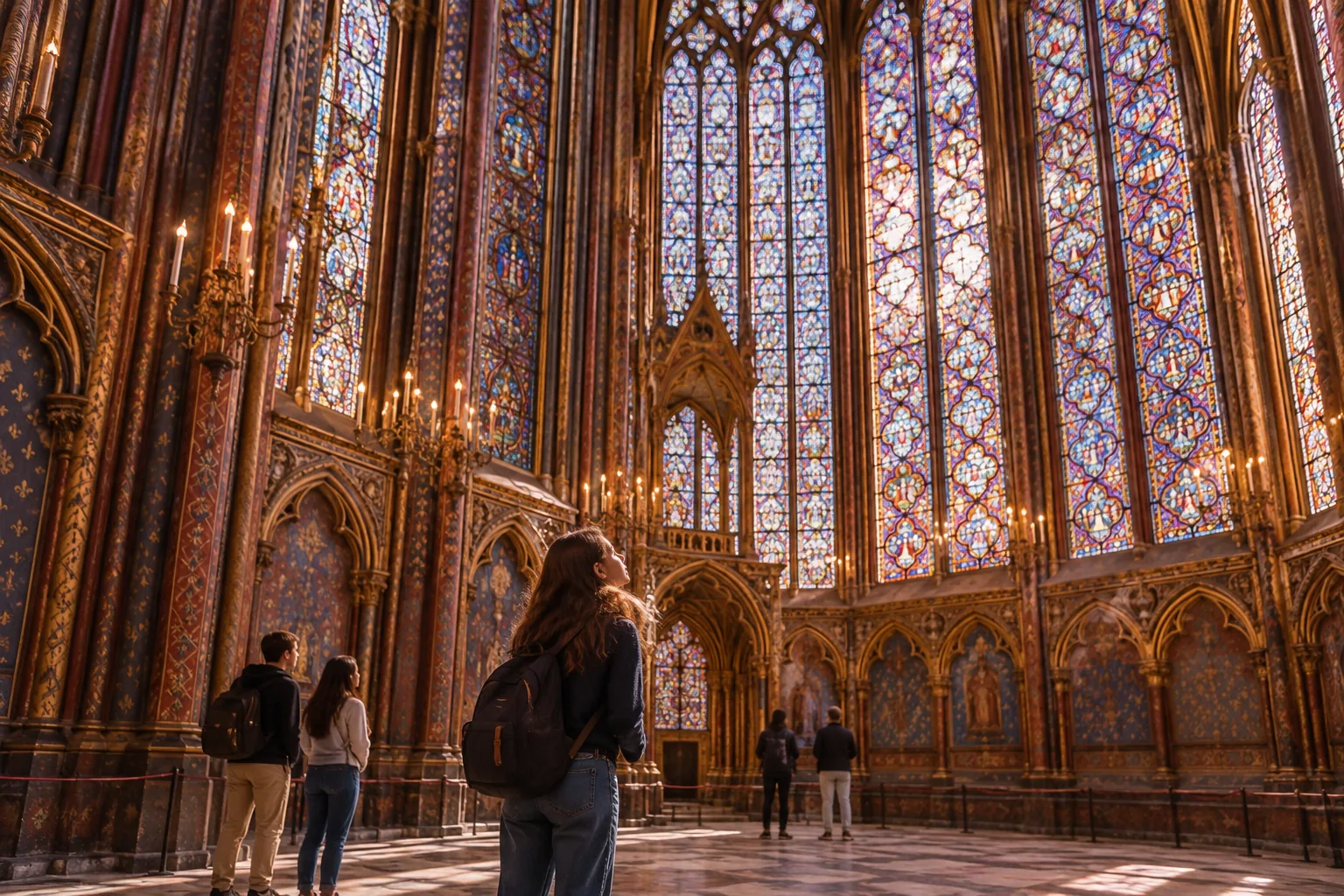
Explore royal power through two different kinds of space
Sainte-Chapelle was built for Louis IX in the thirteenth century to house relics associated with Christ's Passion. Its upper chapel served the king and distinguished guests, while the lower level served palace staff. That difference invites a teen to consider how architecture expressed hierarchy as well as devotion. A visit can begin with that question instead of a request to admire the glass without knowing its purpose.
The neighboring Conciergerie preserves lower rooms of the former royal palace, including the Gothic Salle des Gens d'Armes. Its later prison history should not obscure the building's medieval role, although the two periods can be compared. Our guide to Paris for history lovers helps you identify which question belongs to each setting. Let the teen notice a structural detail before consulting the monument's explanation for the information it actually supports.
Look for defense inside the modern city
The Louvre began as a fortified castle under Philippe Auguste, long before the museum most visitors recognize today. The museum's historical presentation includes medieval remains, giving a teen another way to approach the institution beyond famous paintings. Check its current route and room information before planning around that part of the building. Our guide to a focused museum visit can help you keep the investigation manageable.
Fragments of Philippe Auguste's city wall also survive within the later urban fabric. The City of Paris identifies a tower remnant on rue du Louvre, an example of defense absorbed into a changed neighborhood. Look from appropriate public space and check current access rather than assume every historic fragment is freely entered. Ask the teen how a boundary once separating inside from outside can become something almost hidden among buildings.
Do not treat every old-looking lane or uneven wall as proof of medieval origin. Check the site's documentation and distinguish a surviving fragment from restoration, later construction, or a remembered route. A short observation can still be rewarding when the original structure is incomplete. It makes the city a puzzle to investigate through evidence rather than a setting where any atmospheric detail earns a convenient date.
Keep literary Paris separate from medieval evidence
Victor Hugo's Notre-Dame de Paris was published in 1831, offering a later imaginative view of a medieval setting. Esmeralda belongs to that novel and is not a documented medieval Parisian whose biography can be followed like a historical source. Explore the Immmersiv character themes with that distinction in mind. The site lists Notre-Dame with Esmeralda as Being Created, so its concept should not be presented as an available booking.
Read the general performance format to understand the role of professional actor embodiment, while checking individual product status separately. Our guide to experiencing history through places and questions helps connect imagination with evidence without confusing them. A teen can enjoy a fictional character while recognizing which account belongs to the nineteenth century. The distinction makes the literary layer another subject to explore rather than a substitute for medieval history.
Medieval Paris for teenagers works best as an investigation of what buildings and fragments were made to do. Royal spaces, a fortress, and a city wall open different questions about the people who used them. Keep restoration and literary invention visible as part of the encounter. Your teen can then approach the period through evidence while still appreciating the stories later generations built around it.
Discover an Immmersiv Experience
For a separate medieval-history outing beyond Paris, investigate Joan of Arc: The Trial in Rouen, with a professional actor embodying Joan of Arc. The encounter is in Rouen, so it requires its own travel plan rather than an addition to a central Paris walk. Read the actual trial premise and confirm suitability, language, availability, and practical demands. Keep the performed perspective distinct from documentary evidence about the historical proceedings.