Where Can You Still See Revolutionary Paris?
Revolutionary Paris is still visible, but rarely in the uncomplicated form a traveler first imagines. A stone fragment may have been moved, an object may carry a commemorative meaning, and a recognizable garden may have changed around a documented event. The pleasure of looking closely comes from understanding those differences. Instead of searching for a perfectly preserved city from 1789, follow several kinds of evidence and let each reveal a different part of the period.
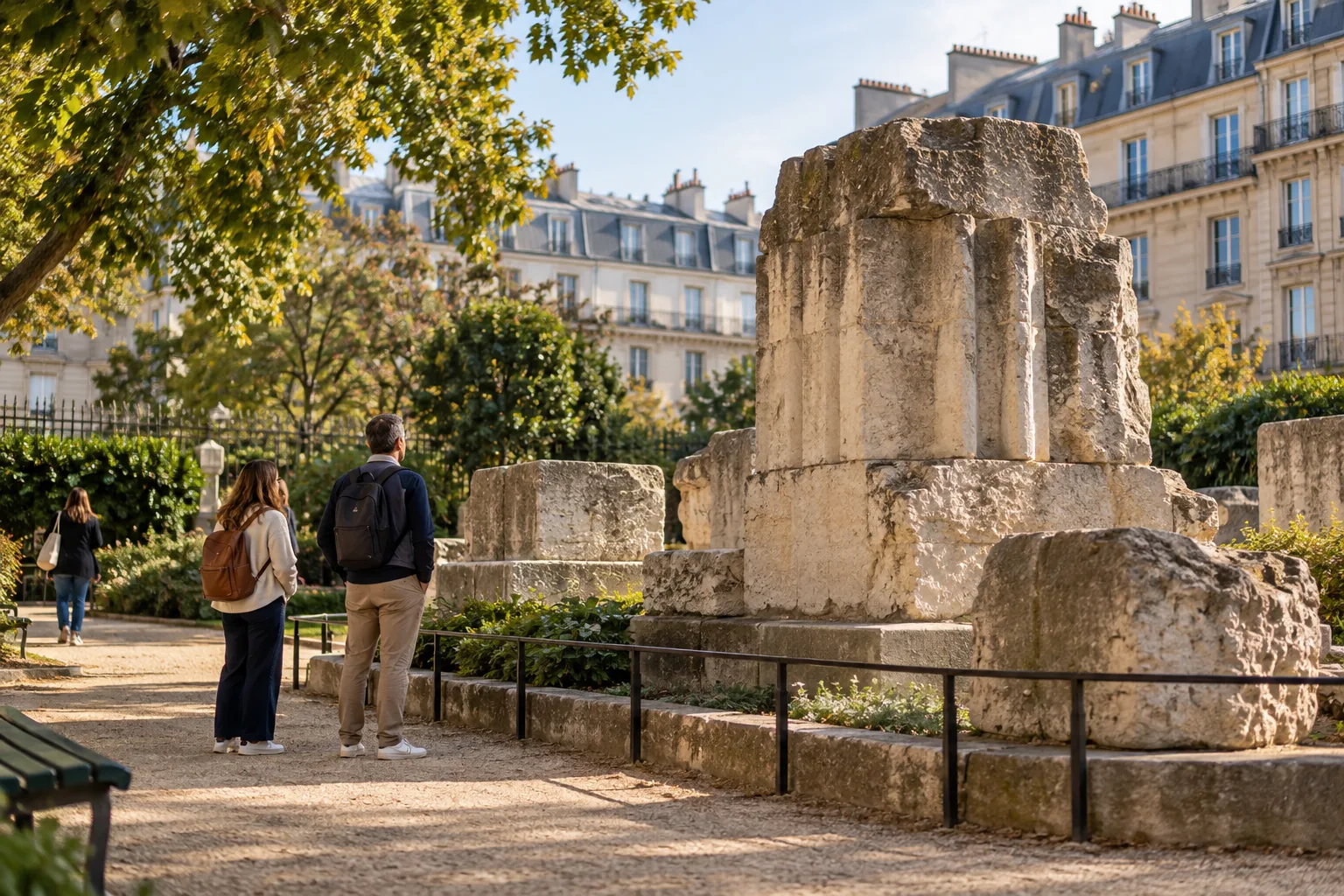
A relocated fragment preserves material rather than position
Square Henri-Galli holds reassembled remnants connected with the Bastille's Liberty Tower. The City of Paris explains that the stones were discovered during Métro construction in 1899 and moved to the square. What you encounter there is genuine material in a later arrangement and location. Our guide to the Revolution's historical locations helps keep a surviving fragment distinct from the site of the original event.
This is a useful first distinction for anyone interested in what remains. Physical survival does not automatically mean that an object stands where it did when the Revolution began. A labeled fragment and a historical plan work together, because each supplies information the other cannot. Read the current interpretation before imagining a complete tower or assigning every visible stone an undocumented story.
Collections make small traces and contemporary images legible
The Musée Carnavalet's revolutionary presentation includes material associated with the Bastille as well as works addressing broader political developments. The museum's account discusses keys, fragments, and representations within the history of the city's revolutionary period. Such collections allow a traveler to encounter evidence at a scale that a large public square can make difficult to grasp. Check the individual label and current display information rather than assume that every documented object is permanently on view.
Choose an object and ask what relationship it has with the event it represents. A contemporary image, an architectural fragment, and a souvenir produced afterward can each be informative for different reasons. Our guide to combining collections and interpreted stories helps preserve those differences while planning a cultural day. An object does not have to be an untouched relic of a famous moment to offer a worthwhile historical question.
The museum can also widen the frame beyond the most recognizable dramatic sites. Its historical account follows civic organization, the monarchy's changing position, and the emergence of new political arrangements. Use a few selected works to ask how people represented participation or authority rather than attempt to master every revolutionary year in one visit. Our article on life and political change during the Revolution provides a chronological framework for those questions.
Recognizable places need their event and later history explained
The Palais-Royal connects with public political speech in July 1789, while the Tuileries setting connects with the attack on the palace in August 1792. The palace itself is gone, so these places do not preserve their historical circumstances in the same way. The city's documented revolutionary route identifies their roles and helps explain what today's view cannot show. Compare the event account with the present setting without treating every visible feature as contemporary evidence.
Use the Immmersiv map for broader cultural planning while checking each museum or monument's practical arrangements independently. Browse the available character themes and read the performance format when a personal viewpoint would complement your research. An actor embodies a character through interpretation, while surviving evidence and later commemoration require their own labels. Keep those forms of encounter separate enough that a memorable scene does not turn an unsupported detail into historical fact.
You can still see revolutionary Paris through material, images, and places with documented historical roles. The important question is what each trace preserves and what has changed since the event. Relocated stones, museum collections, and an altered urban setting need different ways of looking. Together they make a richer visit than the search for one supposedly untouched revolutionary scene.
Discover an Immmersiv Experience
For a separate visit focused on a royal personality, investigate Marie Antoinette, Rebel Queen, with a professional actor embodying Marie-Antoinette. The encounter belongs to Versailles and offers an interpreted viewpoint rather than a tour of Paris's surviving revolutionary traces. Confirm current availability, language, suitability, travel, and practical arrangements. Read the actual premise before assuming admission to any palace or monument is included.