French Revolution for Teens: Where to Experience the Story in Paris
A teenager arrives at Place de la Bastille expecting the prison and finds a busy square dominated by a column. The difference between expectation and the actual place opens a useful historical question. Revolutionary Paris survives through sites, objects, and later acts of remembrance, not as an untouched stage set. Follow a few distinct parts of the story and ask what each location preserves, what has disappeared, and who shaped the memory you encounter today.
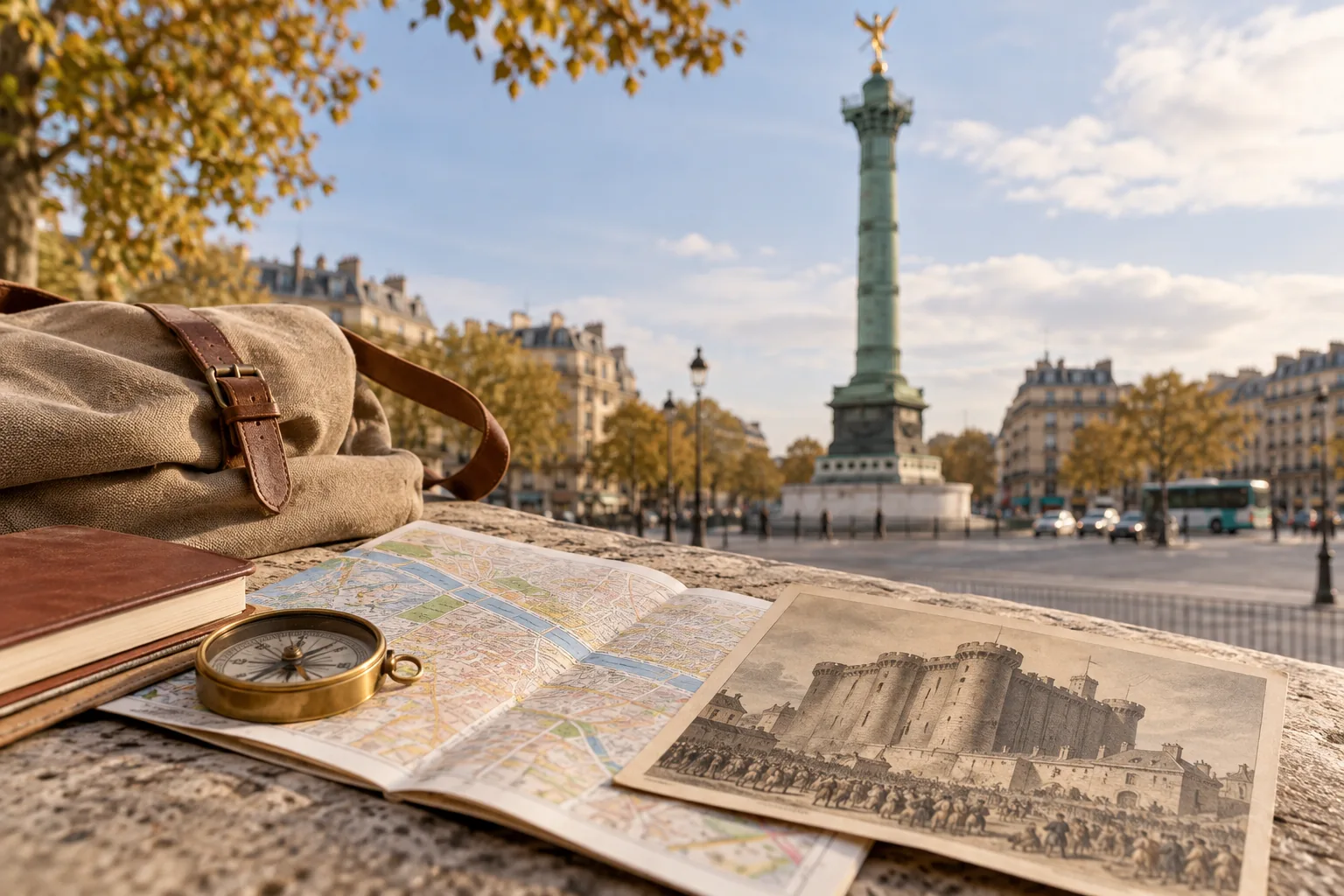
Bastille: begin with the difference between event and memorial
The Bastille was attacked on July 14, 1789, and the fortress was subsequently demolished. The July Column now occupying the square commemorates the revolutionary days of July 1830, a different uprising. That distinction is an important first lesson in reading a historical place. Our guide to Paris for history lovers helps you build a visit around questions rather than assume the most visible monument belongs to the event named in the place.
Ask the teen how you might represent an event when its building no longer exists. A map, an image, a written account, and a later memorial each provide a different kind of information. Consult the city's historical explanation before assigning the column a meaning from its location alone. The square can introduce a conversation about how revolutionary memory continued after 1789 without making later events part of the same moment.
Conciergerie and Concorde: approach difficult history carefully
The Conciergerie connects with detention and the Revolutionary Tribunal, which was established in the palace in 1793. Its history also reaches back to the medieval royal palace, so not every visible architectural feature belongs to the Revolution. Review the monument's interpretation with your teen and keep those periods separate. Our guide to history beyond a textbook can help turn a familiar narrative into questions about the surviving setting.
Marie-Antoinette's imprisonment adds a personal thread, while the commemorative chapel on the site of her cell belongs to the Restoration period in 1816. That later intervention shows how a place of detention became a site of royalist remembrance. Present the change as part of the history rather than claim the chapel is an untouched prison interior. Discuss why a later government might choose to commemorate the queen in that particular way.
At today's Place de la Concorde, Louis XVI was executed on January 21, 1793, when the square was known as Place de la Révolution. The contemporary setting does not reproduce the event, and the subject deserves a serious explanation rather than a dramatic game. Allow the teen to ask about political change and violence without requiring an immediate verdict on the whole Revolution. Keep individual biographies within the broader context instead of reducing a complicated period to heroes and villains.
Use objects and interpretation to deepen the route
A focused visit to the Musée Carnavalet can add material evidence to the locations you have discussed. Choose current collection themes relating to the Revolution instead of promising a particular work will always be displayed. Our guide to combining museums and performed experiences helps distinguish what an object documents from the perspective a story supplies. Leave time to compare the sources rather than try to join every revolutionary site in one day.
Explore the Immmersiv character themes and the performance format if a portrayed personality connects with the teen's question. Use the map to recognize that the Marie-Antoinette encounter is in Versailles, requiring its own practical plan outside central Paris. A professional actor's interpretation is a different experience from visiting the Conciergerie. Confirm suitability, language, availability, travel, and the actual premise before choosing it.
Revolutionary Paris becomes more understandable when a teenager can distinguish the event, the surviving evidence, and the later memorial. Bastille, the Conciergerie, and Concorde offer different parts of that investigation. Give difficult subjects context and leave room for questions that a single visit cannot settle. The trip can then connect a known chapter of French history with places whose meaning continued to change afterward.
Discover an Immmersiv Experience
For a separate visit to Versailles, investigate Marie Antoinette, Rebel Queen, with a professional actor embodying Marie-Antoinette. Read the actual royal-streets premise rather than assume it includes entry to the palace or Paris's revolutionary sites. Confirm suitability, language, availability, travel, and practical arrangements. The portrayed viewpoint can complement historical research while remaining clearly framed as performance.