Monet’s Wheatstacks: A Familiar Shape, a Different Season
Two stacks stand in a field, one large and one small. At first, the scene seems almost too simple to hold your attention for long. Then a second painting brings the same kind of shapes into a landscape of snow, and everything begins to change. Monet’s wheatstacks invite you to discover how much a familiar subject can reveal when you return to it under different conditions.
Begin in the fields beyond the garden
In the fall of 1890, Monet arranged for wheatstacks near his home to remain in the fields over winter, according to the J. Paul Getty Museum. The arrangement gave him a subject he could return to as the seasons changed. These were agricultural forms, not decorative structures installed in the water garden. That distinction opens a different view of the landscape around Giverny.
The series asks us to think beyond the best-known image of a painter looking at flowers and a pond. A field could offer its own stable shapes and changing appearances. The garden remains another essential part of his world, explored in Monet’s water garden as a landscape made to be painted. Keeping the two settings distinct helps us notice the different possibilities each one offered.
Look first at the end of summer
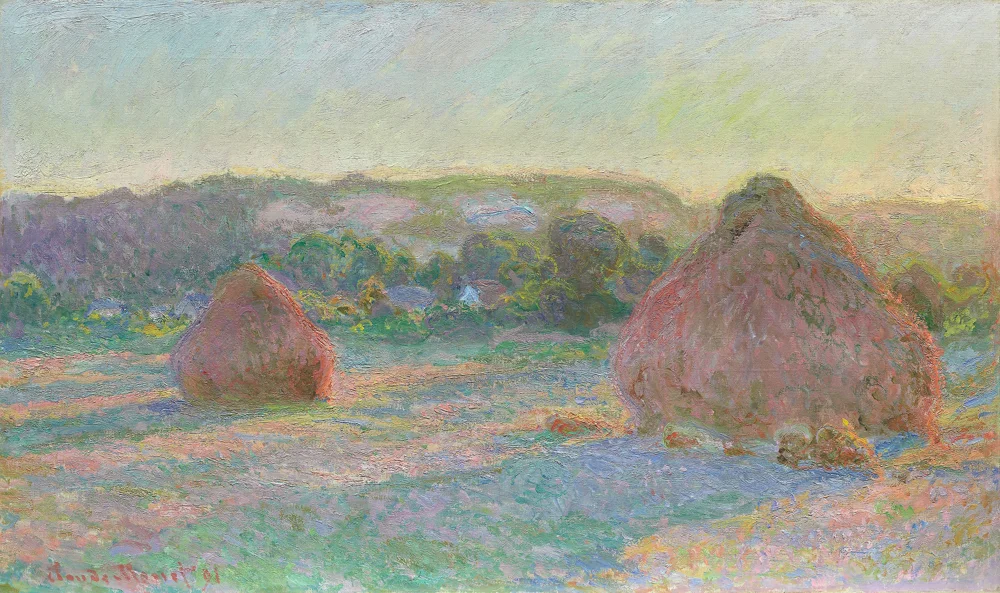
The Art Institute of Chicago dates Stacks of Wheat (End of Summer) to 1890–91. In its reproduction, two rounded stacks rise against a low band of distant buildings and vegetation. The larger shape occupies the right side while the smaller one stands farther left. Their placement gives the scene a clear structure before you begin to follow the individual marks of paint.
Try looking at the ground rather than at the stacks themselves. Bands of pink, green, and cooler blue-green spread across the field, making the surface feel varied rather than uniformly brown. The stacks also contain several colors instead of one simple straw-colored tone. You can begin the comparison by asking where a color reappears elsewhere in the picture, without needing to identify every brushstroke. If a difference feels difficult to describe, point to one patch of ground and name the colors you can actually see.
Return when the field is covered in snow
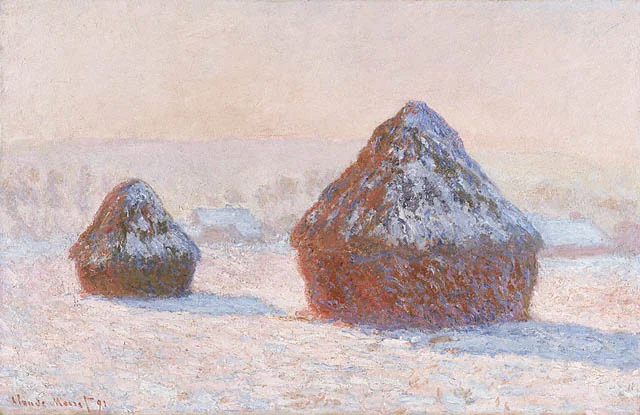
The Getty’s Wheatstacks, Snow Effect, Morning is dated 1891. The second reproduction here exchanges the summer field for pale ground and stacks dusted with snow. Their darkened sides and long shadows give the familiar shapes a different presence. You can recognize the subject while feeling that the picture has changed in almost every other way.
Monet began paintings outdoors and also reworked them in his studio, as the Getty explains. The finished canvases therefore should not be reduced to instant records made without later decisions. Follow the pinks and blues in the snowy image, then compare the warmer and greener passages in the summer view. For another subject transformed through repeated looking, continue with Monet’s Rouen Cathedral series.
Make a small comparison part of your next visit
You can try this kind of looking with a child, a friend, or simply on your own. Choose one feature, such as the edge of a shadow, and compare it across the two reproductions. Then choose a second feature and see whether your first impression still holds. In Monet’s Saint-Lazare paintings, trains and steam offer another way into the relationship between a place and its changing appearance.
At Giverny, that habit can make an ordinary patch of light worth a second glance. The Immmersiv Monet experience offers a professional actor’s interpretation of the artist within its published itinerary. This article does not identify a surviving wheatstack field or add a stop to that route. Consult what to expect from an Immmersiv experience and the current experience details for the practical side of your visit.
Discover an Immmersiv Experience
Explore Inside Claude Monet’s Giverny with a professional actor embodying Claude Monet. This article provides background for your curiosity. It does not promise stops or access beyond the published experience route. Consult the current experience page for its route and practical details.