Monet’s Rouen Cathedral Series: One Façade, Changing Light
The stone doorway is recognizable, yet its colors refuse to remain fixed. In one painting, cool blue and lavender gather around the portal; in another, pale yellow seems to spread across the same carved surface. Monet’s Rouen Cathedral series asks you to stay with those differences. What first appears to be a repeated subject becomes an invitation to notice how light, paint, and the act of looking can transform a building.
Begin with the years behind the dates
Monet worked on views of Rouen Cathedral during painting campaigns in 1892 and 1893. The Metropolitan Museum of Art explains that he moved among canvases as the day’s light changed. He later continued the work in his studio at Giverny, adjusting individual pictures and their relationships to one another. Many canvases consequently bear the date 1894, rather than simply recording the year of his first work before the cathedral.
This chronology matters because it changes the story we tell about the finished paintings. They are not merely a sequence of untouched impressions carried straight from a window to an exhibition wall. Observing the facade and reconsidering the painted surfaces belonged to the same extended undertaking. For another stage in his exploration of atmosphere, compare Monet’s paintings of steam at Saint-Lazare, where a very different structure offered changing conditions to look at.
Compare two canvases before naming the colors
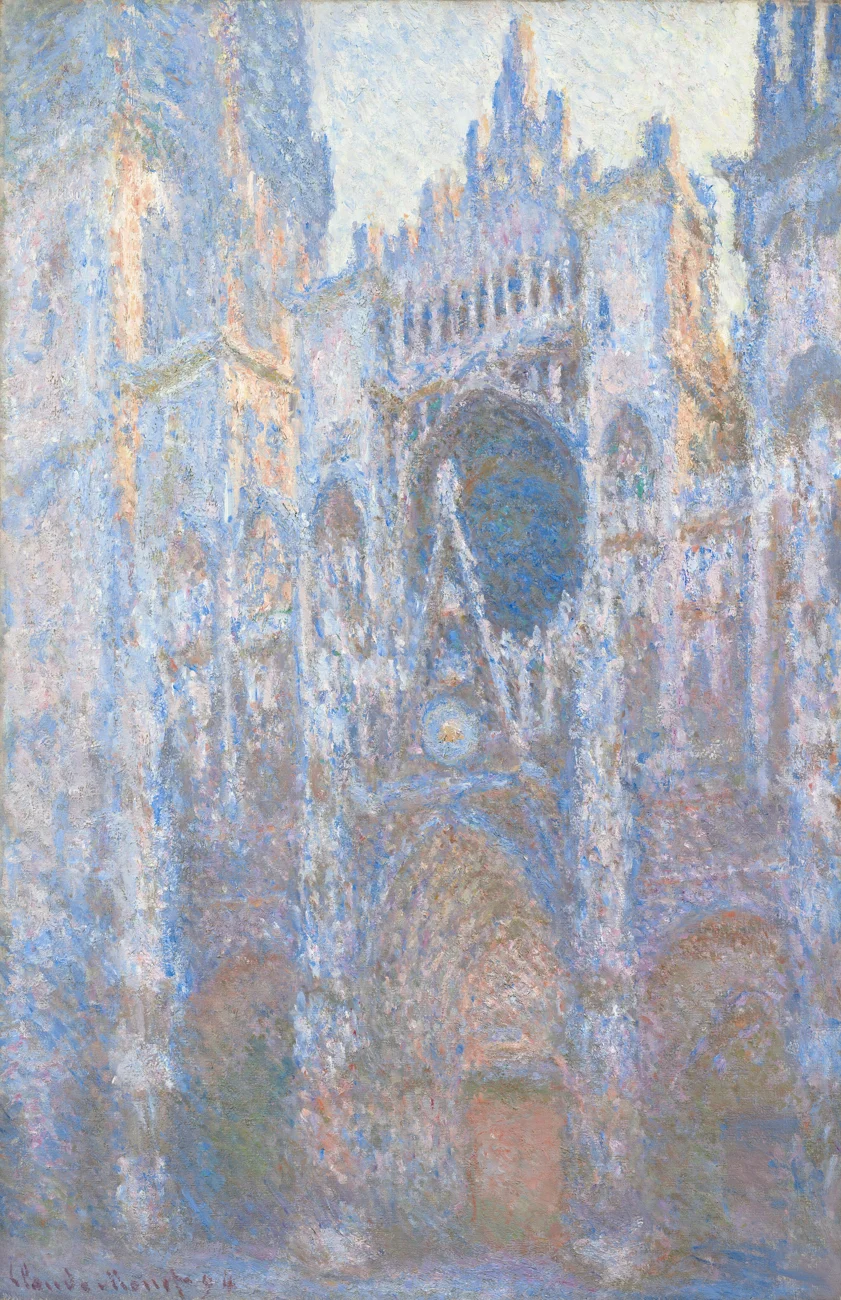
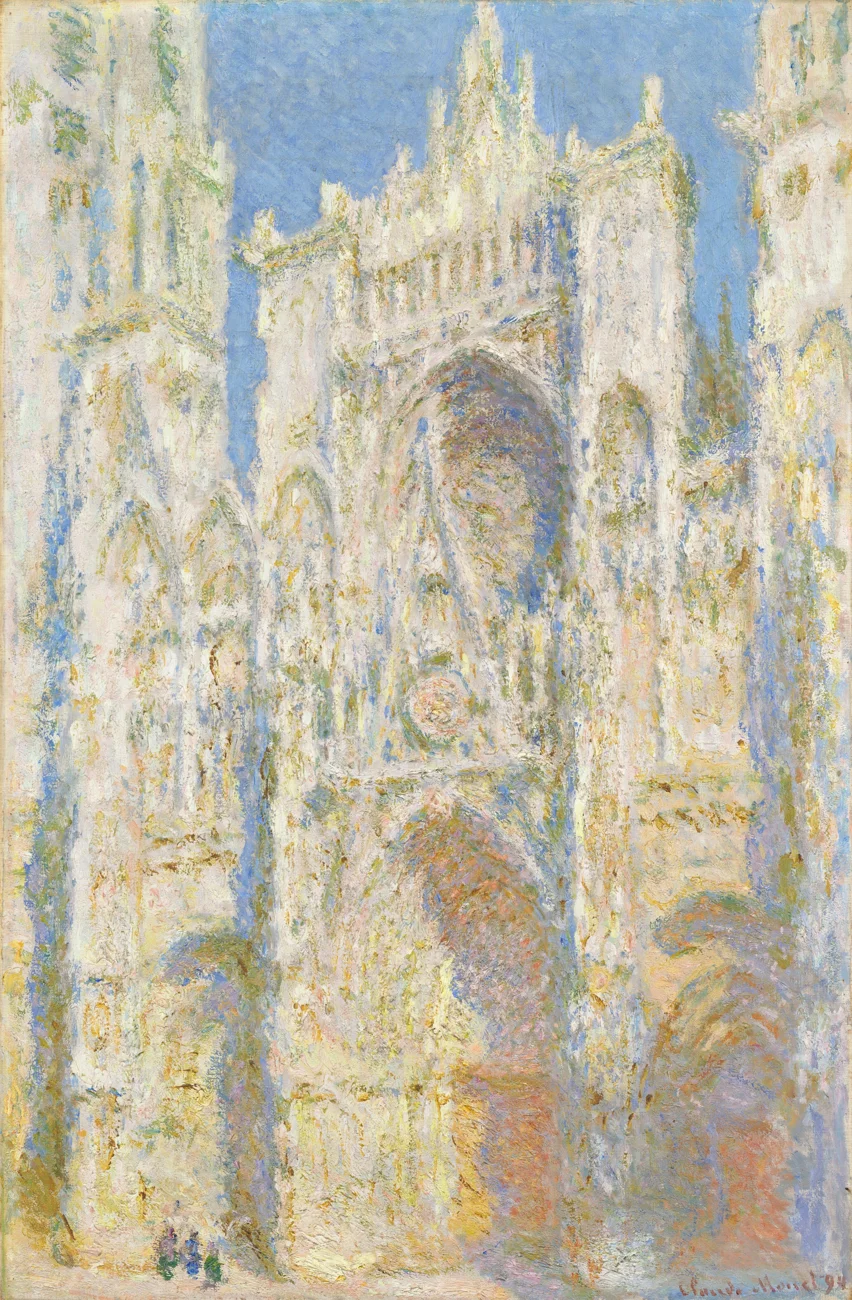
The two reproductions here belong to the National Gallery of Art in Washington. Both are dated 1894, but their titles distinguish Rouen Cathedral, West Façade from Rouen Cathedral, West Façade, Sunlight. Begin by finding the central doorway in each. Then trace the pointed forms above it and the interruptions where the architecture runs beyond the edge of the picture.
Now move your attention from those recognizable features to the patches of paint around them. In the first image, blues and purples are conspicuous in the central facade. In the Sunlight version, lighter yellow and cream passages alter the balance, while blue remains important in the surrounding forms. These are observations you can test against the images themselves, rather than a reason to assign every version an exact hour without documentary evidence.
A series makes comparison part of the experience
The Rouen museum’s account emphasizes Monet’s interest in studying light through a single recurring subject. It also distinguishes the viewpoints associated with his different studios around the square. Repetition therefore does not mean that every canvas has an identical arrangement of forms. Looking for both continuity and variation gives you a more useful starting point than treating one painting as the definitive view.
Twenty of the cathedral paintings were exhibited together at the Galerie Durand-Ruel in Paris in 1895. Seen as a group, they invited attention to relationships that a single reproduction cannot fully convey. You can practice a modest version of that comparison by moving between the two images on this page. The same interest in sustained looking opens another conversation with Monet’s water garden at Giverny, where the place itself became part of his artistic work.
Carry the painter’s question into Normandy
Rouen offers a building with a history extending far beyond the years in which Monet painted it. The artist’s series selects one problem from that much larger history: how a familiar facade changes as it is seen and painted. For a different way to read the city’s visual language, explore the displays and civic symbols of the Gros-Horloge. The clock and the cathedral call for different questions, even when they form part of the same visit.
Our Giverny introduction provides context for the village where Monet later worked on the canvases. Consult Inside Claude Monet’s Giverny for the published actor-led route, and what to expect from an Immmersiv experience for its format. The Rouen paintings reproduced here are held in Washington, so their inclusion does not imply that the originals are shown on the Giverny walk. A useful preparation is simply to choose one patch of color and notice how differently it behaves in each canvas.
Discover an Immmersiv Experience
Explore Inside Claude Monet’s Giverny with a professional actor embodying Claude Monet. This article provides background for your curiosity. It does not promise stops or access beyond the published experience route. Consult the current experience page for its route and practical details.