Monet at Gare Saint-Lazare: Painting Steam beneath an Iron Roof
A locomotive almost disappears into a cloud beneath a station roof. Above it, iron girders form a sharp framework against the soft movement of steam. Monet’s Gare Saint-Lazare paintings bring those opposites together: a built structure that stays in place and an atmosphere that keeps changing. They offer a vivid urban chapter in the career of an artist so often associated with gardens and water lilies.
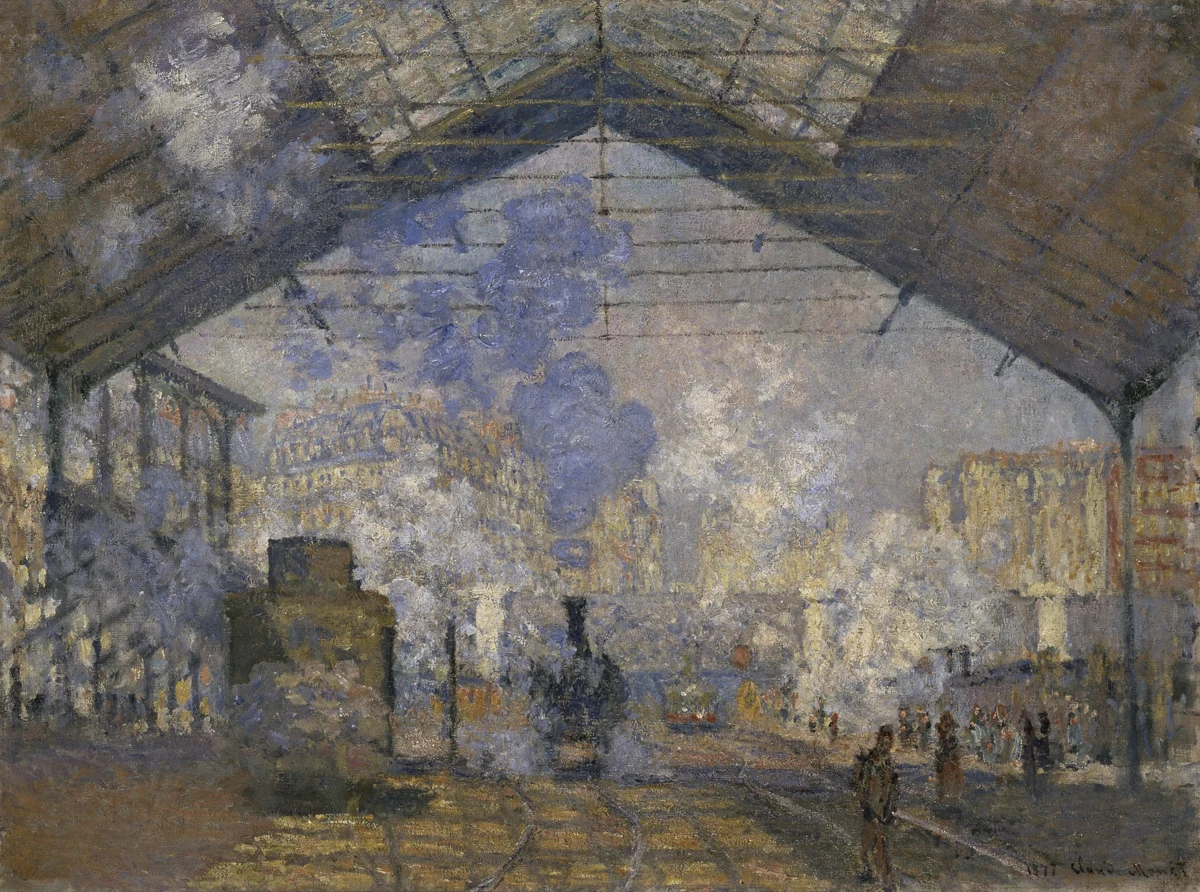
A Paris station became an artist’s subject
In early 1877, Monet obtained permission to paint the Gare Saint-Lazare and its approaches. The station connected Paris with Normandy, where he had grown up, and with places west of the city associated with Impressionist painters. He made twelve views rather than treating the subject as a single composition. The changing viewpoints let a familiar transport hub become a sustained artistic investigation.
The Musée d’Orsay places this work after Monet’s move from Argenteuil to Paris. Its account emphasizes his interest in depicting modern life, alongside painters such as Manet, Degas, and Caillebotte. A railroad station offered movement, new architecture, and the changing effects of light in one setting. For the wider artistic context, explore Monet’s Paris and the birth of Impressionism before returning to the particular spaces inside these pictures.
Look where the roof meets the steam
In the version belonging to the Musée d’Orsay, the roof gives the picture a strong architectural shape. Beneath it, pale vapor partly dissolves trains, people, and the view beyond the platforms. The museum’s interpretation draws attention to effects of color and light rather than detailed descriptions of machinery. What first seems an industrial subject becomes a place for exploring how much of a scene paint can reveal or leave indistinct.
Try following a roof beam with your eye before looking into the cloud below it. One gives you a firm line, while the other makes it difficult to decide where an object ends. The contrast rewards a slow second look at a painting that initially appears full of hurried activity. Compare it later with Monet’s water garden at Giverny, where another kind of setting invites attention to surfaces, reflections, and the movement of the eye.
One station produced several different pictures
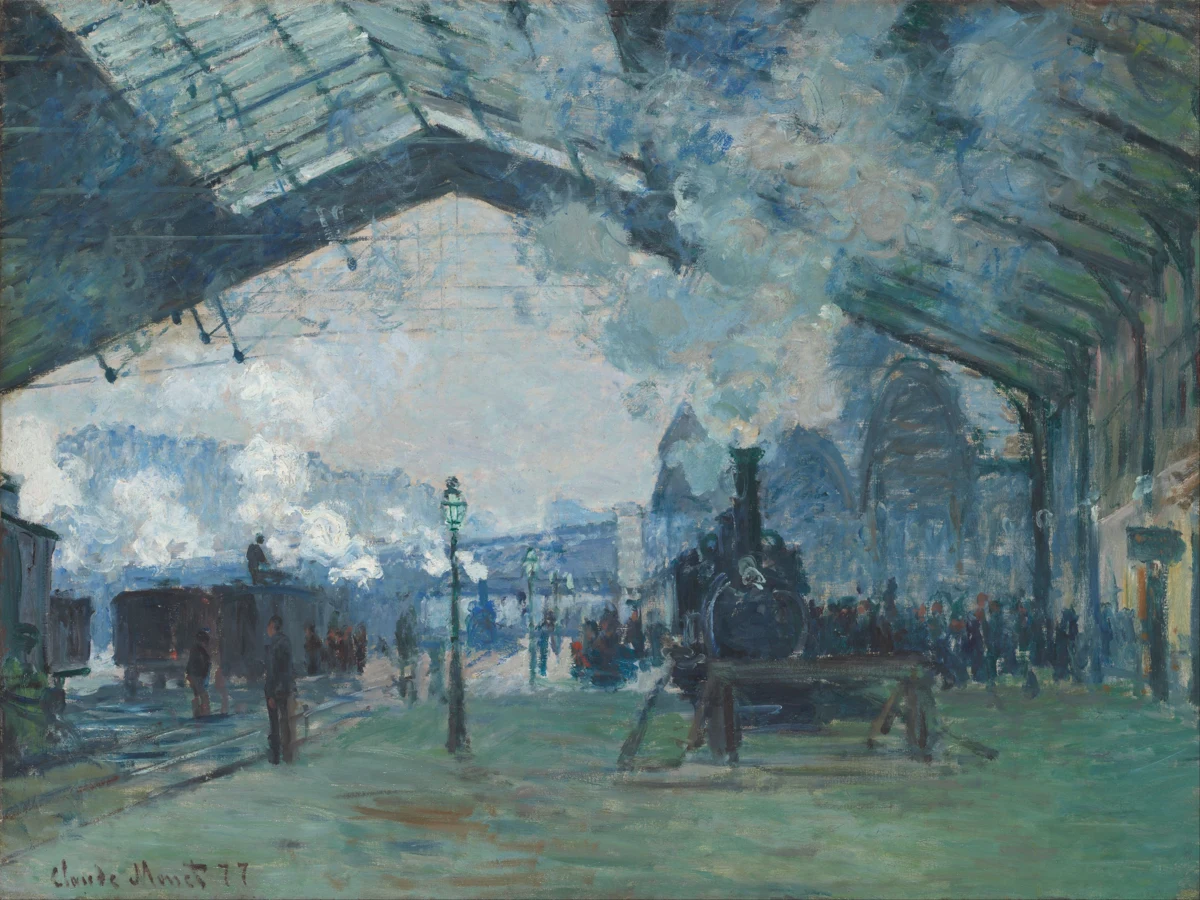
The second painting reproduced here is Arrival of the Normandy Train, Gare Saint-Lazare, now in the Art Institute of Chicago. Both works date to 1877, but a shared station and year do not make them interchangeable. The angle of the roof, the position of the locomotives, and the spread of vapor establish different visual rhythms. Set them side by side and the decision to return to a subject starts to feel like an exploration rather than a repetition.
Another version, in London’s National Gallery, is among the more freely painted works of the group. The gallery explains that even its apparently rapid execution involved several stages. A loose brushstroke should therefore not automatically be read as proof that an entire canvas was completed in one uninterrupted session. The picture’s surface and the history of making it can tell related stories without giving exactly the same impression of time.
Carry an urban Monet into a garden encounter
These canvases broaden the picture of an artist whose name can so quickly evoke a pond. They ask you to look at an ordinary place of travel as a subject with its own forms, colors, and atmosphere. Monet’s collection of Japanese prints offers another route into the variety of images surrounding his life and work. Taken together, such encounters make room for curiosity about his artistic choices beyond a single famous motif.
If your itinerary includes Inside Claude Monet’s Giverny, the station paintings provide background rather than a promise of works displayed on the route. Consult the Immmersiv experience guide for how a professional actor brings a historical figure into an encounter. A separate Paris chapter might lead you toward Montmartre’s artistic setting, without turning every place into part of Monet’s biography. The next time you pass through a station, pause to notice what the light does to the structure above you.
Discover an Immmersiv Experience
Explore Inside Claude Monet’s Giverny with a professional actor embodying Claude Monet. This article provides background for your curiosity. It does not promise stops or access beyond the published experience route. Consult the current experience page for its route and practical details.