Monet’s Poplars on the Epte: Painting Trees on Borrowed Time
A row of trees can look like the most dependable thing in a landscape. For Claude Monet in 1891, it became a subject with a deadline. His poplars on the River Epte were part of a working countryside where trees could be sold as timber. Looking at these paintings means following both the lines on the canvas and the practical arrangement that allowed those lines to remain in view.
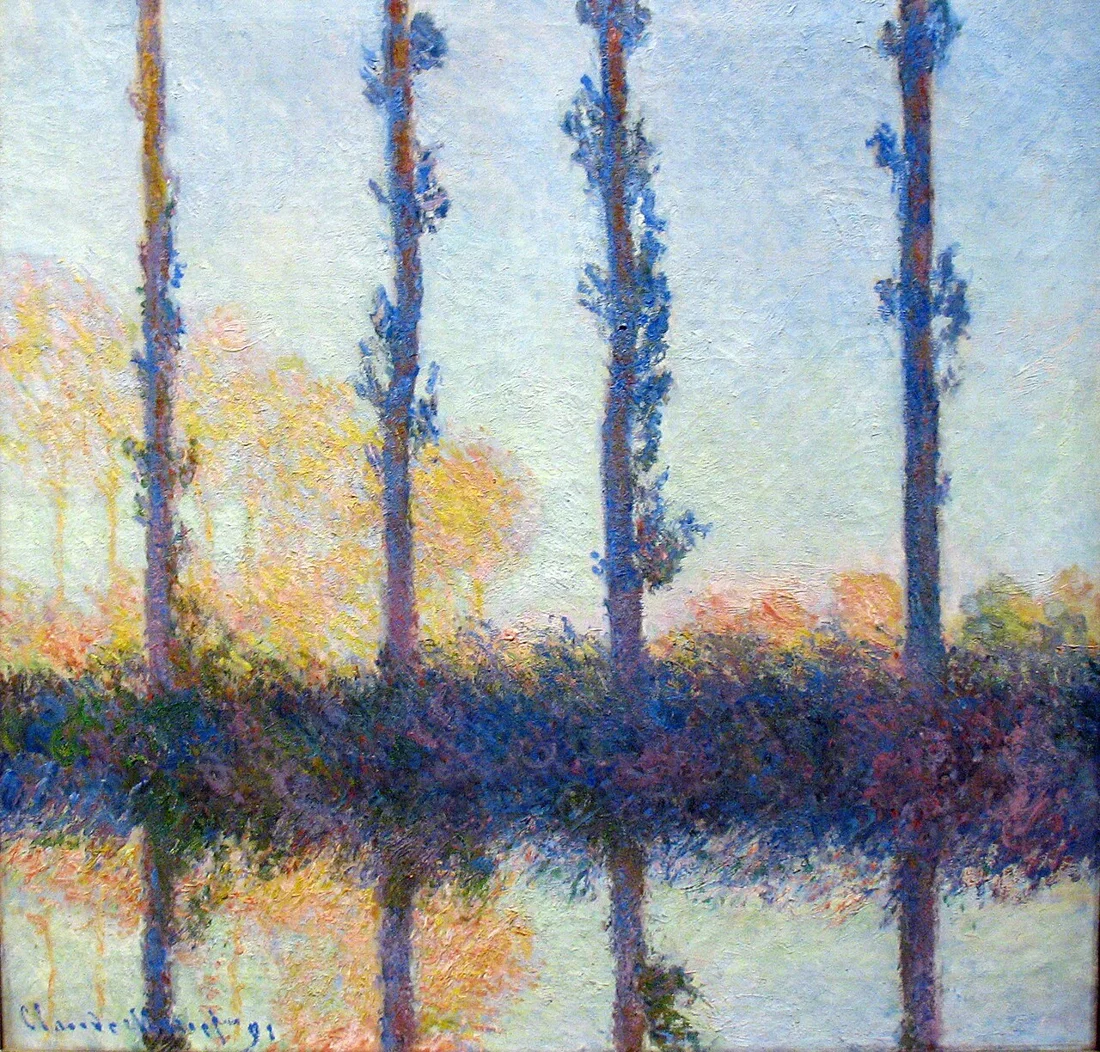
A riverside subject with a timber merchant in its story
The Metropolitan Museum of Art dates The Four Trees to 1891. Its collection record explains that Monet painted the poplars during the summer and fall along the Epte near Giverny. The village of Limetz decided to sell the trees at auction, putting his unfinished work at risk. Monet paid a local timber merchant to keep them standing until he had completed his paintings, securing time rather than a promise of permanent protection.
That distinction gives the episode its particular character. This was an agreement connected to a painting project, not evidence that the trees became a protected public reserve. You can compare it with the artistic reserves of Fontainebleau to see how different the circumstances could be when artists cared about a landscape. In one story, the urgent question was how long a particular motif would remain available to paint.
A boat changes the place from which you look
The Fitzwilliam Museum describes Monet working from a rowing boat upstream from his home. The Met notes that some canvases were made from the bank and others from a boat equipped to hold several pictures. Water was therefore part of the working arrangement as well as part of the subject. The position of a painter on a river helps explain why a familiar line of trees can appear as an unexpected arrangement of trunks, sky, and reflection.
In The Four Trees, start with the dark upright trunks before trying to identify every patch of foliage. Their reflections extend the vertical rhythm into the lower part of the canvas. A pale horizontal band of river cuts across that rhythm without bringing it to a complete stop. The result rewards a slower look: the trees can read as living forms and as a framework holding the whole picture together.
Compare the square and the tall canvas
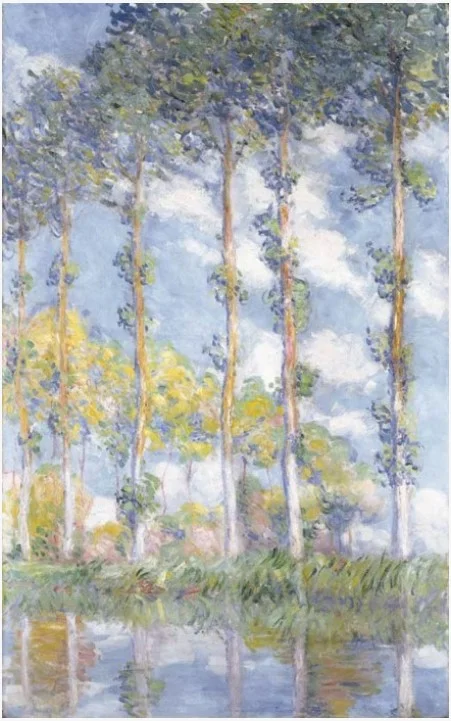
The second reproduction here shows another Poplars canvas from 1891, catalogued as W1301. Its tall format gives the upward movement a different emphasis from the nearly square Four Trees. Look at the space available beside the trunks, then compare how much of your attention stays near the water. These are observations you can make from the reproductions without needing to know the exact spot where either easel or boat was placed.
It is useful to place these river pictures beside Monet’s wheatstacks at Giverny. Both groups invite comparison across related canvases, but the poplars introduce a distinct physical problem: the subject itself could be cut down. The Met records that fifteen poplar paintings were exhibited together in Paris in 1892. Seeing related works as a group allowed their differences to become part of the experience rather than treating each one as an isolated landscape.
Carry the distinction back to Giverny
The Epte paintings should not be confused with Monet’s designed water garden. A riverbank and a garden made for painting raise different questions about what an artist finds and what an artist arranges. The Giverny landmark guide offers a starting point for the place behind those questions. Keep the river story in mind without assuming that a present-day garden visit recreates the route or viewpoint of 1891.
For a story-led connection, read the published description of Inside Claude Monet’s Giverny. It sets out the experience itself, while this article supplies a separate historical lens for looking at the paintings. The what-to-expect guide explains the format before you choose an activity. Neither a reproduction nor an evocative historical episode establishes present access, a particular stop, or a booking time.
Discover an Immmersiv Experience
Explore Inside Claude Monet’s Giverny with a professional actor embodying Claude Monet. This article provides background for your curiosity. It does not promise stops or access beyond the published experience route. Consult the current experience page for its route and practical details.