Fontainebleau’s Artistic Reserves: When Painters Helped Protect a Forest
An old tree can be timber, a living habitat, or the subject of a painting. In nineteenth-century Fontainebleau, those different ways of seeing the forest helped shape a remarkable conservation story. Painters wanted the landscapes they knew to survive, not simply to remain visible on a canvas. Fontainebleau’s artistic reserves reveal how attention to a place could develop into an argument for protecting it.
The painters valued particular trees and places
Artists associated with Barbizon worked among the trees, rocks, and clearings of Fontainebleau Forest. The Office national des forêts identifies Corot, Millet, and Rousseau among the painters drawn to the landscape. Their interest was more specific than a general admiration for greenery. Individual trees, ponds, and familiar views could become subjects whose disappearance would change the character of a place they knew closely.
The forest was also a working landscape with a history of timber production. To value an old tree primarily as a motif for a painting was therefore to bring another interest into the discussion of its future. That encounter between a practical resource and an artistic subject gives the story much of its force. Our overview of artists who changed Paris offers a wider context for approaching the people behind such different ways of looking.
Rousseau painted a landscape under pressure
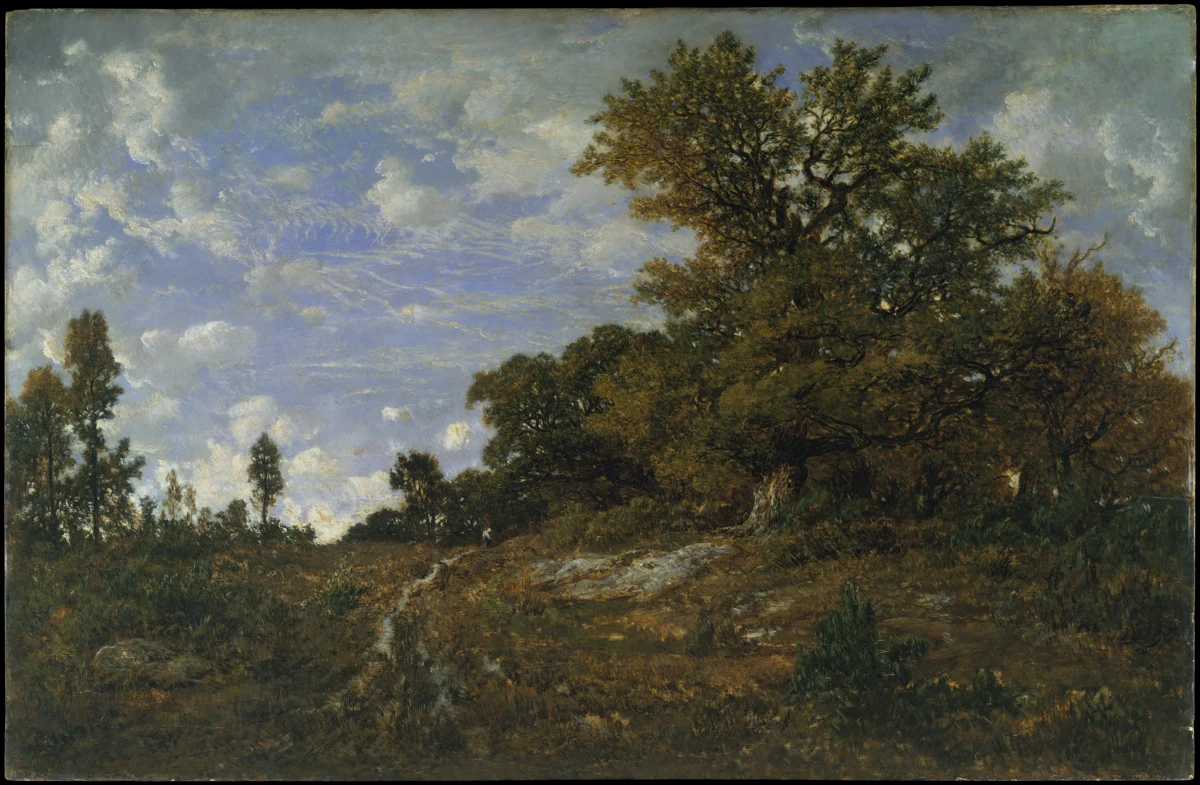
Théodore Rousseau’s The Edge of the Woods at Monts-Girard, Fontainebleau Forest dates to 1852–54. The Metropolitan Museum’s account connects it with woods whose old trees were vulnerable to harvesting, which Rousseau opposed. Look at the younger growth in the cleared opening on the left and the mature trees on the right. The contrast gives a particular visual form to a question about what would remain standing.
The Met also records that Rousseau worked on the panel for two years and included it in his display at the Universal Exposition of 1855. The picture is more than an instant view copied from a single position in the woods. Its arrangement draws attention to differences in growth, scale, and openness. Compare that shaping of a landscape with Monet’s water garden at Giverny, where another relationship between a living place and a painted subject developed.
Protection took the form of artistic reserves
An imperial decree of July 18, 1861 established the forest’s artistic reserves. The ONF explains that painters of the Barbizon school sought protection for the motifs of their work, including remarkable trees, landscapes, and ponds. The measure applied to designated areas, rather than turning every part of the forest into a single untouchable reserve. That distinction matters when connecting the nineteenth-century decision with the forest’s later conservation history.
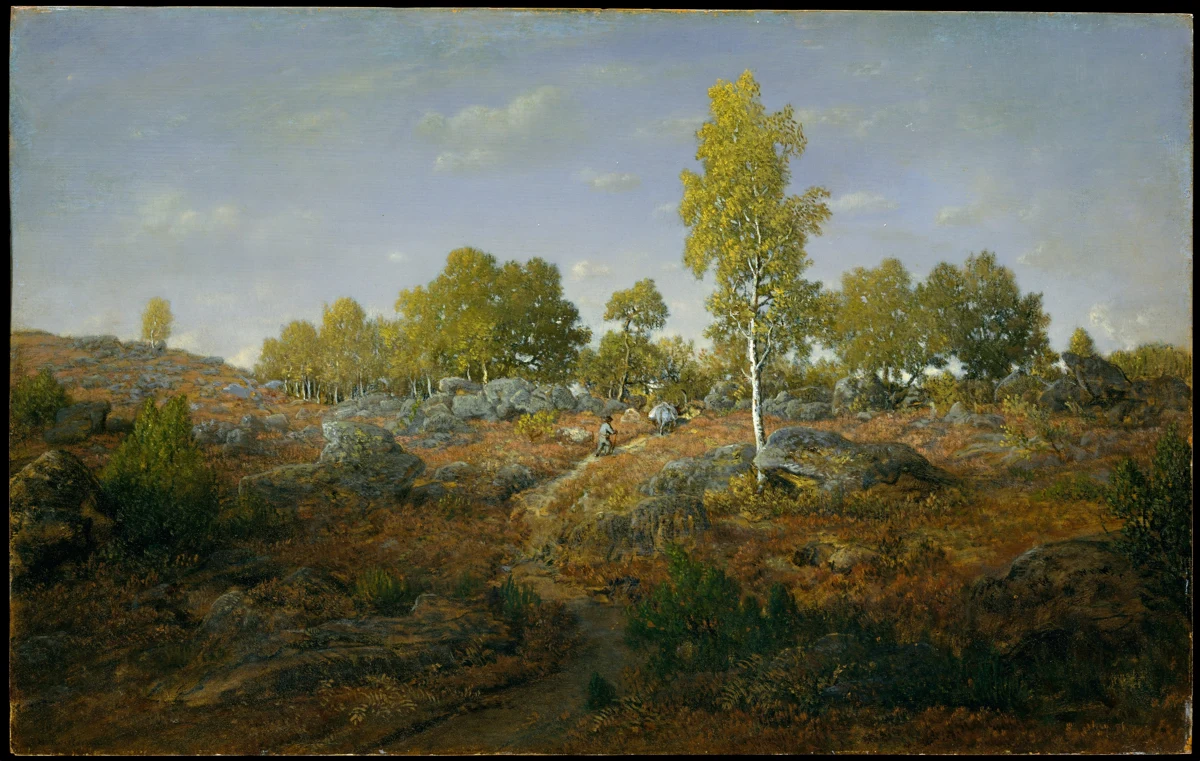
A second Rousseau painting reproduced here, An Early Summer Morning in the Forest of Fontainebleau, is dated probably 1861 by the Met. It shows another view of the forest, with light, rocks, and scattered trees rather than the dense group of old trunks in Monts-Girard. Its approximate date should remain approximate, even beside a conservation decree with a precise day. Together, the two pictures suggest how varied the landscapes valued by a painter could be.
Keep artistic history distinct from today’s forest rules
The ONF traces later biological reserves to the history of the artistic areas, with the first biological reserves established in 1953. Their modern purposes and rules should not be treated as identical to the nineteenth-century arrangement. A historical name on a map is not a promise that every protected area can be entered. Consult current ONF information and follow authorized routes when planning a walk through the forest.
Our Fontainebleau introduction places the woodland within a wider cultural setting, while the Grand Veneur’s forest legend explores a different layer of storytelling. For the published itinerary and actor-led encounter, see The Mysteries of Fontainebleau Forest and the guide to the Immmersiv format. The reserve history supplies background without promising access to particular protected sectors. Let it invite a closer look at how a tree, a rock, or an opening in the woods can become something people decide is worth keeping.
Discover an Immmersiv Experience
Explore The Mysteries of Fontainebleau Forest with a professional actor embodying the Grand Veneur. This article provides background for your curiosity. It does not promise stops or access beyond the published experience route. Consult the current experience page for its route and practical details.
Continue Exploring
Sources and further reading
- Office national des forêts — Forêt de Fontainebleau: entre landes et chaos rocheux
- Office national des forêts — Réserve biologique intégrale du Gros Fouteau–Hauteurs de la Solle
- The Metropolitan Museum of Art — The Edge of the Woods at Monts-Girard, Fontainebleau Forest
- The Metropolitan Museum of Art — An Early Summer Morning in the Forest of Fontainebleau