What Remains of Medieval Paris?
Medieval Paris does not survive as one complete neighborhood waiting behind a modern façade. Its traces appear in buildings, fragments, objects, and a city fabric altered many times since their creation. That partial survival is not a reason to abandon the search. It gives a traveler a more interesting task: identify what is actually present, determine what it documents, and recognize which parts of the setting belong to later generations.
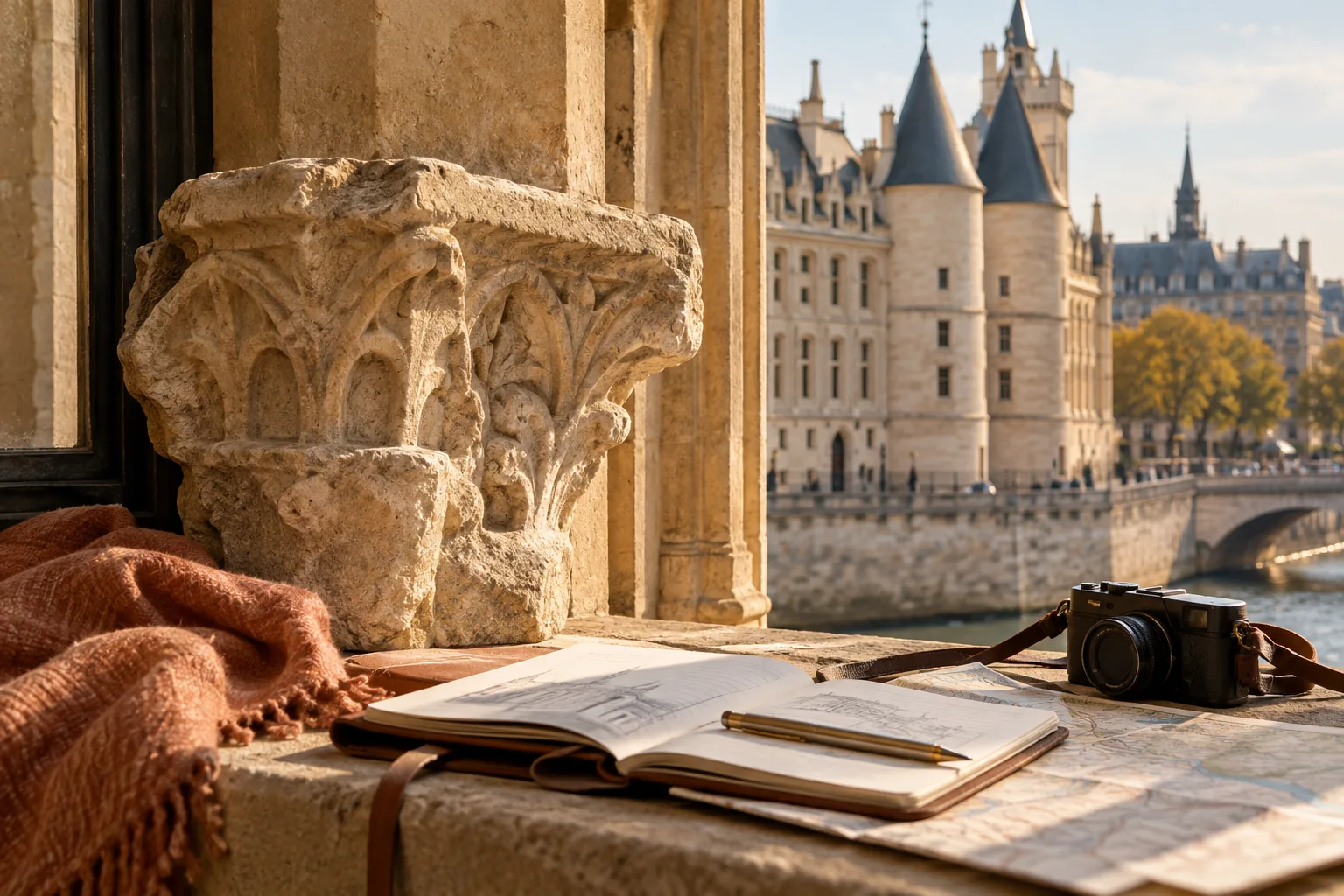
Royal architecture preserves particular uses, not an entire world
Sainte-Chapelle survives as a monument commissioned by Louis IX to house prestigious Christian relics. Its medieval purpose remains essential to understanding the building, even though later damage and restoration are also part of its history. Do not treat every visible feature as untouched simply because the original commission belongs to the thirteenth century. The monument's own historical interpretation helps distinguish origin, survival, and the work that followed.
The Conciergerie retains lower rooms of the medieval royal palace, while its later prison history adds another layer. A visitor needs to distinguish the date of a room from the date of the event commemorated within the broader site. Our guide to Paris for history lovers helps frame that comparison. Surviving royal space represents a particular institution, not a complete account of how every medieval resident lived.
Defensive fragments show a boundary absorbed into the city
The Louvre's historical presentation includes remains of the fortress that preceded its later palace and museum roles. Elsewhere, the City of Paris identifies fragments of Philippe Auguste's wall within the modern urban fabric. A tower remnant on rue du Louvre is one documented example of a structure incorporated among later buildings. Look from appropriate public space and check access rather than assume every surviving fragment can be entered or touched.
A fragment can establish that a structure existed without revealing its full appearance or every activity around it. Use a documented plan or institutional explanation to understand the relationship between the surviving part and the former whole. Our guide to history through places and evidence helps keep observation separate from inference. An old-looking street name, surface, or doorway needs its own documentation before it becomes a medieval fact.
The absence of an original structure is also part of what a visitor encounters. Later building, demolition, adaptation, and restoration have changed how fragments relate to the spaces around them. Ask what remains physically present and what is represented through an explanation or reconstruction. That distinction gives a partial trace meaning without requiring you to imagine that the surrounding city has stayed unchanged.
Objects and later images preserve different kinds of information
At the Musée de Cluny, medieval collections include works such as stained glass, sculpture, tapestries, and manuscripts, alongside objects of everyday use. Check labels for date, origin, and purpose instead of assuming every item documents Paris itself. Our guide to Paris for museum lovers helps build a focused visit around those questions. A displaced object can preserve evidence of making and use while requiring context to explain its original setting.
Later literary imagination adds another layer that should not be confused with a surviving medieval record. Explore the Immmersiv character themes and read the performance format with that difference in mind. Use the map for location, checking the actual status and practical conditions of each encounter separately. A professional actor's portrayal, a legend, and a documented historical object each offer something different to investigate.
What remains of medieval Paris is valuable precisely because its survival is partial and layered. A chapel, a palace room, a defensive fragment, and a museum object answer different questions. Read the documentation and acknowledge later interventions instead of searching for a completely untouched past. The city becomes easier to understand when you can name what survives and what you are still being invited to imagine.
Discover an Immmersiv Experience
For an interpreted medieval-history encounter on a separate trip, investigate Joan of Arc: The Trial in Rouen, with a professional actor embodying Joan of Arc. The location is Rouen, not Paris, so it needs its own travel arrangements. Read the trial premise and confirm suitability, language, availability, and practical demands. Compare the performed perspective with documentary evidence rather than treat the narrative as an untouched account from the past.