Van Gogh’s Tree Roots: A Landscape without a Horizon
The landscape gives you no reassuring strip of sky. Color and branching forms crowd the surface until you begin to recognize roots, trunks, and a sloping bank. Van Gogh’s Tree Roots turns a small piece of ground into an unusually absorbing subject. Before asking what it means, give yourself time to discover what the picture actually shows.
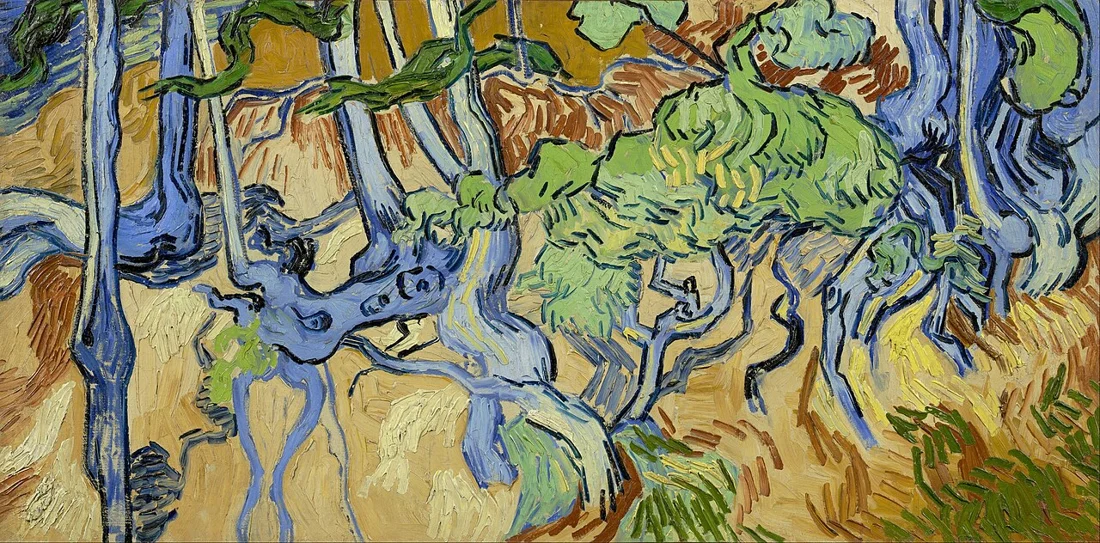
A familiar landscape turned into a close encounter
The Van Gogh Museum dates Tree Roots to July 1890 in Auvers-sur-Oise. Its collection record describes a slope with trunks and roots belonging to trees used for timber. Browns and yellows suggest the ground, while cooler colors pull the eye across the surface. Without a distant horizon, it is easy to notice the painted shapes before identifying the place they describe.
Look for one branching line, then follow it until another color interrupts your route. Repeat the exercise elsewhere and the picture begins to organize itself gradually. There is no need to identify every root to enjoy that process. Compared with the recognizable building in Van Gogh’s Church at Auvers, this subject asks you to find your bearings through much smaller features.
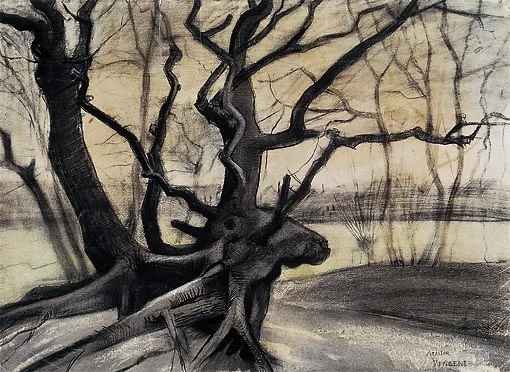
An earlier drawing keeps the roots in perspective
Tree roots had interested Van Gogh long before his arrival in France. The Kröller-Müller Museum dates Tree Roots in a Sandy Ground to April–May 1882, when he made it in The Hague. It combines pencil, black chalk, washes, and opaque watercolor on paper. Its dark, knotted forms offer a striking comparison with the later oil painting’s stronger contrasts of color.
The museum connects that early work with Van Gogh’s expressed interest in struggle within nature. That is evidence attached to the 1882 drawing, not permission to assign exactly the same message to every later root. Place the works side by side and ask what changes in material, scale, and color. The comparison reveals a continuing subject without pretending that eight years of artistic development can be reduced to a single unchanged thought. The 1890 canvas is roughly twice as wide as it is high. The earlier sheet is less elongated, so the two works also frame their subjects differently.
A final painting is still more than a final chapter
The Van Gogh Museum’s collection record calls the Auvers canvas probably his very last painting. It also notes that the work was not entirely completed. Both qualifications matter when you meet a confident caption or a dramatic retelling. The chronology gives the picture special weight, but it cannot supply a complete account of what the artist was thinking.
Try returning to the visible surface after reading that label. You may notice a yellow patch, a blue contour, or a trunk you missed when searching for a final message. That attention makes room for Van Gogh as a working artist as well as a famous life story. It connects naturally with his painted response to Daubigny’s garden, another Auvers subject that rewards close observation.
From the canvas to a hillside at Auvers
In 2020, the Van Gogh Museum announced a discovery connecting the painting with a bank in Auvers-sur-Oise. Researcher Wouter van der Veen had recognized the forms in an old postcard. In July 2021, the museum reported that a historical photograph confirmed the location. These are dated research findings, not guarantees of present-day access to the site. The original painting remains in Amsterdam. Like the later publication of Van Gogh’s letters, the discovery also has a history of how evidence reached its audience.
Van Gogh’s last days in Auvers-sur-Oise offers a theatrical encounter with a professional actor embodying Vincent. The roots discussed here provide historical background; this article does not promise access to a particular bank, private property, or the original artwork. Consult the experience overview and the current route before planning around a specific stop. A useful habit needs no special access:look down, notice a small natural pattern, and give it the attention you would normally reserve for a famous landmark.
Discover an Immmersiv Experience
Explore Van Gogh’s last days in Auvers-sur-Oise with a professional actor embodying Vincent van Gogh. This article provides background for your curiosity. It does not promise stops or access beyond the published experience route. Consult the current experience page for its route and practical details.