Van Gogh’s Daubigny Garden: Following Another Painter’s Footsteps
A garden can hold the trace of another artist even when that person is no longer there. In Auvers-sur-Oise, Vincent van Gogh found such a connection in the garden associated with Charles-François Daubigny. Van Gogh’s Daubigny Garden is therefore more than a title attached to a pleasant patch of greenery. Looking at a small study beside a wider canvas reveals how one place could become several different painted encounters.
Arrive in a village with an artistic past
The Van Gogh Museum dates Vincent’s arrival in Auvers-sur-Oise to May 20, 1890. Its account places him in a village already connected with other artists rather than in an isolated discovery of his own. Daubigny belonged to an older generation of painters whom Vincent admired. That admiration gives the garden an artistic history before we begin to examine its flowers or paths.
The museum explains that Daubigny had moved to Auvers around 1860 and that his widow still lived in the house when Vincent arrived. The encounter was with a place associated with the older painter, not a meeting between the two artists in 1890. A garden could preserve that connection through its setting and the attention another painter gave it. For a broader view of the earlier landscape tradition, explore Fontainebleau’s artistic reserves and the painters of Barbizon.
Begin with the small study
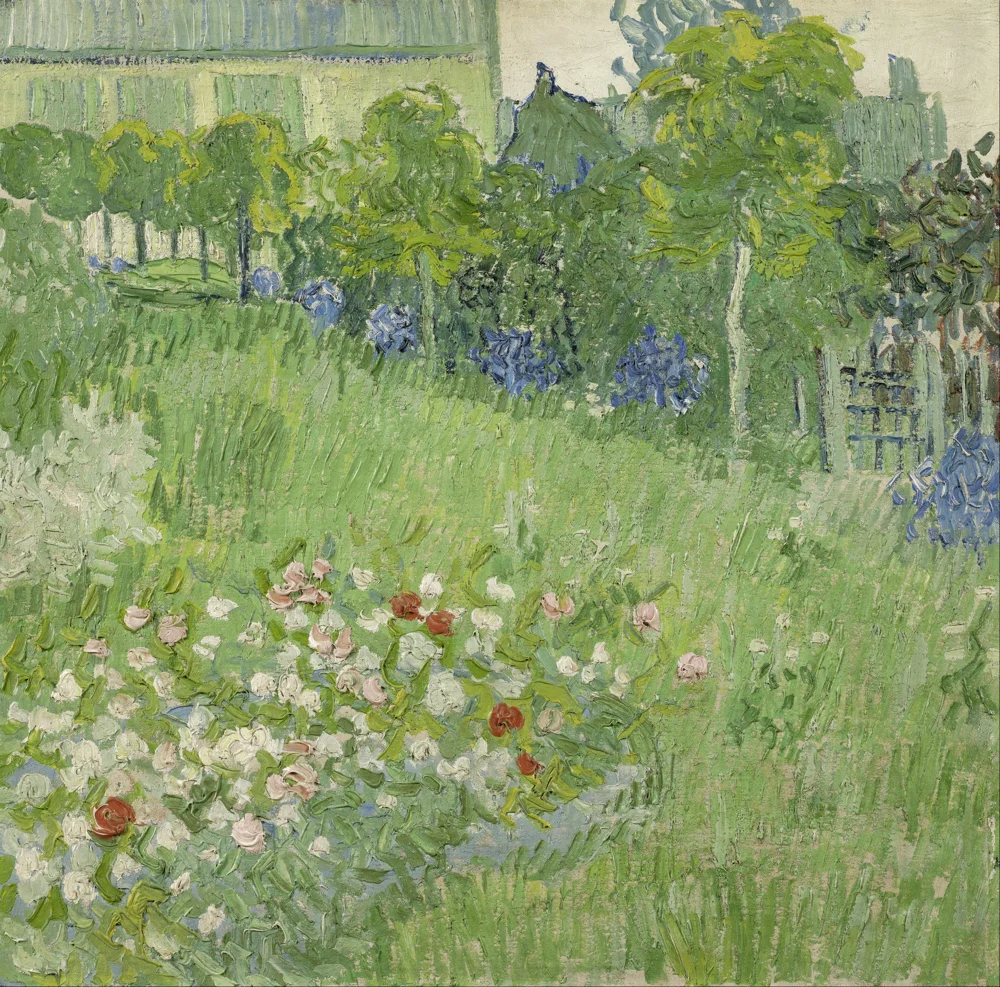
The first image here reproduces the Van Gogh Museum’s Daubigny’s Garden, dated June 1890. The museum describes it as a study for two larger paintings showing more of the grounds. This smaller work concentrates our attention on a portion of the garden. It gives us a useful starting point without requiring us to treat every version as an interchangeable image.
In the reproduction, upright patches of blue and violet stand among varied greens. Lighter flowers and short strokes interrupt the foreground, while architecture appears beyond the plants. The eye can move between those marks without following a single dominant path through the scene. Compare that garden-centered encounter with Van Gogh’s Church at Auvers, where a building gives a different point of departure for looking.
Open the view onto a wider canvas
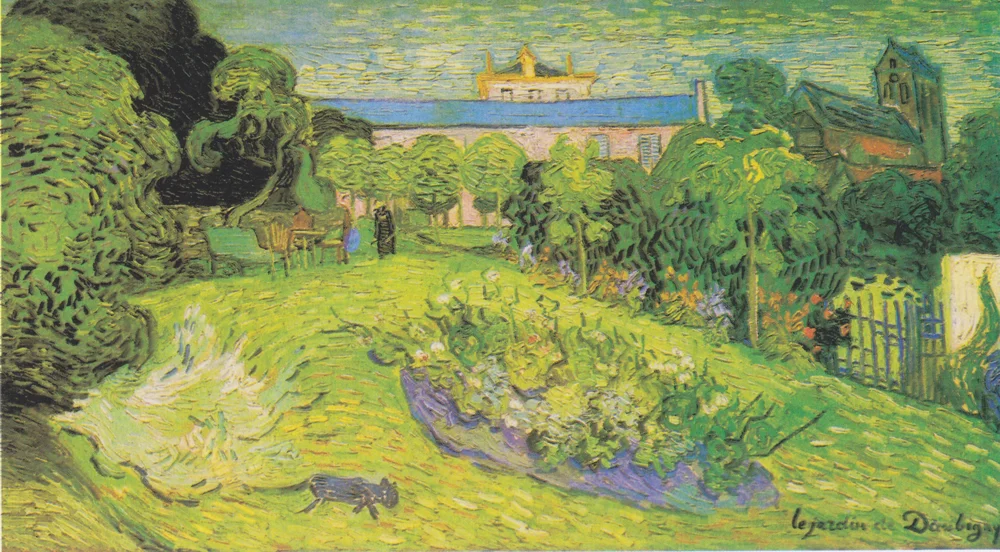
The second reproduction shows a much wider version of Daubigny’s Garden, catalogued as F777. Its horizontal shape immediately changes the experience of looking. Paths, planted areas, trees, and the enclosing edges spread across a broader field. You can follow relationships between those areas instead of concentrating on one closely framed patch.
Try beginning with the pale path and then moving toward the darker trees. Next, compare the small upright marks across the planted areas with those in the study. The two reproductions share a subject, but their framing does not ask the eye to do exactly the same work. This is an invitation to compare visible choices, rather than a claim that a particular color proves a private emotion or a medical condition.
Follow a connection rather than invent a meeting
The Hiroshima Museum of Art also holds a broad Daubigny’s Garden canvas dated 1890. Its collection entry is another reminder that the subject exists in more than one substantial version. It is not the same object as the F777 reproduction shown here. Keeping the works distinct is part of the same care needed when comparing Van Gogh’s portrait and etching of Doctor Gachet.
A visit to Auvers-sur-Oise can begin with this habit of looking for connections while keeping the evidence clear. The Immmersiv Van Gogh experience offers a professional actor’s interpretation of the artist within its published route. This article does not establish garden access, a museum display, or an additional itinerary stop. Consult what to expect from an Immmersiv experience and the current experience details to plan the practical side of your visit.
Discover an Immmersiv Experience
Explore Van Gogh: The Last Days in Auvers with a professional actor embodying Vincent van Gogh. This article provides background for your curiosity. It does not promise stops or access beyond the published experience route. Consult the current experience page for its route and practical details.