Jo van Gogh-Bonger and the Letters That Reached Readers in 1914
A painting reaches us through more than the person who made it. Someone preserves it, arranges its exhibition, and helps later viewers understand its circumstances. Jo van Gogh-Bonger belongs at the center of that wider story. Her work on Vincent’s letters to his brother Theo gave readers another way into an artist whose pictures now seem immediately familiar.
Begin with an editor, rather than a supporting character
Jo was Theo van Gogh’s wife and the mother of their son, Vincent Willem. The Van Gogh Museum’s biographical research treats her as a historical subject with a life and work of her own. That perspective matters when a famous artist’s relatives risk appearing only as people in the background of his story. Preserving a collection and preparing correspondence for readers require decisions, sustained attention, and judgment.
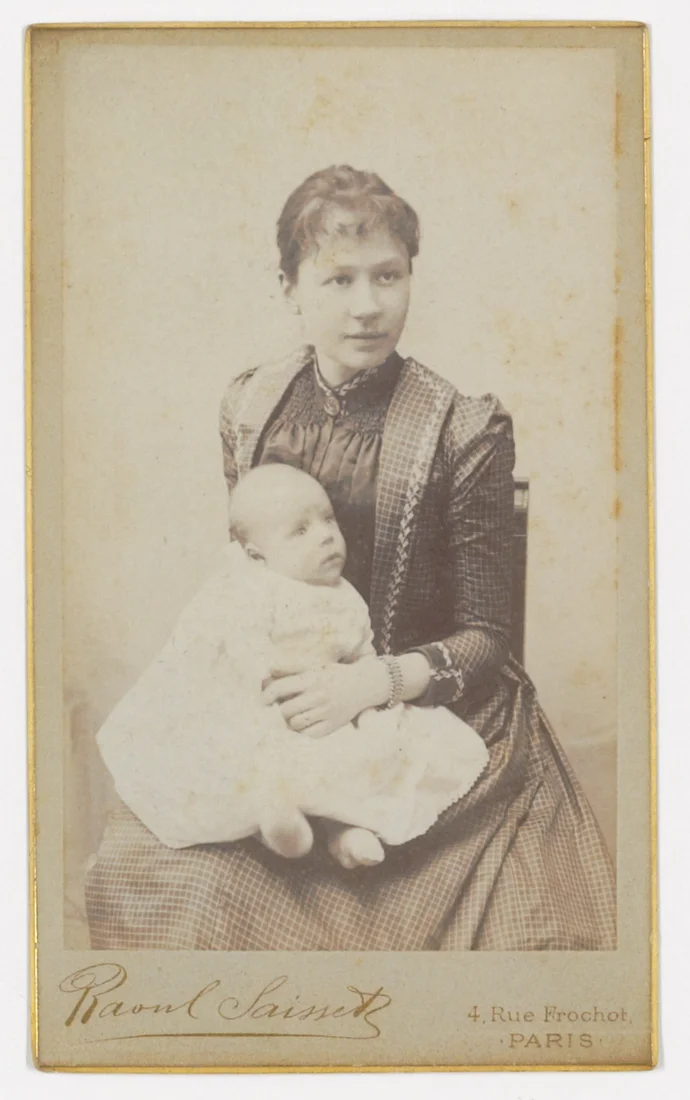
The photograph here shows Jo with her young son in Paris in 1890, in Raoul Saisset’s studio. It precedes the publication discussed in this article by almost a quarter century. Read its date before imagining that it records her editorial work at a desk. A family portrait can introduce the people involved without pretending to document every later achievement.
Three volumes brought letters to a new audience
In 1914, Brieven aan zijn broeder appeared in three volumes. The Dutch literary library DBNL identifies Jo van Gogh-Bonger as the editor and records a first edition for each volume in that year. The title means Letters to His Brother. This is a specific publication of Vincent’s letters to Theo, rather than a claim that every surviving letter to every correspondent appeared together for the first time.
The change from private correspondence to a published edition is easy to overlook. A letter begins with a particular recipient who already understands part of the conversation. A later reader has different questions and far less shared background. The published book allows that reader to follow a relationship across time, while also making the editor’s work part of how the relationship is encountered.
Read the correspondence beside the pictures
Letters can encourage slower looking, but they do not turn every painting into a puzzle with one written solution. Notice when a document discusses a particular work and when it speaks more broadly about daily life or artistic ambitions. Keep those kinds of evidence distinct. Our account of Almond Blossom as a family gift offers one example of how a painting can belong within a family relationship as well as a museum collection.
A different set of questions accompanies the portraits and etching of Doctor Gachet. There, comparing objects and formats helps prevent a familiar name from flattening separate works into one image. The same care is useful for correspondence. The sender, recipient, date, language, and edition each tell you something about the document you are actually reading.
Carry the history of preservation to Auvers
The different paintings of Daubigny’s garden invite close attention to what changes between related works. Jo’s editorial story adds another kind of comparison: the distance between an artist’s working life and a later reader’s access to it. Use the Auvers-sur-Oise landmark guide to place the village within that broader history. The landscape, the surviving pictures, and the published documents are connected sources, each with its own history of transmission.
Immmersiv’s Van Gogh experience in Auvers approaches the setting through a professional actor embodying the artist. Read what to expect from the format and consult the experience page for its actual route. This editorial history adds context without promising an additional stop or access to a collection. It also leaves a useful question for any encounter with a celebrated artist: whose patient work made this encounter possible?
Discover an Immmersiv Experience
Explore Van Gogh’s Last Days in Auvers-sur-Oise with a professional actor embodying Vincent van Gogh. This article provides background for your curiosity. It does not promise stops or access beyond the published experience route. Consult the current experience page for its route and practical details.