Van Gogh’s Almond Blossom: A Family Gift against a Blue Sky
White flowers spread across a blue sky, their branches reaching beyond the edges of the canvas. There is no sitter to introduce and no building to identify. Yet Van Gogh’s Almond Blossom carries a deeply personal story: it was a gift for a new member of his family. Knowing that purpose changes the way we look, turning a familiar image into a conversation between a painter, his brother, and a child.
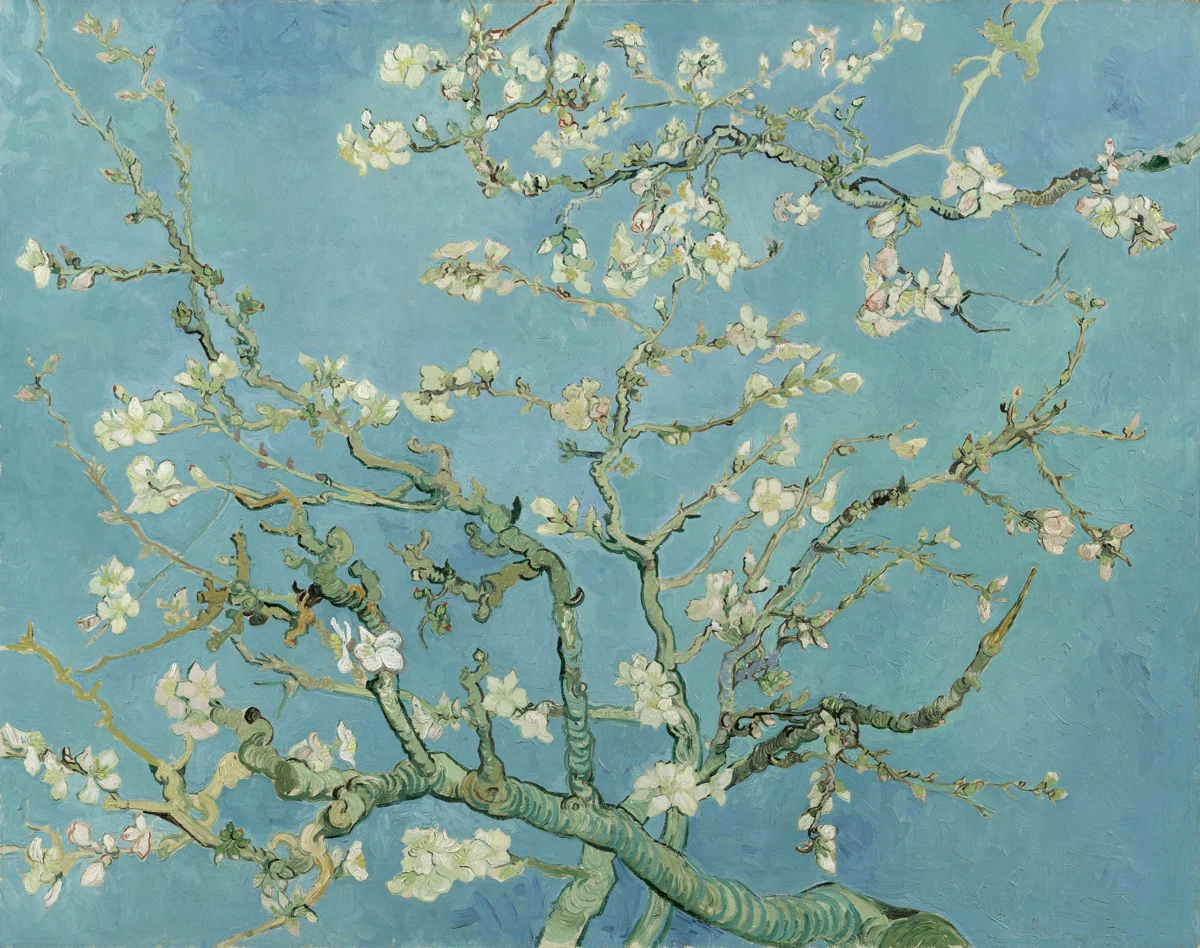
Begin with the child for whom it was painted
Van Gogh painted Almond Blossom in Saint-Rémy-de-Provence in February 1890. The Van Gogh Museum identifies it as a gift for his brother Theo and sister-in-law Jo following the birth of their son, Vincent Willem. The baby shared the painter’s first name. This family connection gives the work a clear purpose beyond its later popularity as a decorative image.
The correspondence published by the Van Gogh Museum and Huygens Institute provides another route into that moment. Letter 855, addressed to his mother on February 19, 1890, is associated with the painting in the scholarly edition. A letter and a canvas preserve different kinds of evidence. As with Van Gogh’s portrait and etching of Doctor Gachet, keeping the documents and the visible artwork in conversation makes the story richer.
Let your eye follow the branches
Begin with the thick branch near the lower edge, then follow its smaller offshoots across the blue. Some lines bend gently while others divide at sharper angles. Pale petals gather in clusters, leaving open spaces between them. The picture rewards a slow movement of the eye rather than a quick search for one central object.
The composition offers no distant horizon to settle into. Branches cross the frame, and the sky remains close behind them throughout the image. You can compare the darker contours with the lighter flowers without needing to identify a precise viewpoint outside the painting. The museum connects the strong outlines and the placement of the tree in the picture plane with Van Gogh’s interest in Japanese prints.
Compare a blossom in the sky with a sprig indoors
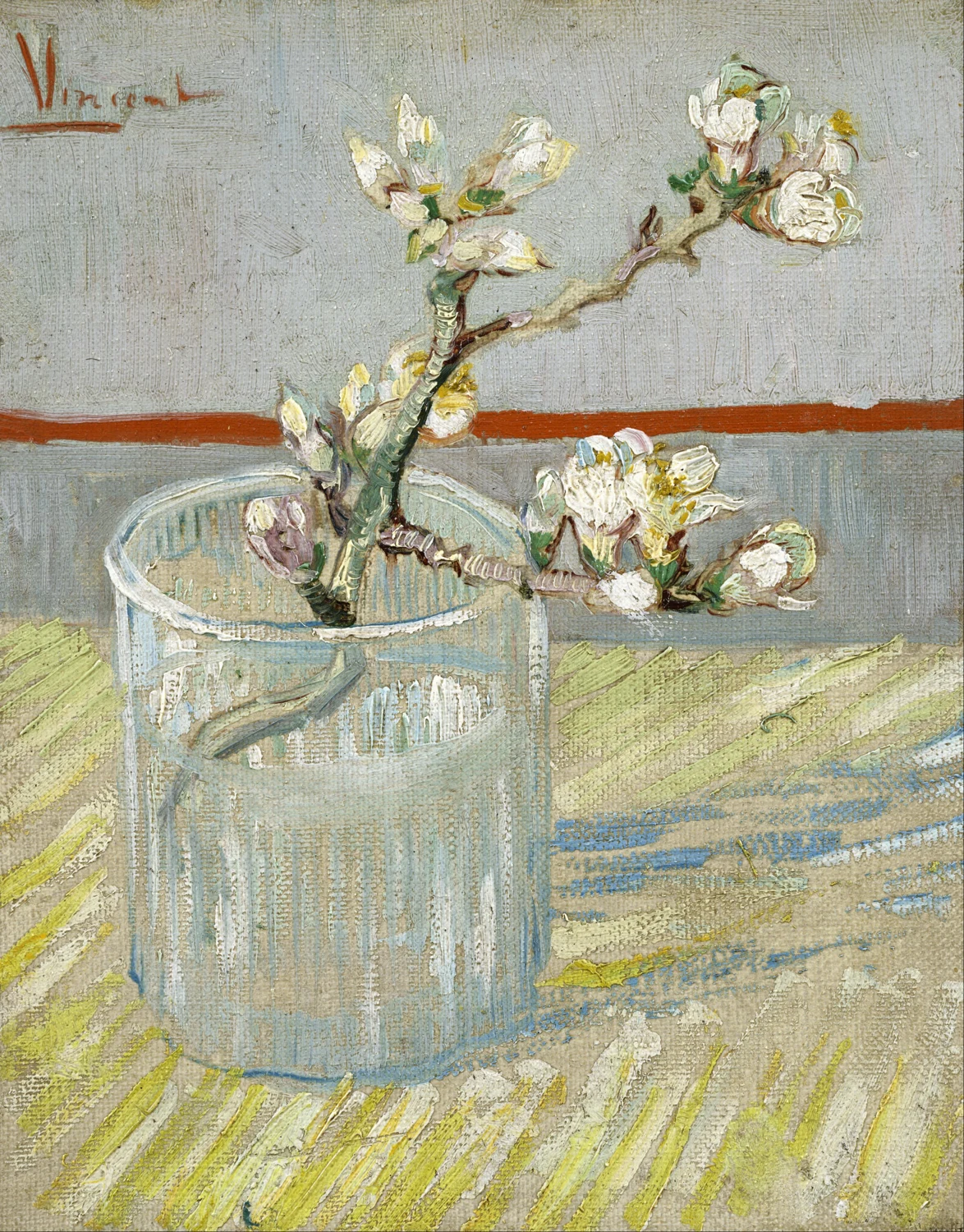
The second image shows Sprig of Flowering Almond in a Glass, painted in Arles in March 1888. The Van Gogh Museum’s collection record identifies this earlier work as a small oil painting. Here the blossom rises from a drinking glass on a tabletop. Its setting gives the branch a visible support and brings the viewer into an enclosed arrangement of objects.
Set the two reproductions beside one another and notice what the glass changes. In the earlier work, the stem leads downward to a container and a table. In Almond Blossom, the blue spaces let the branching forms fill the whole field of attention. The comparison shows how a related subject can generate very different experiences, just as the portrait of Père Tanguy invites looking at the relationship between a figure and the images surrounding him.
Carry the habit of close looking into Auvers
Almond Blossom belongs to the Saint-Rémy chapter of Van Gogh’s work, while the earlier sprig belongs to Arles. Neither should be presented as a painting made in Auvers-sur-Oise. For that later setting, turn to the Church at Auvers and the village behind the painting. Keeping the places distinct lets each work retain its own circumstances while still forming part of the same artist’s story.
Our introduction to Auvers-sur-Oise provides a starting point for exploring that final chapter in France. The published page for Van Gogh: The Last Days in Auvers explains the actor-led experience and its route. Read what to expect from Immmersiv for the format before making your plans. The paintings discussed here are held by the Van Gogh Museum in Amsterdam, so this French experience does not imply that the originals are on display along its route.
Discover an Immmersiv Experience
Explore Van Gogh: The Last Days in Auvers with a professional actor embodying Vincent van Gogh. This article provides background for your curiosity. It does not promise stops or access beyond the published experience route. Consult the current experience page for its route and practical details.