Monet’s Studio Boat: A Floating Place to Look at the Seine
A painter does not always need a room with four walls. On the Seine near Argenteuil, Claude Monet found another way to place himself inside a landscape. His studio boat carried the workplace onto the water. Two paintings from 1874 let you approach that small craft from surprisingly different directions.
A workplace beyond the riverbank
Monet lived in Argenteuil from 1871 to 1878, before the long Giverny chapter most travelers associate with him. The Seine offered boats, banks, weather, and reflections rather than a single fixed composition. A floating studio let the painter work from the river itself. The Kröller-Müller Museum connects that choice with the example of Charles-François Daubigny, another painter who used a studio boat.
Think of the boat as equipment for looking, rather than a romantic escape from work. Moving away from the bank changes which objects overlap and how much water fills the foreground. A familiar shoreline can become a different arrangement without the buildings changing at all. That attention to position adds another dimension to Monet’s part in the emergence of Impressionism.
Manet brings you close to the painter
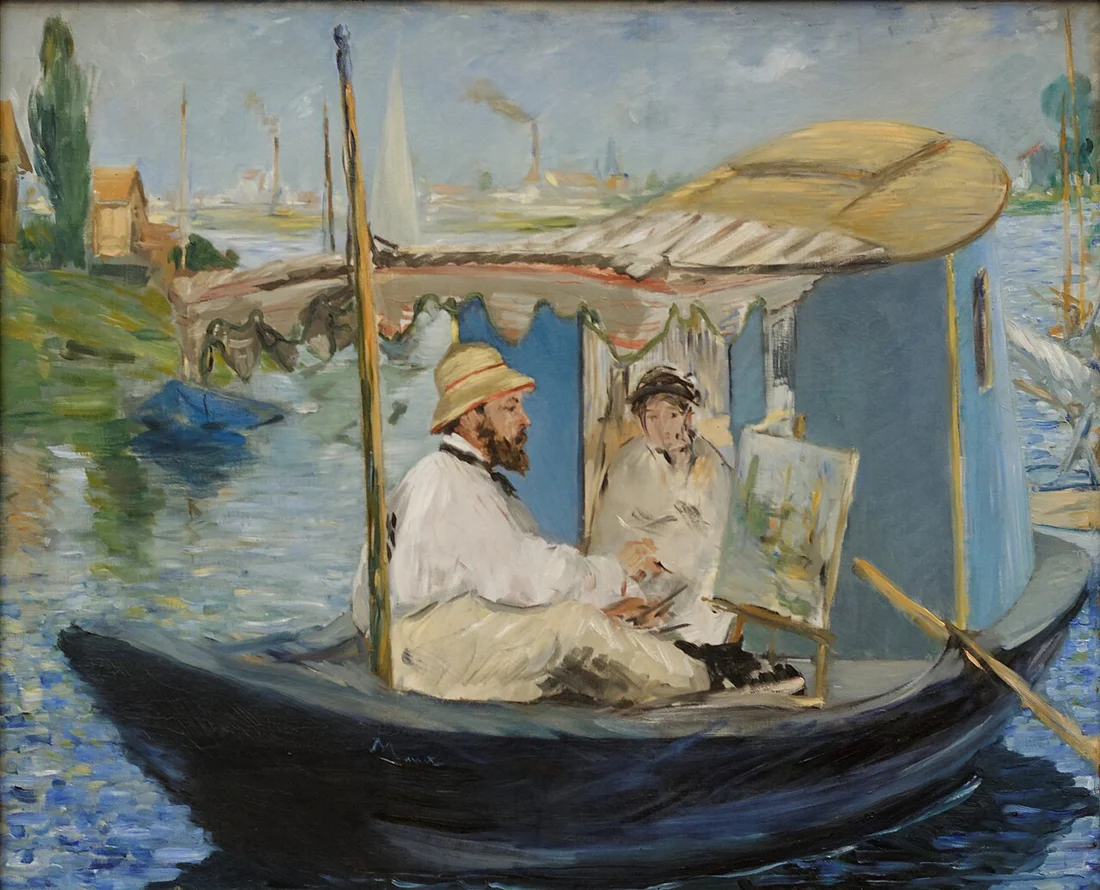
Édouard Manet’s 1874 painting places Monet and his wife aboard the little craft. The Bavarian State Painting Collections identifies the scene as a portrait of the painter working in bright summer light. Monet appears in profile against the cabin’s blue wall. The curved boat, pale canopy, and surrounding water give his concentrated activity an unexpectedly open setting.
Look at how little distance separates the working figure from the river. The cabin provides a compact structure, while the painted water keeps the surroundings visibly loose. You can follow the contrast without inventing words spoken between the people aboard. Compared with the industrial atmosphere of Monet’s railway paintings, this workplace offers another encounter with movement and changing light.
Monet lets the river take over
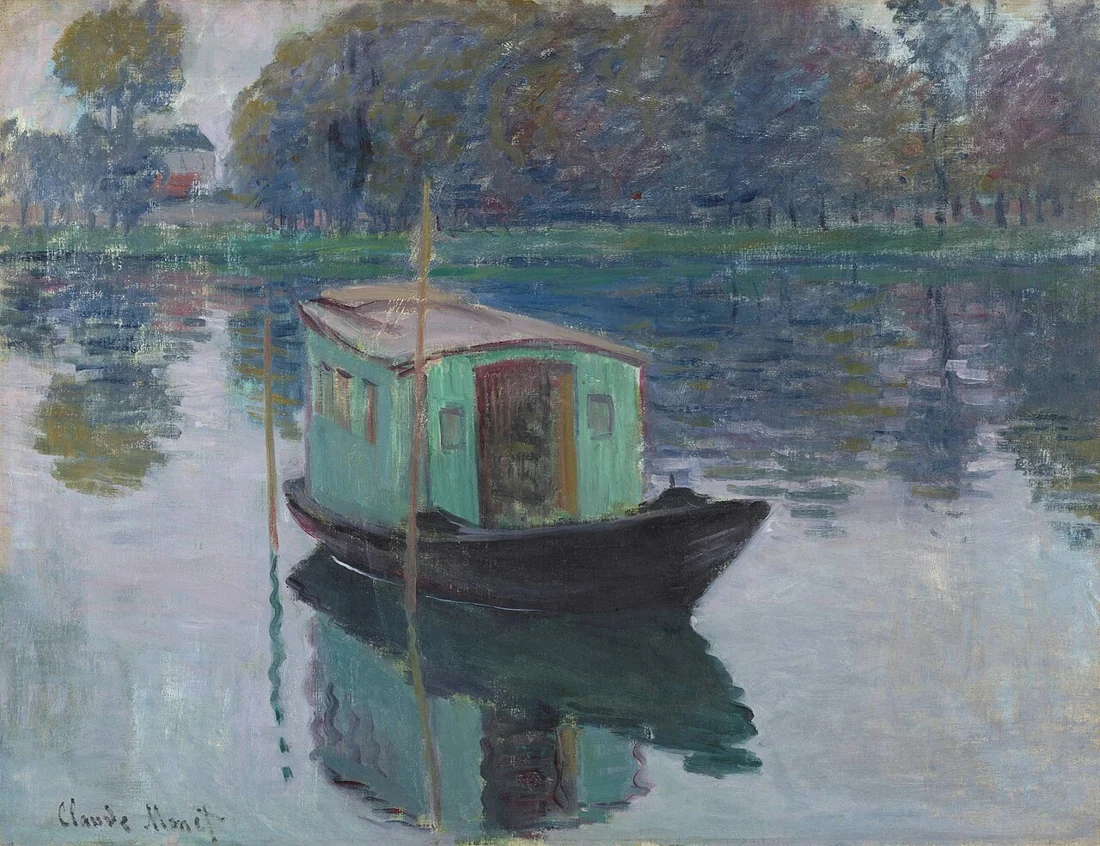
Monet’s own 1874 studio-boat painting shifts your attention away from a clearly described face. The boat rests between two poles, with trees and sky reflected around it. The museum describes the indistinct figure in the cabin as probably Monet himself. Keep that uncertainty intact: the person is less immediately legible than the watery space that holds the craft.
The two pictures make a useful looking exercise for adults and younger travelers alike. First find the boat’s dark hull, then compare the amount of surrounding water. Ask whether you notice a person working or a landscape reflecting itself. This is a different question from identifying landmarks, and it needs no specialist vocabulary or imagined reconstruction. Notice, too, how a reflected shape can stretch farther than the object above it. The exercise turns a boat from a detail to identify into a way of understanding how the whole picture is organized.
Carry the question forward to Giverny
The studio boat belongs to Monet’s Argenteuil years; it should not be folded into the later garden as though both settings were identical. The water garden at Giverny offers another chapter in his sustained attention to reflected light. When exploring Giverny’s place in his story, carry the question of viewpoint with you. Where does a painter stand, and what disappears when that position changes?
For a character-centered continuation, Inside Claude Monet’s Giverny connects the later setting with a professional actor embodying Monet. It does not relocate the Argenteuil boat or promise that historic vessel as part of the experience. The experience overview explains how these encounters work. Let the paintings remain your evidence, and let the river remind you that choosing where to look is already a creative decision.
Discover an Immmersiv Experience
Explore Inside Claude Monet’s Giverny with a professional actor embodying Claude Monet. This article provides background for your curiosity. It does not promise stops or access beyond the published experience route. Consult the current experience page for its route and practical details.