Monet at Sainte-Adresse: The Normandy Summer before the Water Lilies
Before the water lilies, there were boats pulled onto a Normandy beach. In 1867, Claude Monet spent the summer at Sainte-Adresse, near Le Havre. The pictures associated with that stay offer several versions of the same coastal world. Look across them and a seaside holiday becomes a lesson in how a painter can change the story simply by changing the view.
A familiar painter in a different landscape
Monet at Sainte-Adresse belongs to an earlier chapter than the garden most visitors associate with his name. The Metropolitan Museum dates both Garden at Sainte-Adresse and Regatta at Sainte-Adresse to 1867. These are coastal scenes, with the sea carrying much of the visual drama. Set them beside the later water garden at Giverny and notice how different settings can sustain the same curiosity about looking.
That comparison works best when the paintings keep their individual dates and places. A beach does not become an early version of a lily pond merely because Monet painted both. The people, boats, and architecture give this coastline a social life of its own. Thinking about those details helps you meet an artist working within a particular summer, rather than a famous name detached from his surroundings.
A terrace turns leisure into a composition
Garden at Sainte-Adresse presents a sunlit terrace with the sea beyond it. According to the Met, Monet used relatives as models, including his father, seated in a Panama hat. Its curators emphasize the elevated viewpoint and the division of terrace, water, and sky into distinct bands. The scene feels inviting, but the organization is deliberate: your eye moves through an arrangement of color and space.
The museum connects that approach with Monet’s admiration for Japanese prints. Our article on the Japanese prints in his Giverny collection explores that wider interest. Here, try considering how much the viewpoint changes what the scene can show. A higher position opens the terrace and the sea together, while making the picture’s stacked areas of color especially noticeable.
One coast can hold a regatta and a working beach
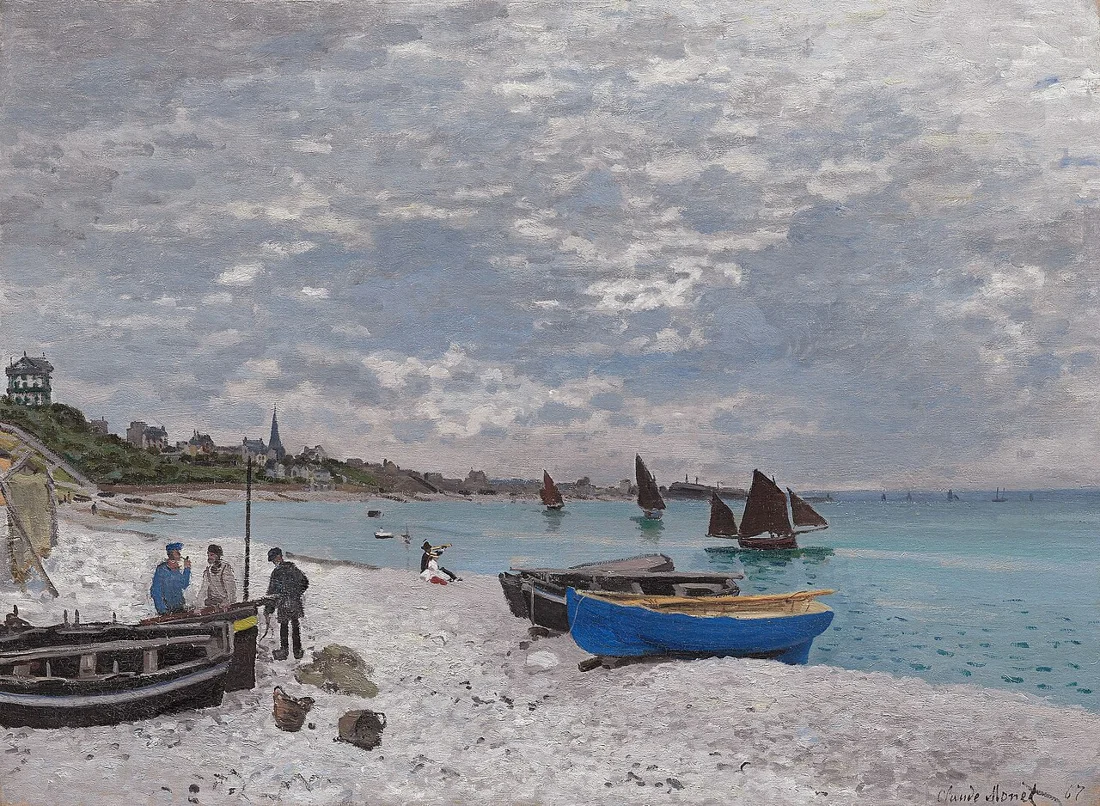
Regatta at Sainte-Adresse offers another version of the coast, with well-dressed spectators watching sailing at high tide. The Met suggests that it was conceived as a pair with The Beach at Sainte-Adresse, now in the Art Institute of Chicago. The latter is the painting reproduced here. Its overcast sky and boats on the exposed shore introduce a different atmosphere from the sunny leisure of the regatta.
Look at the blue boat in the foreground, then follow the dark sails farther out. People gather near the vessels, while a wide area of cloud occupies the upper part of the canvas. The beach is a place of activity as well as a place to look toward the horizon. Comparing the two pictures invites you to consider weather, tide, and human use together, without reducing the coast to a single picturesque mood.
Bring a coastal question to Giverny
These works also have a history beyond the summer in which they were painted. The Met records that Garden at Sainte-Adresse appeared at the fourth Impressionist exhibition in 1879. Creation and public presentation therefore belong to separate moments in this picture’s story. For another encounter between modern surroundings and painterly choices, compare Monet’s steam-filled Gare Saint-Lazare paintings.
The Giverny landmark guide introduces the setting of a later chapter, and Inside Claude Monet’s Giverny offers an encounter with the painter through a professional actor. Read what to expect from the experience format for practical context. Consult the current experience page for its route and access details. Carry one question from the coast into that encounter: what has Monet chosen to put between you and the horizon?
Discover an Immmersiv Experience
Explore Inside Claude Monet’s Giverny with a professional actor embodying Claude Monet. This article provides background for your curiosity. It does not promise stops or access beyond the published experience route. Consult the current experience page for its route and practical details.