Denecourt’s Blue Trails: How Fontainebleau Learned to Welcome Walkers
A painted mark on a rock can look like a very small intervention in a large forest. In Fontainebleau, that modest idea belongs to a much bigger history of making landscapes accessible to visitors. Claude-François Denecourt combined paths, printed guides, and carefully chosen viewpoints into a way of encountering the woods. Following his story changes the question from what a forest contains to how somebody has invited us to look at it.
A guidebook could open the forest before a path did
The departmental archives of Seine-et-Marne trace Denecourt’s published guides back to 1839. Their holdings preserve different editions, maps, practical addresses, and descriptions of walks. These were tools for travelers who wanted to explore a landscape they did not already know. A book could organize the visit before anyone reached a particular rock, by deciding which places deserved a name, an explanation, or a place on the page.
That is a useful way to approach an old travel guide. Look for what it makes easy to find, then consider what it leaves outside the chosen itinerary. A printed route is an invitation with a point of view, rather than a neutral inventory of every tree and stone. The same distinction helps explain why two visitors can enter the same forest and come away with very different versions of the place.
Blue arrows became a route through the landscape
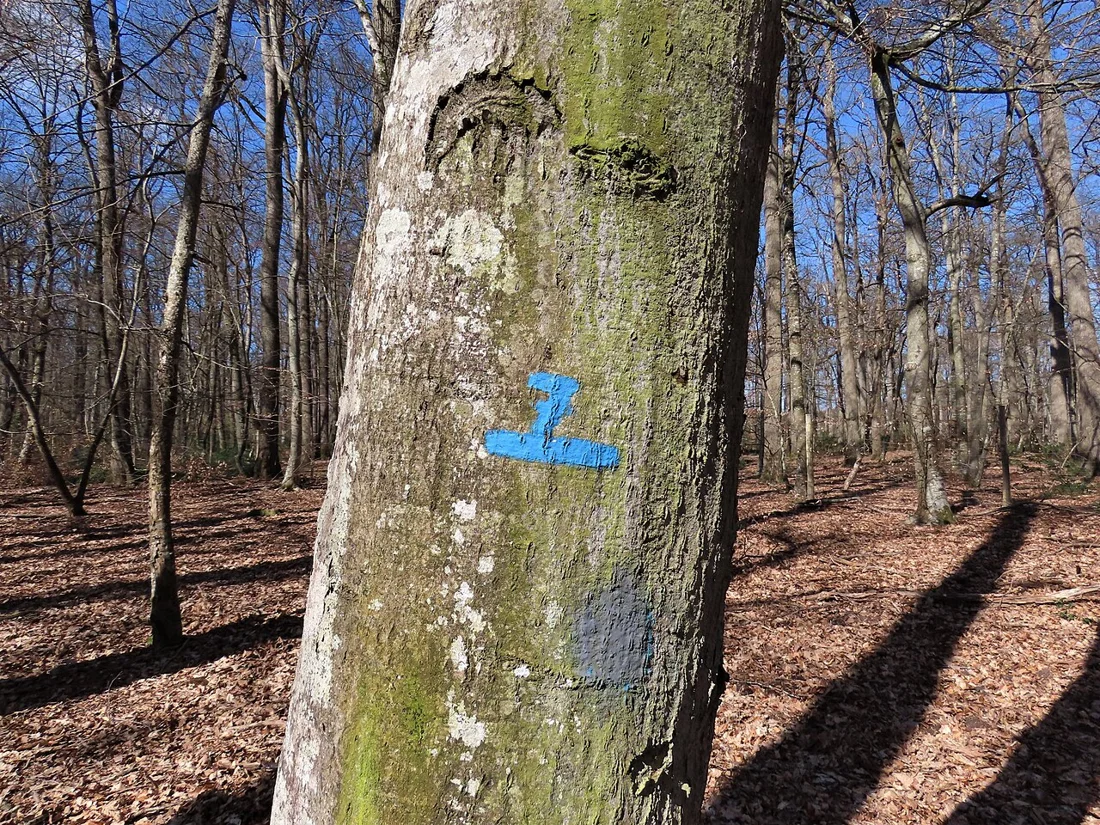
From 1842, Denecourt began laying out forest paths marked with blue arrows, with permission from the forestry administration. The archives describe practical interventions that included passages, tunnels, and artificial grottos. This was work on the ground as well as work on paper. The blue marks connected a traveler’s immediate surroundings with a route that somebody else had considered and arranged in advance.
In the modern photograph reproduced here, notice how a small painted sign stands out from the tree bark around it. The contrast gives a deliberate human mark a particular job within a much larger setting. It does not tell you that every blue mark everywhere in Fontainebleau has the same meaning. The photograph documents a named Denecourt-Colinet circuit at one moment, rather than providing a complete or current set of walking directions.
A picturesque forest could also be a constructed experience
The ONF’s history emphasizes how actively Denecourt shaped some of the places visitors encountered. Its example of the Caverne des Brigands describes a site rearranged to create a picturesque setting. A romantic-sounding name therefore deserves its own question before it is treated as evidence of an ancient event. Compare that habit with the Grand Veneur forest legend, where listening to a story and establishing a historical occurrence are different activities.
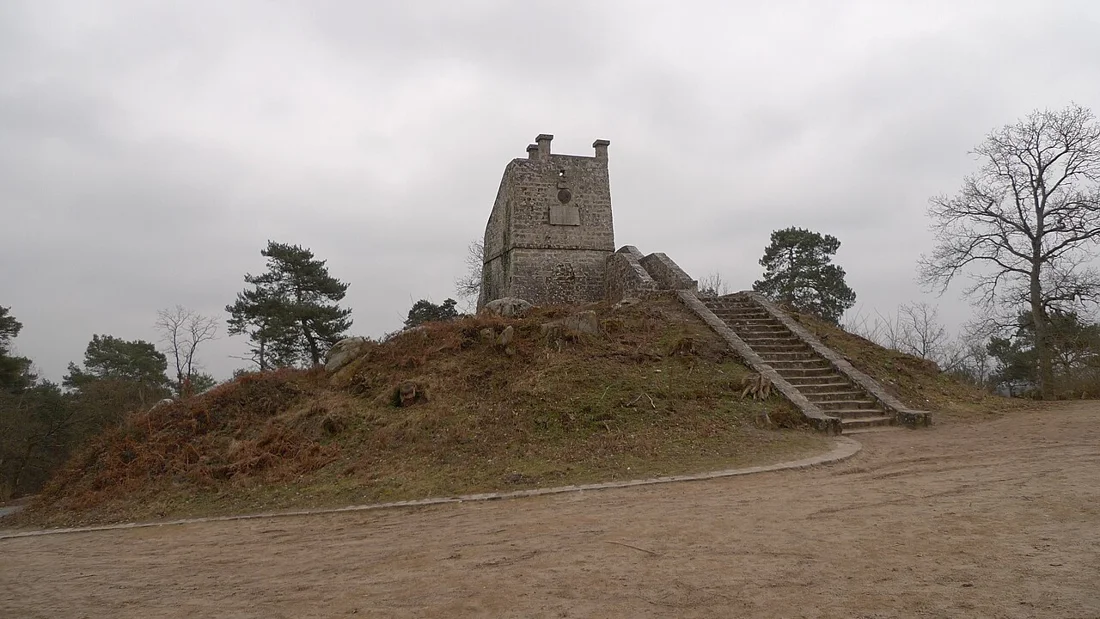
The observation tower now called the Tour Denecourt dates to 1853. Seen in the second photograph, its stone platform makes the idea of a selected viewpoint unusually tangible. The ONF also explains that Charles Colinet continued Denecourt’s work and extended the network of paths. The familiar paired name Denecourt-Colinet is a reminder that a visitor landscape can have several makers rather than a single moment of invention.
Put a walker’s forest beside a painter’s forest
Denecourt’s paths offer a different angle from Fontainebleau’s artistic reserves and Rosa Bonheur near Fontainebleau. One story concerns how to move through a place, another the protection or representation of parts of that place. The Fontainebleau landmark guide helps connect those histories with the wider setting. Looking at them together reveals a forest shaped by visitors, artists, administrators, and storytellers as well as by natural processes.
Immmersiv’s Mysteries of Fontainebleau Forest experience approaches the setting through a performed historical character. Read what to expect for the format and consult the published experience page for its actual route. This article supplies a history of forest visiting, not a new itinerary or a statement of present trail access. What it offers for any future encounter is a question worth carrying: who chose the path, the name, and the view?
Discover an Immmersiv Experience
Explore The Mysteries of Fontainebleau Forest with a professional actor embodying the Grand Veneur. This article provides background for your curiosity. It does not promise stops or access beyond the published experience route. Consult the current experience page for its route and practical details.