Rosa Bonheur near Fontainebleau: Looking Closely at the Animal World
A line of powerful horses fills one canvas, while a single dog holds the attention in another. Both belong to the world of Rosa Bonheur, an artist whose work rewards a close look at animals as individual subjects. Her story also leads beyond Paris to By, near the forest of Fontainebleau. Discovering Rosa Bonheur near Fontainebleau gives this familiar destination another human connection, alongside its royal history and forest legends.
Follow the painter from Paris to By
Bonheur acquired the château of By in Thomery in 1859, according to the site’s own historical account. It explains that she commissioned the architect Jules Saulnier to build her studio and moved in the following year. The property became a home and a place to work. Its location connects her story with the Fontainebleau area without turning By into part of the royal palace.
The Muséum national d’Histoire naturelle describes her sustained study of animals and her interest in the wildlife of the nearby forest. Her approach involved observation rather than relying only on a convenient image of an animal. This offers a different point of entry from the painters who helped protect Fontainebleau’s forest. Both stories encourage us to think about the area as a working environment for artists, with different subjects and concerns.
Enter the movement of The Horse Fair
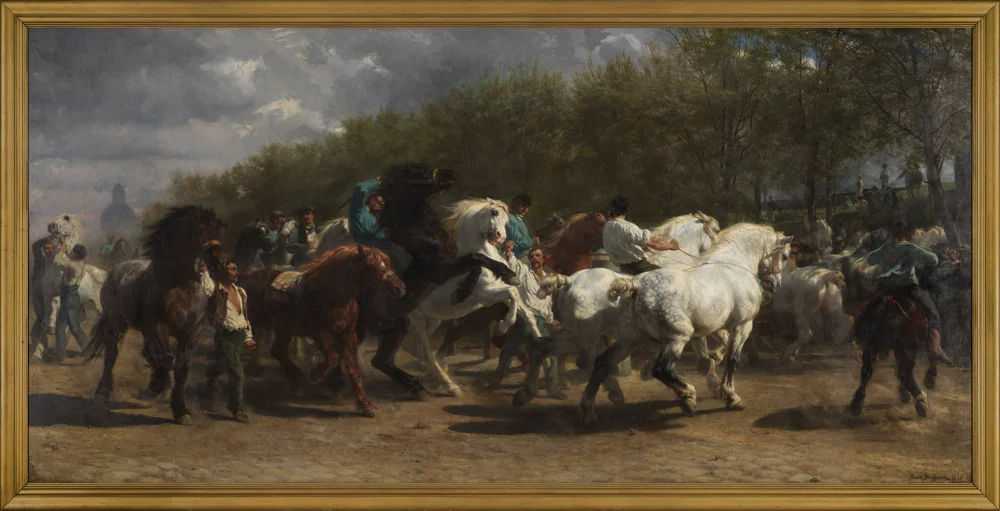
The Horse Fair represents the horse market on Paris’s Boulevard de l’Hôpital, with the Salpêtrière visible in the left background. The Metropolitan Museum of Art dates the painting to 1852–55 and records its debut at the Paris Salon of 1853. Bonheur repeatedly visited the market to sketch the animals. The painting therefore belongs to her career before the purchase of By, rather than documenting a fair beside her later home.
In the reproduction, horses and handlers occupy a broad sweep across the foreground. Notice the turns of the heads, the different positions of the legs, and the contrast between pale coats and darker bodies. Those variations keep the animals from becoming one repeated shape. Following the movement from one horse to another lets you explore the picture before worrying about remembering every date.
Pause with a single hound
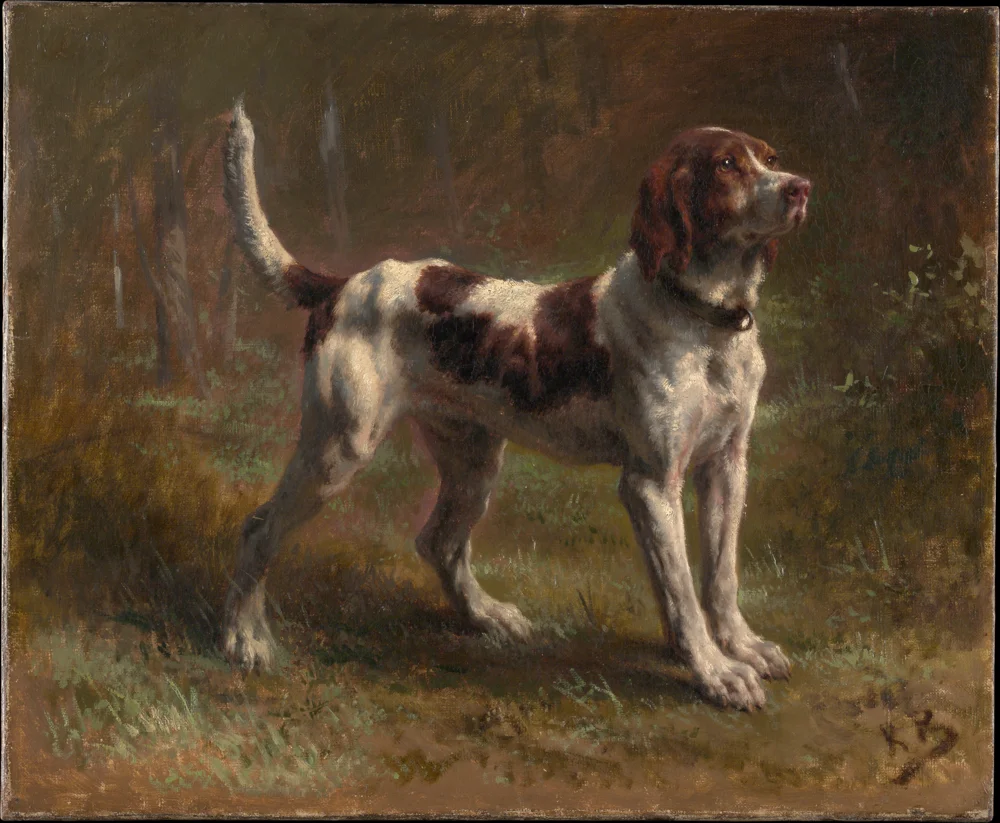
A Limier Briquet Hound, painted around 1856, shifts attention from a crowded market to one dog. The Met identifies it as a work made from life and says the animal belonged to the Vicomte d’Armaille. This is a particular sitter rather than a generic woodland emblem. Its smaller cast of characters changes the kind of encounter the painting offers.
Look at the raised tail, the planted front feet, and the head turned toward the right. Against the subdued setting, the white coat and darker patches give the body a strong presence. You can compare that quiet attention with the activity of The Horse Fair without imagining that the two scenes happened in the same place. For a different relationship between an artist, a sitter, and a working life, explore Père Tanguy’s paint shop and Van Gogh’s portrait.
Keep the artist’s history and the forest’s legend distinct
The story of Fontainebleau can accommodate both close observation and imaginative storytelling. Bonheur’s documented career offers one route into the area, while the legend of the Grand Veneur offers another. A painted animal, a historical archive, and a forest tale do not provide the same kind of evidence. Keeping that distinction clear allows each to remain interesting on its own terms.
The Immmersiv Fontainebleau experience uses a professional actor embodying the legendary Grand Veneur. It is not a Rosa Bonheur experience, and this article does not add By or her studio to its itinerary. If you are considering a separate visit to her home, check the château’s current official information independently. Read what to expect from an Immmersiv experience and its published route before making plans.
Discover an Immmersiv Experience
Explore The Mysteries of Fontainebleau Forest with a professional actor embodying the legendary Grand Veneur. This article provides background for your curiosity. It does not promise stops or access beyond the published experience route. Consult the current experience page for its route and practical details.