Poe’s Raven in Paris: The Book Mallarmé and Manet Made in 1875
A reader sits beneath a lamp, surrounded by restless strokes of black ink. Turn to another illustration and a bird crosses the space beside an open window. These images belong to an unusual Paris chapter in the life of an American poem. Poe’s Raven in Paris becomes a story about what a translator, an artist, and a publisher can make together after the writer is gone.
Three names, three different kinds of work
The 1875 book Le Corbeau brings together Edgar Allan Poe, Stéphane Mallarmé, and Édouard Manet. The National Gallery of Art identifies their roles separately: author, translator, and artist. Poe had died in 1849, so this was a later French interpretation of his writing rather than a collaboration involving three living colleagues. Keeping those roles clear makes the book’s achievement more interesting than imagining a meeting that never happened.
The BnF catalog names Richard Lesclide as the Paris publisher and records both the English text and its French translation. A reader could therefore move between two languages within the same publication. That arrangement gives the translation a visible relationship with its source instead of hiding the American poem behind a French title. For another route by which Poe reached French readers, follow the story of Baudelaire’s translations.
Look at the reader beneath the lamp
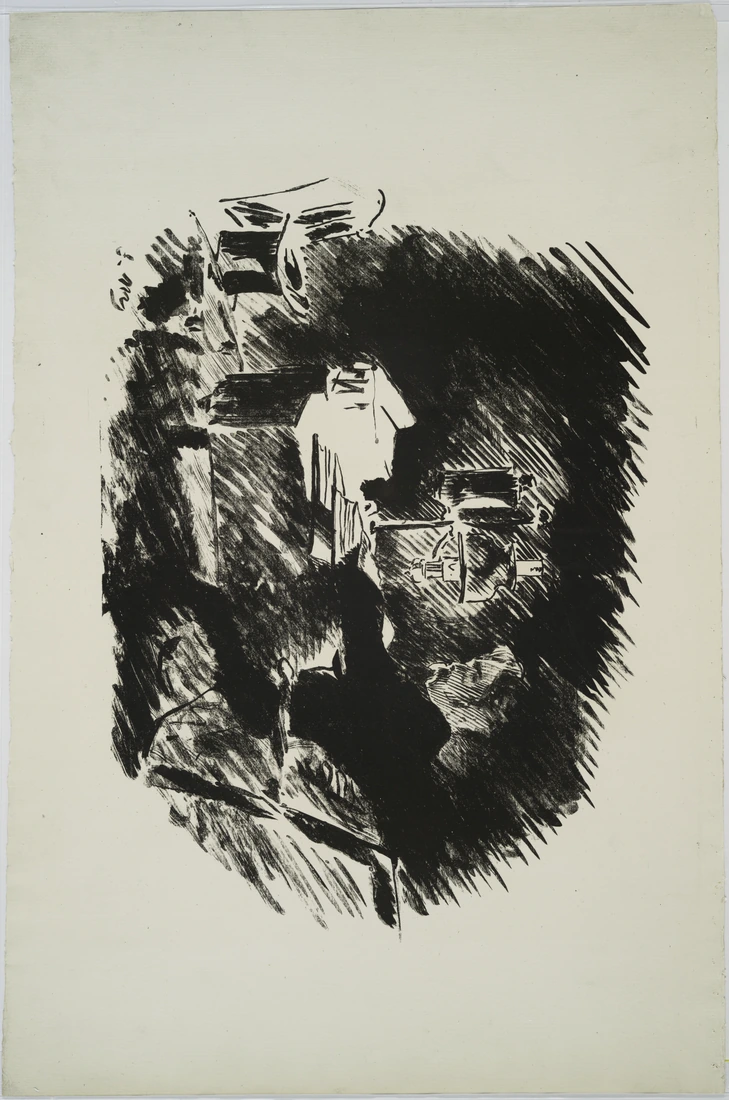
Manet’s illustration Under the Lamp places a pale face within a restless dark surround. The lamp, the seated figure, and the suggestion of reading emerge from marks that remain conspicuously visible. Rather than filling every corner with descriptive detail, the print leaves you to complete parts of the room. Your eye moves between recognizable objects and patches of darkness, giving the act of looking its own small tension.
The Allen Memorial Art Museum connects this atmosphere with the poem’s grieving speaker and the arrival of a raven at night. An illustration can respond to that mood without explaining every line in the same way. Try looking first at the face, then at the large dark areas around it. The balance changes according to where you begin, even though the page itself stays still.
A window turns the page into a threshold
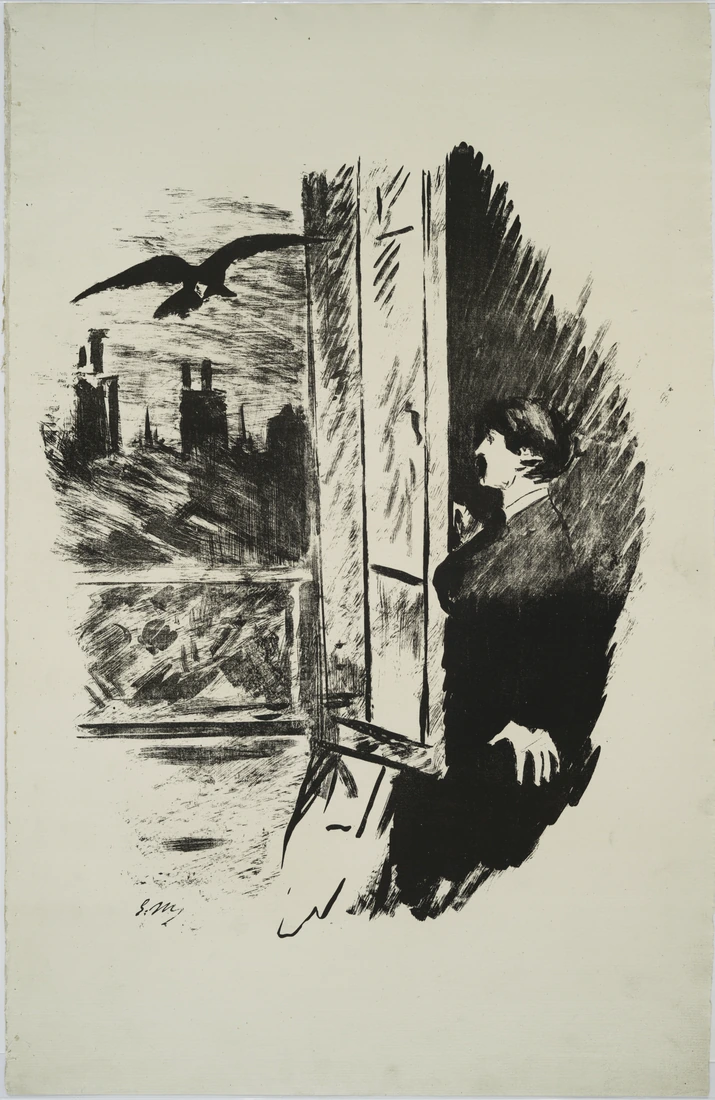
In the second plate reproduced here, the window separates the interior figure from an outside space crossed by the bird. Notice the pale vertical frame and the dark shape of the man beside it. The image gives your gaze a route from one side of the opening to the other. It invites a different kind of attention from the concentrated pool of lamplight in the first scene.
The BnF describes four full-page lithographs as well as smaller designs for the book’s cover and bookplate. Those distinctions matter when a single reproduced image is casually called the whole illustrated edition. A Louvre record of Manet’s correspondence with Lesclide also shows the artist taking an interest in the publication’s presentation. The object was shaped through practical decisions about a book, as well as through literary admiration.
Follow the French afterlife of an American writer
The Paris connection lies in this publication and its makers, rather than in a claim that Poe wrote the poem in the city. Our article on Dupin’s fictional Paris follows another distinction between an imagined setting and a writer’s biography. The history of Paris’s two Shakespeare and Company bookshops opens a separate chapter in the movement of English-language writing through France. Together, these stories suggest how much literary travel can reveal through the circulation of books themselves.
The Île de la Cité guide offers a setting for exploring the city’s darker storytelling traditions. Immmersiv’s The Dark Legends of Paris uses Poe as a theatrical character, embodied by a professional actor. Read what to expect for the encounter’s format. Then return to Manet’s window and consider how a few marks on a page can leave an entire room waiting for a story.
Discover an Immmersiv Experience
Explore The Dark Legends of Paris with a professional actor embodying Edgar Allan Poe. This article provides background for your curiosity. It does not promise stops or access beyond the published experience route. Consult the current experience page for its route and practical details.