Paris with a 10-Year-Old: What to See and Experience
A ten-year-old may arrive in Paris with a strong interest and an equally strong opinion about how to spend the day. A child who enjoys inventing stories might look at a portrait very differently from one who wants to understand a machine. Give those preferences a place in the planning before deciding which famous stop belongs on the itinerary. A useful cultural route offers enough structure to work smoothly and enough choice for your child to feel involved.
Choose a subject before choosing a landmark
Ask your child to choose between a few real themes, such as art, inventions, or the history of ordinary city life. Match that answer with a collection whose published description supports the interest, rather than relying on the reputation of a famous building. The Musée des Arts et Métiers provides family information for exploring its collections, while Carnavalet offers resources focused on Paris and its inhabitants. Our family guide to Paris can help you compare the outing with the rest of your trip.
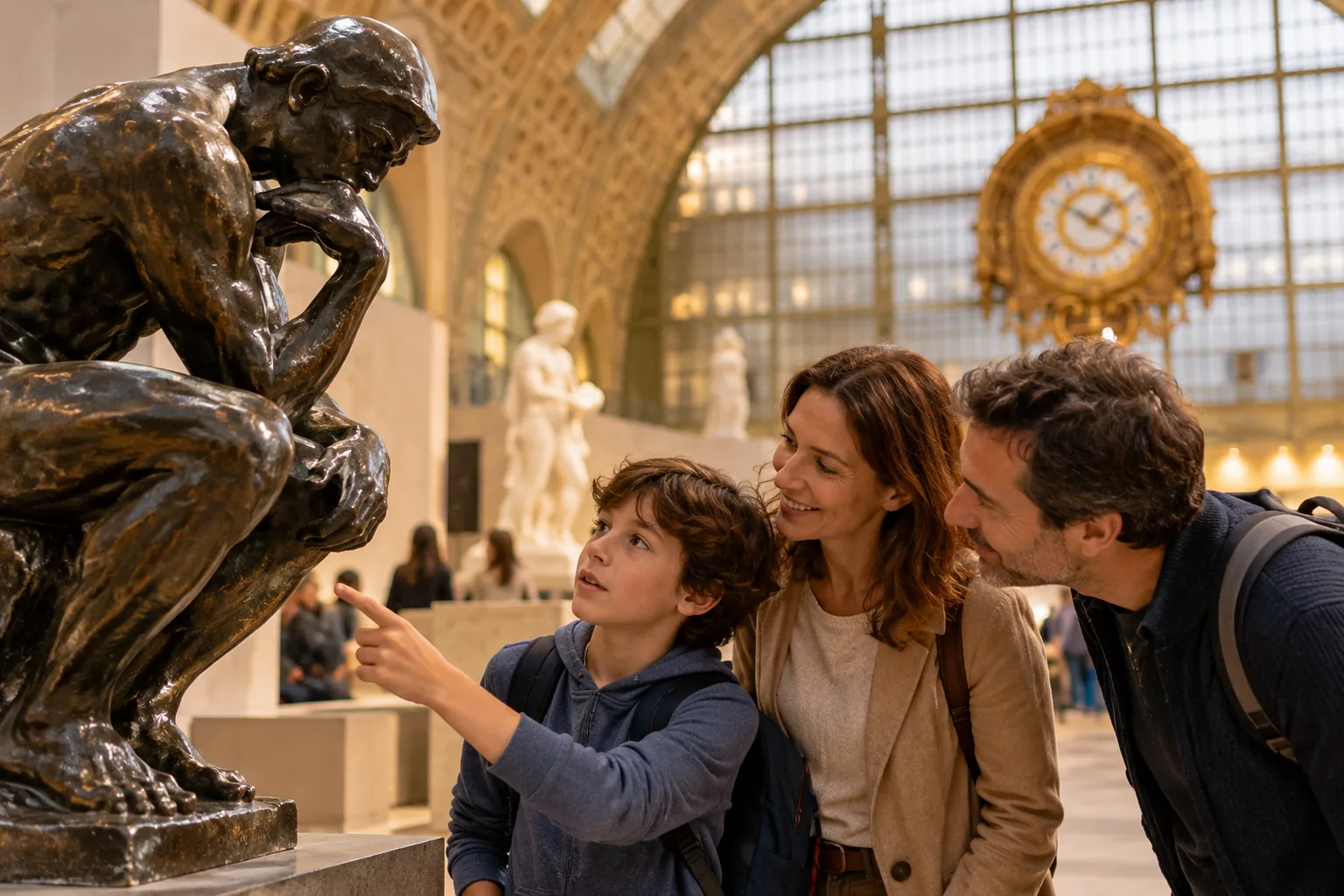
Check any organized activity's age requirements and language, because being ten does not make every family program a suitable match. Distinguish a collection visit from a workshop so that an interest in making things does not become a promise of handling exhibits. For an art-focused child, the Musée d'Orsay's family activity booklets offer another possibility to investigate. Let your child choose a question to pursue, while adults remain responsible for the practical arrangements.
Create a conversation with more than one answer
Looking at two objects can open a richer conversation than trying to name everything in a room. Compare their materials, purposes, or visible details, then read the labels to see which impressions are supported. Encourage your child to explain a preference without requiring the choice you would have made. Our guide to making history fun helps keep the discussion rooted in observation rather than a recital of facts.
Try connecting a museum question with something outside only when the connection is accurate. An object associated with trade can prompt a discussion of how city life depends on work, without proving that a nearby shop has a particular historic origin. If you want to develop that thread through a character, review the Immmersiv themes and the relevant published premise. A clear distinction between evidence and interpretation gives the child permission to imagine while understanding what is actually known.
Give your child a meaningful role in deciding when the chosen visit feels complete. You can agree on a small selection in advance and discuss whether an unexpected object deserves more time. Keep a break available, since strong interest does not remove the practical effort of standing and moving through a museum. A day planned around one evolving question may be more satisfying than a series of unrelated highlights.
Consider a character encounter as another perspective
An Immmersiv encounter uses a performer portraying a personality to connect a story with a place. Read the experience format together and check how the selected encounter works for children before booking. The Père Tanguy experience is one theme to investigate when artistic Paris fits your child's interests. Do not treat a theatrical portrayal as direct historical testimony or assume that every topic is suitable simply because the child enjoys history.
Ask about age suitability, language, interaction, walking demands, and availability for the specific experience. Give your child the option of preparing a question while leaving room to observe quietly if that feels more comfortable. Our guide to activities adults enjoy too can help you find a subject that supports a conversation across generations. Place the encounter in a manageable day rather than presenting it as an extra reward that requires completing a long museum route first.
Paris with a ten-year-old can become an exploration of ideas as much as a collection of sights. A carefully chosen object, a genuine comparison, or a character's interpreted perspective can provide the thread that joins the day together. Leave enough space for your child to disagree, reconsider, or ask something unexpected. Their developing view of the city is part of what makes the trip worth sharing.