What Was Paris Like in the Middle Ages?
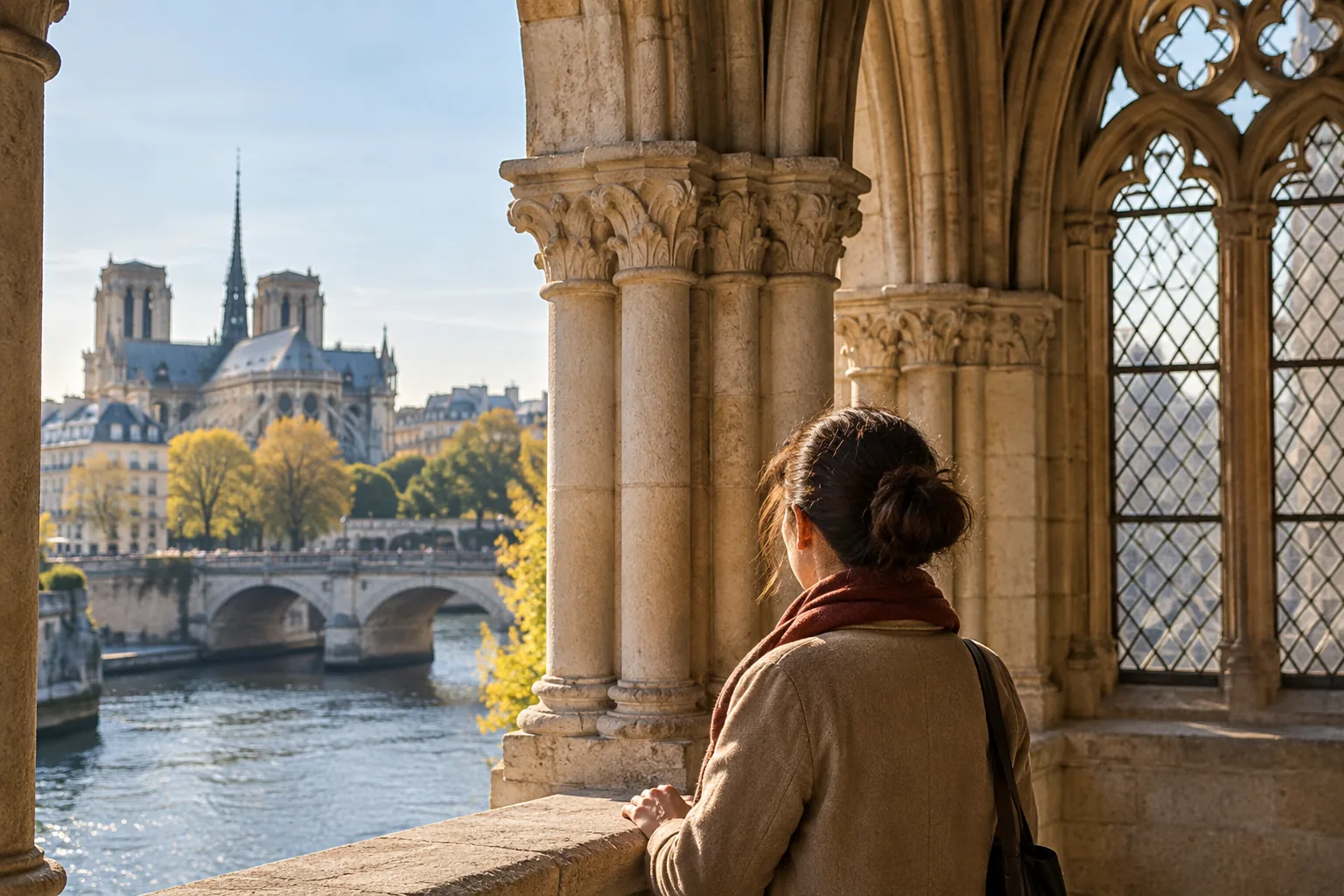
A medieval window or wall can make the past feel present, but it does not describe every life lived around it. Paris in the Middle Ages was a city of different institutions, occupations, and relationships to power. Royal space, regulated trades, and university communities offer useful ways into that world. Begin with those distinct settings rather than imagine the entire period as either a gloomy street scene or an uninterrupted procession of kings.
A royal city with boundaries that changed
The royal palace on Île de la Cité formed an important center of power, while surviving rooms at the Conciergerie preserve particular phases of its medieval development. Sainte-Chapelle connects Louis IX's patronage with the prestige of sacred relics. Those sites illuminate royal purposes more directly than the daily experience of every resident. Our guide to medieval traces in Paris helps distinguish what a monument preserves from what it leaves undocumented.
Philippe Auguste's defensive wall placed a physical boundary around parts of the city, and fragments remain within the later urban fabric. A boundary organized the relationship between inside and outside, but its surviving stone cannot reproduce every movement through a former gate. Consult documented plans and historical explanations before projecting today's street pattern backward. The city changed during the medieval centuries, so one wall or royal commission should not stand for the entire period.
Work and learning reveal other parts of the city
The Livre des métiers associated with Étienne Boileau preserves regulations concerning Parisian trades in the thirteenth century. The BnF's catalogue identifies the text and later scholarly editions, providing a starting point for investigating organized work. A regulation records what an authority sought to establish, rather than prove every worker always followed the rule. That distinction makes the document useful without turning it into a complete transcript of daily life.
The Sorbonne's history supplies another setting beyond the royal palace. Robert de Sorbon created a college in 1253, with its foundation confirmed by Louis IX in 1257, according to the Chancellerie des Universités de Paris. Colleges offered places for study and accommodation within a wider university world in which Latin helped connect scholars from different regions. Our guide to French history before a Paris visit helps place that institution within the broader period without confusing a medieval college with today's university organization.
Objects can approach daily life at a different scale from a wall or an institution. The Musée de Cluny's collections include material connected with everyday use alongside religious and luxurious works. Read each label for origin and purpose, because a medieval object displayed in Paris was not necessarily made or used there. A vessel or tool can open a question about an activity while still requiring evidence about the person and setting involved.
Visit with questions rather than a complete imagined street scene
Choose a royal space, a defensive fragment, or a collection theme as the beginning of a focused visit. Our guide to experiencing medieval Paris today helps make a practical selection instead of attempting every trace in one day. Check entry, access, and current collection information separately for each institution. A smaller route leaves room to compare what the evidence actually tells you.
Explore the Immmersiv character themes and read the performance format when an interpreted story connects with your interests. Use the map to distinguish a Paris outing from an encounter requiring a separate trip. A professional actor's portrayal can offer a perspective, while literary characters and invented dialogue remain clearly identified. It should not supply missing historical detail simply because the scene feels convincing.
Medieval Paris becomes more understandable when royal, working, and scholarly settings remain distinct. Each supplies a different question and a different kind of evidence. Look closely at what survives, read the documentation, and leave unsupported parts of the picture open. The city can then feel historically rich without requiring an invented account of every person who once lived behind its walls.
Discover an Immmersiv Experience
For a separate medieval-history trip, investigate Joan of Arc: The Trial in Rouen, with a professional actor embodying Joan of Arc. The encounter takes place in Rouen, so it needs travel arrangements beyond a Paris walking itinerary. Read the actual trial premise and confirm suitability, language, availability, and practical demands. Keep the performed viewpoint distinct from documentary evidence about the historical proceedings.