Napoleon and the Rosetta Stone: Discovery Was Only the Beginning
A broken stone can be famous for a discovery that did not happen all at once. The Rosetta Stone was found by soldiers in Napoleon’s army in 1799, but finding it and understanding its writing were different achievements. The later story leads to scholars, comparisons, and a crucial announcement in Paris. Keep those chapters separate and you gain something more interesting than a legend about one conqueror unlocking an ancient civilization.
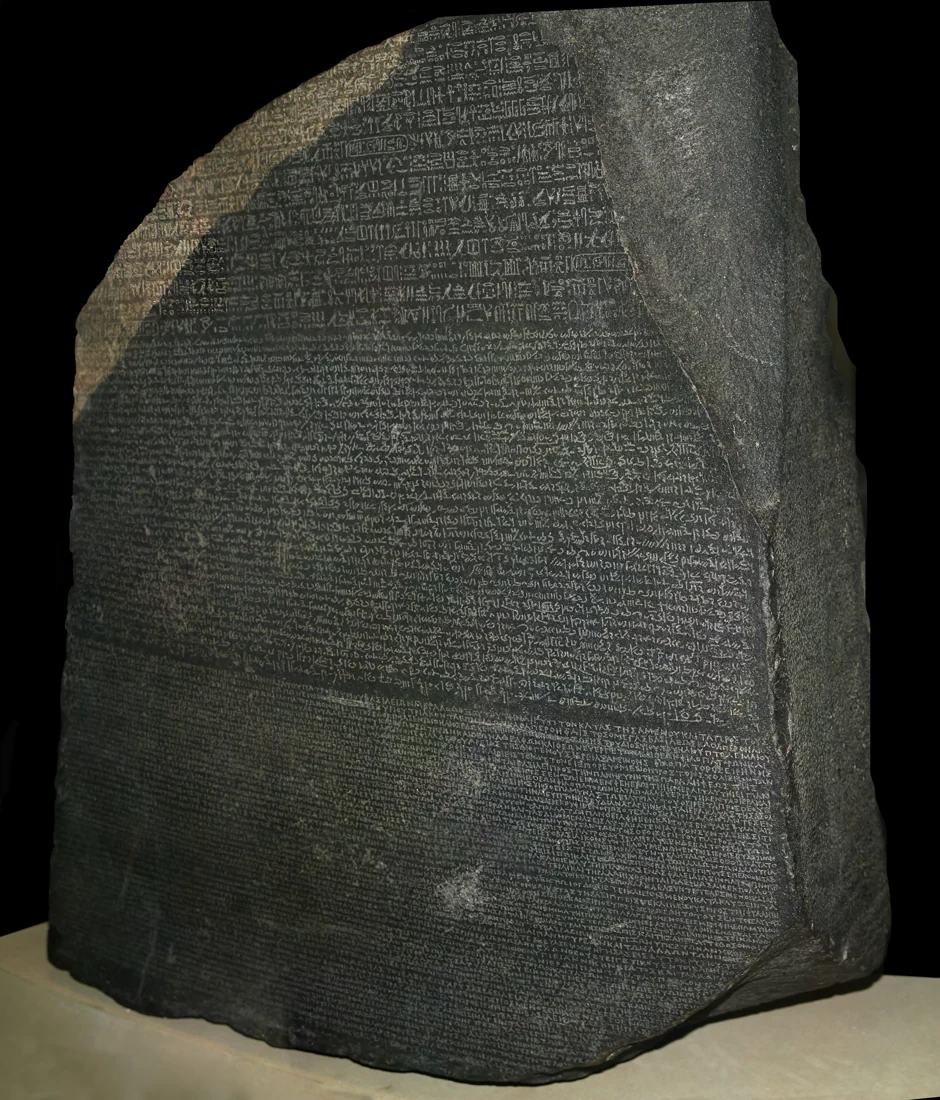
An Egyptian object before a European discovery
The stone’s inscriptions date to 196 BC and concern the rule of Ptolemy V. Its surface carries three scripts: Egyptian hieroglyphs, Egyptian Demotic, and ancient Greek. Three scripts do not mean three separate languages, because two are ways of writing Egyptian. Before it entered a modern story of military expeditions and scholarly rivalry, the object already had a political and religious purpose in Egypt.
That earlier life is easy to miss when a museum object is introduced through the name of a famous European. Begin instead by looking at the three bands of writing and the breaks in the stone. The damaged surface is part of the evidence, rather than a defect you must mentally remove. This approach also helps when exploring Napoleon beyond the legend, where the scale of a reputation should leave room for other people and other histories.
What the soldiers found in 1799
Soldiers encountered the stone during work on a fort near Rashid, the Egyptian town the French called Rosetta. The British Museum’s record associates the find with the French officer Pierre-François Bouchard. Its later movement to Britain followed the French army’s defeat and the 1801 settlement at Alexandria. Discovery, possession, and interpretation therefore belong to connected but different parts of its history.
The distinction matters whenever a military expedition is remembered mainly for the knowledge associated with it. A useful object did not turn conquest into a purely scholarly enterprise, and an army commander did not become its decipherer. The Arc de Triomphe guide offers another setting in which to think about military memory. Read it alongside how Napoleon changed Paris to notice how achievements, institutions, and public images can become tangled together.
Why comparison took more than a dictionary
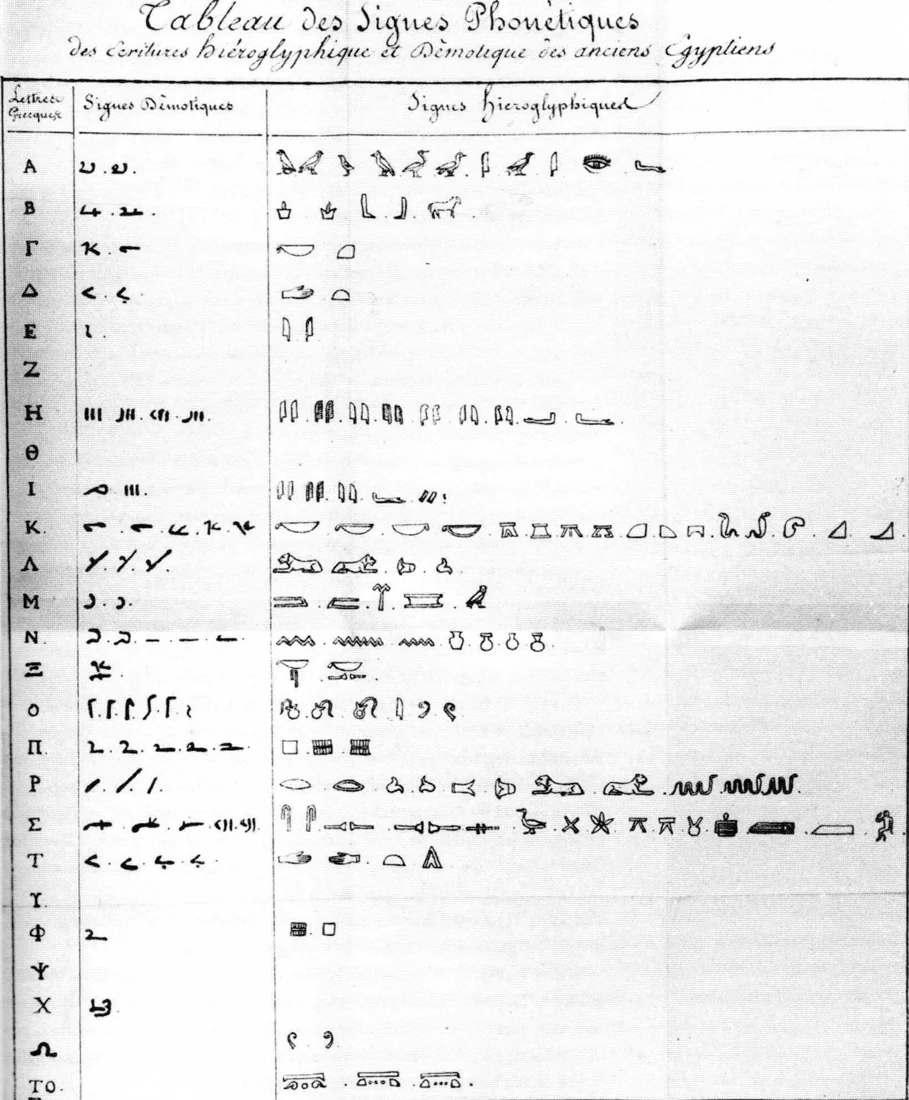
Greek offered scholars an entry into the inscription, but the task required more than matching one familiar word to one unfamiliar picture. Thomas Young helped establish that some hieroglyphs could record sounds in a royal name. Jean-François Champollion’s knowledge of Coptic was central to his broader understanding of the Egyptian language and its writing. His research drew on other texts and monuments as well as the Rosetta Stone.
The table of signs reproduced here makes that patient comparison visible. Look at how the page places signs and sound values beside one another instead of presenting a single mysterious symbol in isolation. The BnF explains that the 1822 publication first addressed phonetic values used in the names of foreign rulers. Treating it as one important stage makes the breakthrough more understandable than imagining that every ancient text suddenly became readable on the same day.
The Paris chapter of 1822
On September 27, 1822, Champollion’s letter to Dacier was read at the Académie des Inscriptions et Belles-Lettres in Paris. The BnF presents the work as the result of research begun years earlier, with sustained collaboration between the Champollion brothers. That date marks a milestone in decipherment, rather than the moment the soldiers found the stone. For a visitor following French history, the Paris connection lies in this scholarly chapter as well as in the earlier expedition.
Our Paris guide for history lovers encourages that movement between an object and the questions surrounding it. You can also return to an earlier political world through Versailles, before Napoleon’s rise. Immmersiv’s Marie Antoinette, Rebel Queen explores that separate royal chapter through a professional actor. Carry the same attentive habit with you: ask whose story a famous name makes visible, and whose work you still need to discover.
Discover an Immmersiv Experience
Explore Marie Antoinette, Rebel Queen with a professional actor embodying Marie-Antoinette. This article provides background for your curiosity. It does not promise stops or access beyond the published experience route. Consult the current experience page for its route and practical details.