Monet’s Japanese Prints: Another Way to Look at Giverny
You may arrive at Giverny expecting to look at a painter’s garden. Monet’s Japanese prints offer a different invitation: look at the pictures he chose to live with. His collection includes works by Hokusai, Hiroshige, and Utamaro, bringing another artistic world into the story of his home. Before you rush toward the water lilies, leave room for the collector behind the painter and for the unexpected ways a picture can teach you to notice a place.
Meet Monet as a collector
The house’s official account describes Japanese prints displayed on the walls of Monet’s Giverny home. These were works he studied and valued, rather than paintings made by Monet himself. The distinction matters when you imagine the house as a record of an artist’s interests. A collection shows what someone returned to looking at, even when it cannot tell you exactly what that person thought on every occasion.
Give the names on the labels the attention you would give Monet’s signature. Hokusai, Hiroshige, and Utamaro should remain artists with their own identities, not disappear into a vague label of inspiration. Ask which subjects or arrangements draw your eye before trying to make a connection to Impressionism. Our introduction to Monet and the birth of Impressionism provides a separate starting point for his French artistic world.
Let a wave change your sense of scale
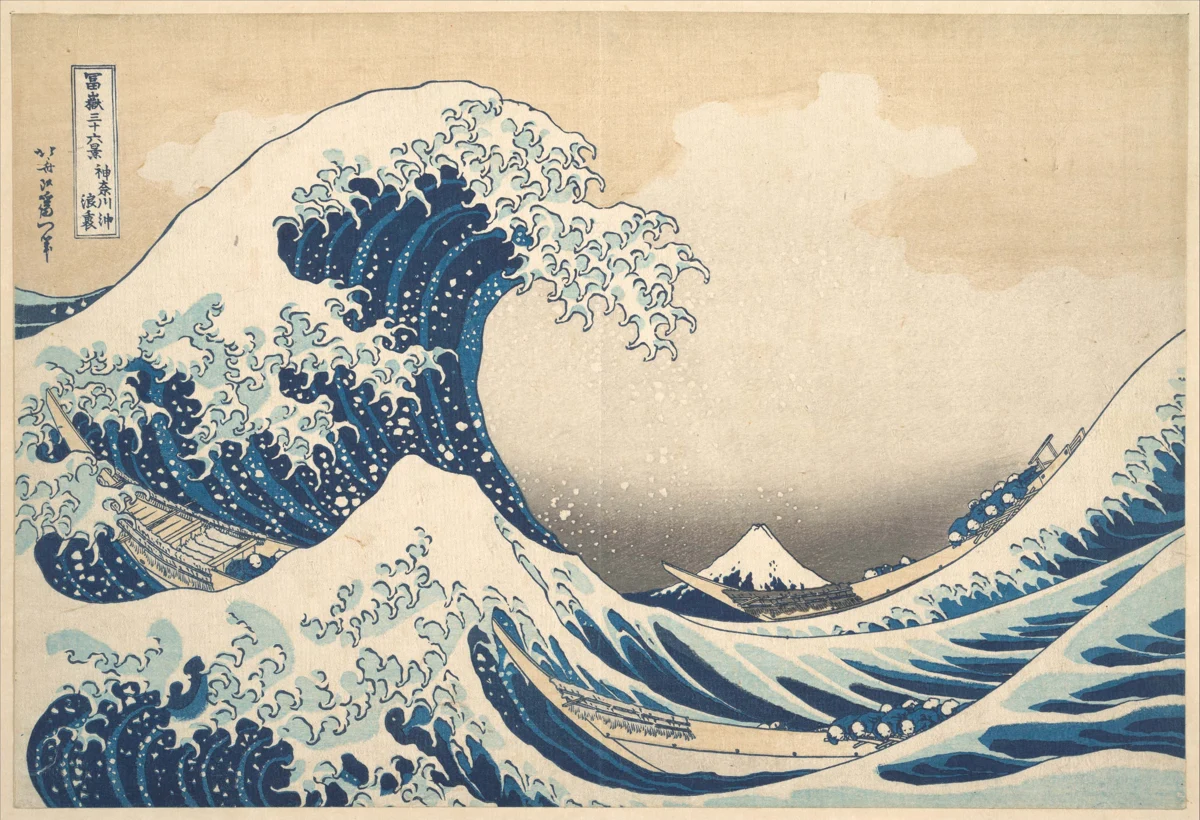
Hokusai’s Under the Wave off Kanagawa makes an arresting exercise in looking. In the Metropolitan Museum’s impression reproduced here, the curling wave dominates while Mount Fuji appears small in the distance. The museum dates this woodblock print to about 1830–32 and identifies it as part of Thirty-six Views of Mount Fuji. This is an example from the Met’s collection, not a photograph of the particular sheet owned by Monet or a claim that this impression is displayed at Giverny.
Look for the mountain before allowing the wave to take over again. Then notice how your sense of importance changes when a large landmark occupies a small part of an image. You can carry that experiment outdoors by choosing a foreground leaf or branch before looking toward a wider view. The garden discussed in our article on Monet’s water garden becomes an opportunity to practice attention rather than simply recognize a famous scene.
Look for movement in a still picture
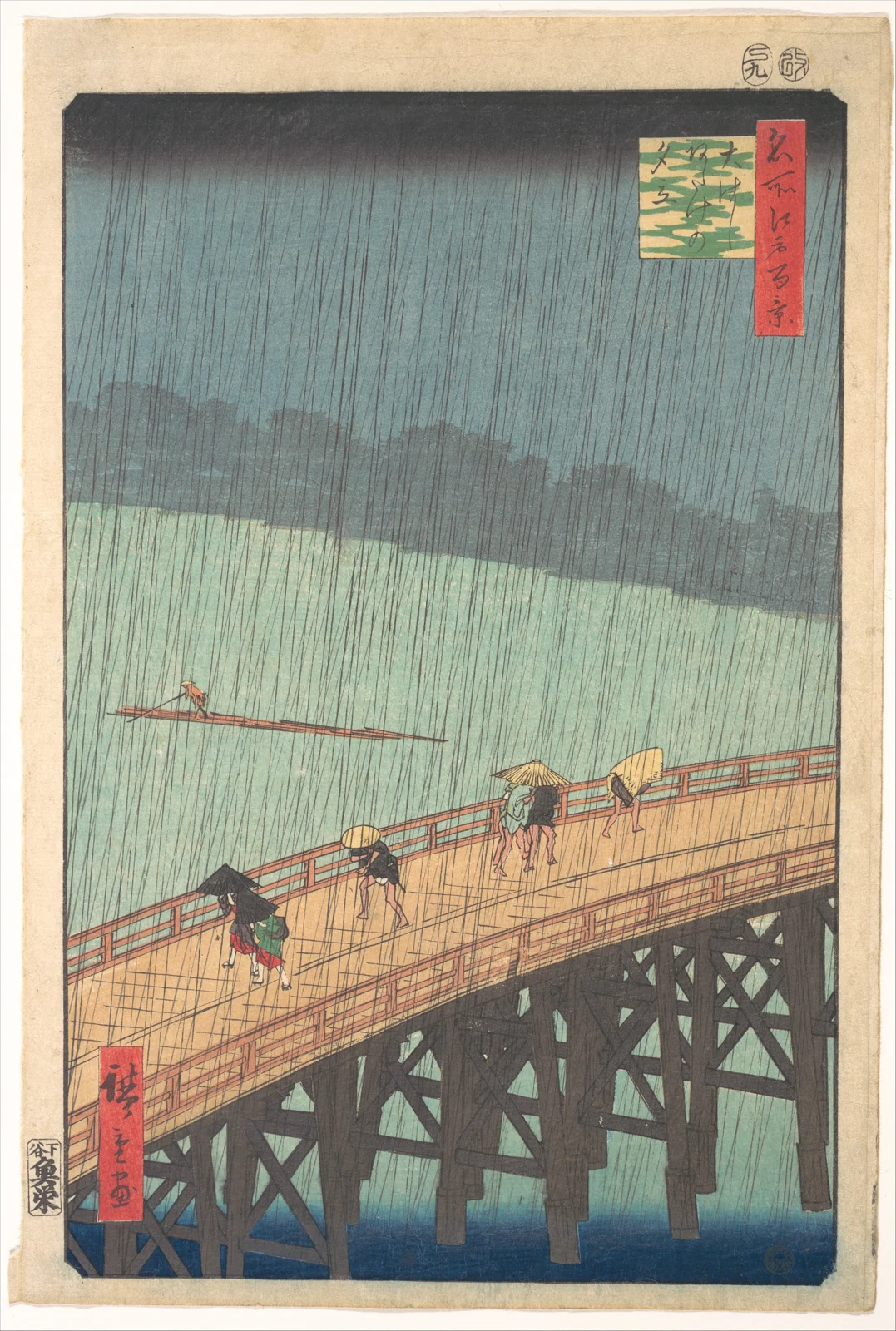
Hiroshige’s Sudden Shower over Shin-Ōhashi Bridge and Atake offers another useful comparison. Dated 1857 by the Met, it shows rain crossing a bridge scene in strong diagonal lines. The people appear caught in changing weather, making a fixed image feel like a passing moment. As with the Hokusai reproduction, the illustrated sheet belongs to the Met and is included as a comparative example, not as an authenticated item from Monet’s own collection.
Trace the rain with your eyes and then follow the span of the bridge. Notice whether your attention moves quickly across the people or settles on a quieter area of water. There is no need to declare that one particular Monet painting came directly from this print to enjoy the comparison. The broader exchange of images between artists also has a place in the story of Père Tanguy’s shop and Van Gogh’s portrait, where Japanese prints form another visible connection.
Bring the collector’s eye back to Giverny
The official Giverny account connects Monet’s interest in Japanese art with the world he created around his pond and bridge. That connection invites comparison rather than a hunt for a single source behind every garden detail. Explore the Giverny setting by alternating between an overall scene and one small arrangement within it. You might leave remembering the placement of a branch or a reflection as clearly as the view you came to photograph.
Immmersiv’s Inside Claude Monet’s Giverny introduces the artist through an immersive theatrical experience performed by a professional actor. The print collection can enrich the questions you bring, without implying that every artwork discussed here forms part of its route. Consult the explanation of the theatrical format and the current experience details when planning. Ask what changes when you look at a painter through the art he collected, and let the answer stay open as you return to the garden.
Discover an Immmersiv Experience
Explore Inside Claude Monet’s Giverny with a professional actor embodying Claude Monet. The artworks discussed here provide background for your curiosity. They are not a promise of stops, access, or artworks included in the theatrical experience. Consult the current experience page for its route and practical details.