Joan of Arc’s Earliest Portrait: A Contemporary Drawing, an Imagined Face
A small figure stands in the margin of a page filled with writing. Centuries later, a painter places an armored Joan beside an altar beneath a great banner. Both images can feel familiar once we know whom they represent, yet they belong to very different moments of looking back. Joan of Arc’s earliest portrait offers a particularly useful lesson: an image made during someone’s lifetime need not preserve an eyewitness likeness.
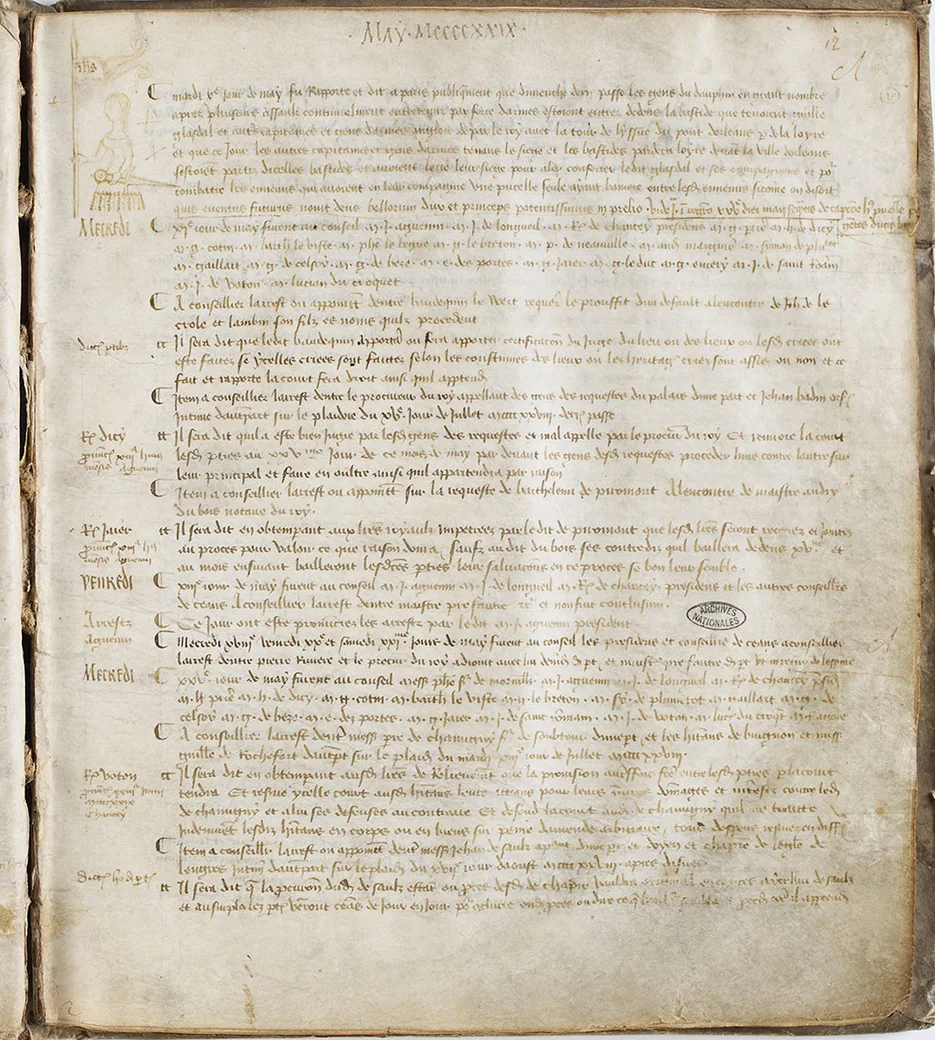
Find the figure inside a judicial record
The Archives nationales preserves a representation of Joan drawn by Clément de Fauquembergue in a register of the Parlement of Paris. The drawing accompanies the entry for May 10, 1429, when news of the lifting of the siege of Orléans reached the city. It is a small marginal figure, about six centimeters high, rather than a separate formal painting. Its position on the page connects an image with the written recording of an event.
The Archives nationales describes it as the only known contemporary representation of Joan’s story and explicitly calls the portrait imaginary. Those two descriptions belong together. Being contemporary tells us when the drawing was made; it does not establish that its maker recorded her appearance from life. That distinction is as valuable as keeping the separate legal moments clear when reading the two proceedings behind Joan’s trial story.
Read the objects before deciding what the face means
In the reproduced register page, the drawing sits apart from the main blocks of text. The figure carries a banner and is associated with a large sword, making identity something communicated through attributes. You do not need to recognize a face to understand that the image concerns a woman linked to war and an emblem. The visual shorthand gives the small figure a presence disproportionate to its size.
Begin by looking at the entire page, then locate the marginal figure and follow the long lines around it. Notice how much of the document is devoted to writing rather than drawing. This is a different encounter from looking at a framed portrait on a museum wall. The page asks us to consider how an image participates in a record, while leaving the maker’s precise intentions open to careful interpretation.
Move forward to Ingres’s painted Joan
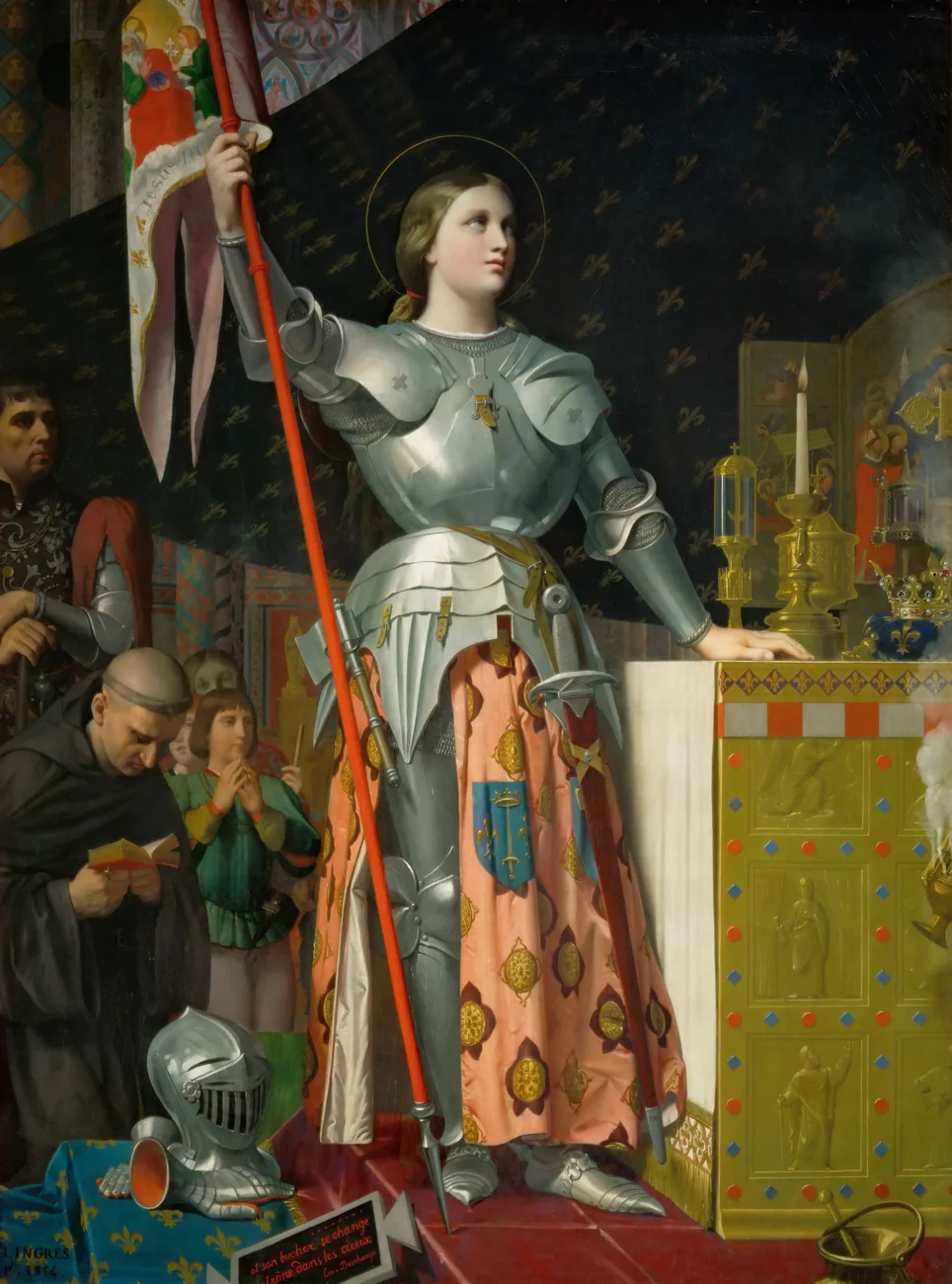
Jean-Auguste-Dominique Ingres completed Joan of Arc at the Coronation of King Charles VII, in the Cathedral of Reims in 1854. The Louvre identifies the work as an oil painting and records its signature and date. Joan appears in armor with a banner in her right hand and her left hand resting on the altar. The setting refers to Charles VII’s coronation at Reims in 1429, rather than to an event the nineteenth-century painter could have witnessed.
The difference in scale is striking: the Louvre records a canvas 2.4 meters high. In the reproduction, armor, textiles, a helmet, and ceremonial objects occupy a richly colored space. Compare that elaborate presentation with the economy of the marginal drawing. As with Marie Antoinette’s portrait with her children, a carefully arranged image can make objects and setting central to the story it tells.
Let each image answer the question it can answer
The drawing helps us explore how Joan entered a contemporary written and visual record. Ingres’s painting helps us explore a much later representation of her place in a royal ceremony. Neither should be used as a photograph of Joan or as independent proof of every detail in the scene it presents. Seeing that limit makes the works more useful, because each remains connected to its own maker, date, and purpose.
For a different example of a familiar name needing historical clarification, read the history behind Rouen’s Joan of Arc Tower. Our Rouen introduction provides city context, while Joan of Arc: The Trial in Rouen gives the actor-led route and what to expect from Immmersiv explains the format. The images discussed here are held in Paris, and their inclusion does not promise that the originals are displayed on the Rouen walk. A useful question to carry with you is simple: does this object document the person, the event, or the way someone chose to remember them?
Discover an Immmersiv Experience
Explore Joan of Arc: The Trial in Rouen with a professional actor embodying Joan of Arc. This article provides background for your curiosity. It does not promise stops or access beyond the published experience route. Consult the current experience page for its route and practical details.