Eugène Boudin: The Painter Who Taught Monet to Look Outdoors
A beach can offer more than a view of the sea. For Eugène Boudin, it offered changing light, passing weather, and people whose everyday presence belonged in a picture. A young Claude Monet learned something decisive from that way of working. Before following Monet into his famous garden, pause with the painter who encouraged him to take his eyes and materials outdoors.
Meet a mentor on the Normandy coast
The National Gallery of Art describes Monet as a teenager known locally for his caricatures when Boudin invited him to accompany painting excursions near Le Havre. Boudin introduced him to plein air painting: working in the open air. That invitation widened the young artist’s field of attention. The coastline became somewhere to observe and paint, rather than simply a setting through which to pass.
The National Gallery of Victoria traces their meeting to 1858 and treats Boudin’s marine painting as an achievement worth considering in its own right. That distinction matters when a mentor risks becoming only a footnote to a more famous career. Boudin had his own subjects, methods, and long relationship with Normandy. His pictures reward attention even before you ask what another painter might have learned from them.
A sunset makes light the main event
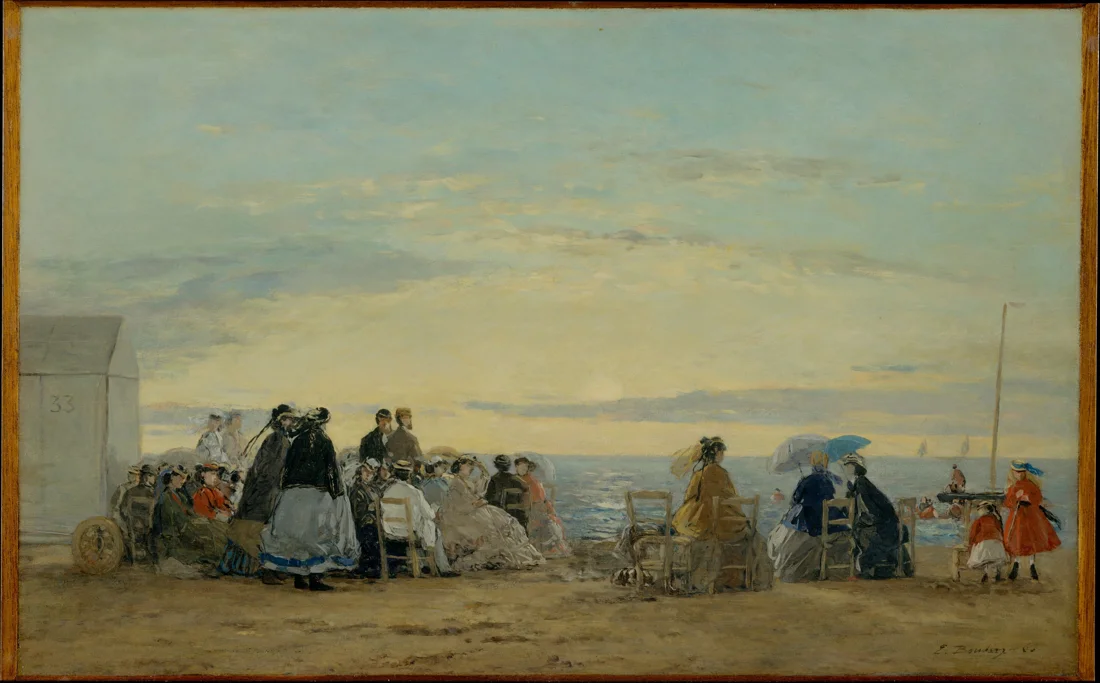
On the Beach, Sunset dates to 1865. The Metropolitan Museum connects Boudin’s command of light effects in this painting with his influence on Monet, noting that the two had worked together on the Normandy coast the previous summer. The work is oil on wood. Its date belongs to an ongoing relationship between the artists, several years after their first encounter.
Look at how the light organizes the scene before trying to make a complete inventory of its people. A sunset changes relationships between bright and dark areas, making atmosphere an active part of the subject. The people belong within those conditions rather than standing outside them as an unrelated addition. That is a useful question to carry into Monet’s different views of Sainte-Adresse: how much of the scene’s meaning comes from the light?
A later pastel catches another kind of beach moment
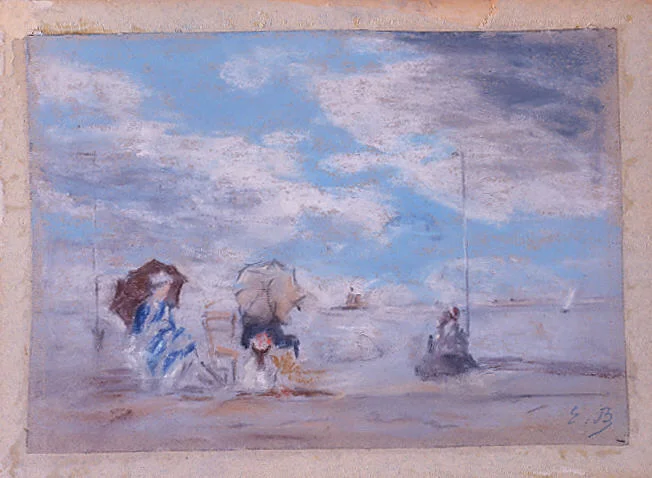
The smaller Beach Scene shown here is a pastel on gray paper mounted on card, dated by the Met to about 1882–83. It belongs to a later stage of Boudin’s work, not the first outdoor lesson of the teenage Monet. The museum emphasizes its lightly described figures and observation of natural effects. It suggests a connection with visits to Deauville and Trouville, while leaving that location as a probability rather than a certainty.
Compare the pastel with the earlier sunset without expecting them to make the same statement. Different materials can invite attention to different marks, textures, and degrees of detail. Notice how much information a small figure can carry without becoming a full portrait. A beach picture can register a social world and a passing atmosphere while leaving many individual identities unspecified.
Follow an influence without turning it into a formula
Learning to work outdoors did not give Monet a single recipe to repeat. The development of Impressionism in Monet’s Paris and his interest in Japanese prints introduce other parts of a much larger artistic life. The Giverny landmark guide places one later chapter in its own setting. Boudin’s contribution becomes more interesting when it opens that story rather than claiming to explain every painting that followed.
In Inside Claude Monet’s Giverny, a professional actor embodies the painter for a theatrical encounter with his world. Read what to expect from the experience format and consult the current experience page for its actual route. This article adds an earlier relationship to the story without promising an extra location or a particular work on display. Next time you look at a painted landscape, consider who first encouraged its maker to go outside and pay attention.
Discover an Immmersiv Experience
Explore Inside Claude Monet’s Giverny with a professional actor embodying Claude Monet. This article provides background for your curiosity. It does not promise stops or access beyond the published experience route. Consult the current experience page for its route and practical details.