Degas’s Little Dancer: Why Wax, Cloth, and Bronze Tell Different Stories
The dancer stands still, but the materials keep changing the way you read her. A skirt made from cloth behaves differently from a modeled leg, and a wax surface does not have the same presence as bronze. Degas’s Little Dancer brings those contrasts into one figure. Looking closely begins with a practical question that is easy to miss: which version of the sculpture are you actually seeing?
An unusual sculpture at the 1881 exhibition
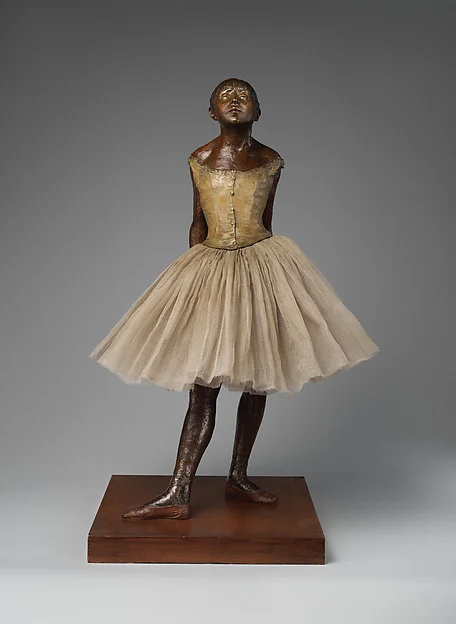
The National Gallery of Art dates its original Little Dancer Aged Fourteen to 1878–1881. Degas presented it at the sixth Impressionist exhibition in Paris in 1881, the only sculpture he publicly exhibited during his lifetime. The figure represented a student from the Paris Opera Ballet, modeled by Marie van Goethem. Wax, real clothing, and human hair gave the work a material presence very different from a conventional white marble figure.
The Gallery’s account records a hostile critical response to the sculpture’s realism. That reception is part of its history, but it need not dictate your own first look. Begin with the raised head, the arms extended behind the back, and the feet set at different angles. The body asks you to consider the effort of holding a pose even though no performance or theatrical scene is unfolding around it.
Look where fabric meets a modeled body
The skirt interrupts the outline of the legs and casts its own soft edge around the figure. Above it, the bodice follows the torso more closely, making another kind of transition between garment and body. In the wax photograph reproduced here, compare those edges with the surface of the face and hands. A sculpture assembled from different materials can ask for several kinds of looking within a single outline.
The National Gallery’s conservation research cautions that the sculpture’s exact appearance in 1881 is not fully documented. The history of its skirt is especially complicated, with evidence and debate about later changes. That makes it unwise to call every visible piece of cloth an untouched survivor from the original exhibition. What you see is a historical object with a later material history, not a perfectly preserved instant that needs no explanation.
A later bronze is not the wax original
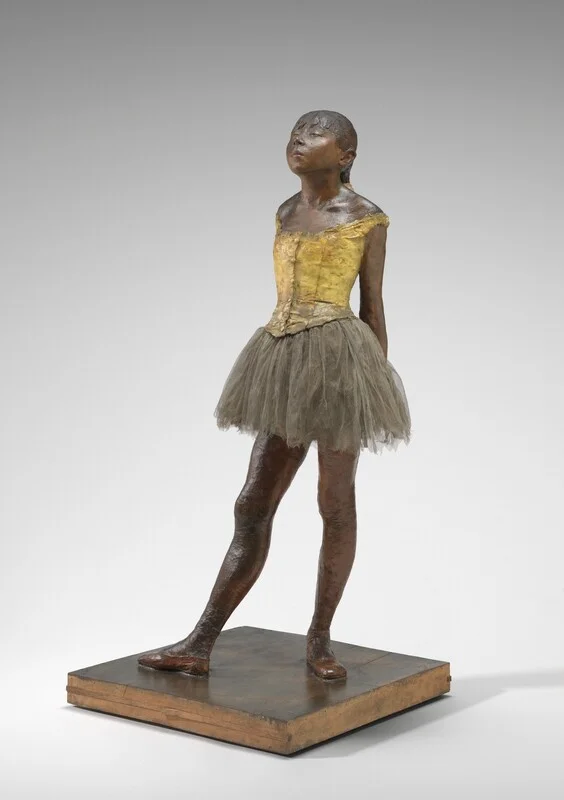
The Met’s version makes the distinction particularly clear. Its collection record gives the date as modeled in 1881 and cast in 1922, and explicitly identifies a modern tutu. The bronze was cast by A. A. Hébrard after Degas’s death in 1917. Those dates belong together on a label because the creation of a model and the manufacture of a particular cast are separate events.
Compare the two photographs without expecting the materials to disappear into one identical image. The bronze’s darker body and the changing light along its limbs give the pose another visual weight. The fabric still adds a texture that the cast metal cannot supply on its own. As with Rodin’s Balzac monument, distinguishing a model from a later public object helps a sculpture’s history become more precise rather than less engaging.
Keep a person behind the famous silhouette
A well-known outline can turn a particular subject into a decorative emblem. Remembering that the model was a young ballet student gives the work a more human starting point, without inventing her private thoughts or future. You can compare that attentive approach with Morisot’s family scene in The Cradle and with the artists who changed Paris. The aim is to ask what a work makes visible before attaching a ready-made story to the person it represents.
The Montmartre guide offers a wider artistic setting, while The Impressionists of Montmartre describes a character-led experience. Check what to expect for its actual format and practical framework. This background article does not add a museum stop or ballet performance to that route. Its invitation is smaller and portable: read the material and the date before deciding that two familiar dancers are the same object.
Discover an Immmersiv Experience
Explore The Impressionists of Montmartre with a professional actor embodying Père Tanguy. This article provides background for your curiosity. It does not promise stops or access beyond the published experience route. Consult the current experience page for its route and practical details.