Rodin’s Balzac in Montparnasse: The Monument Paris Had to Wait For
A writer stands above the boulevard, wrapped in a heavy garment with his head lifted away from the traffic. At first glance, the monument seems at home in a neighborhood associated with literature. Its path into the street, however, was anything but straightforward. Rodin’s Balzac in Montparnasse carries a story of a rejected commission, an unconventional portrait, and a long wait for a public place in Paris.
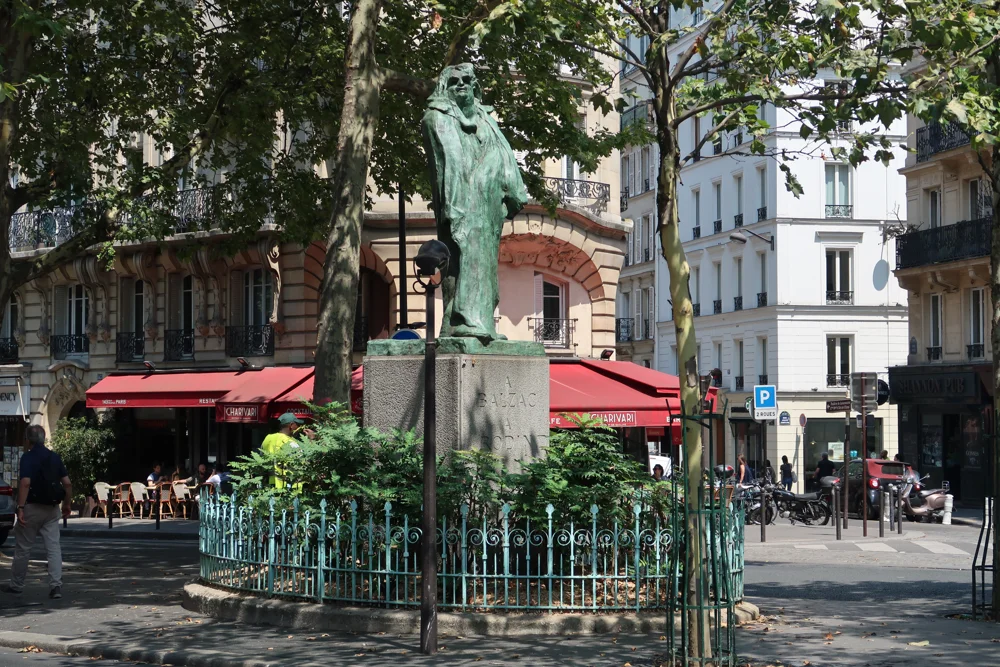
Begin with a commission, not a street corner
In 1891, the Société des Gens de Lettres commissioned Auguste Rodin to make a monument to Honoré de Balzac. The writer had died in 1850, so this was not a portrait made during sittings with the living subject. The Musée Rodin describes the sculptor’s search through images and living people with comparable features. Rodin also made numerous studies before reaching the final figure.
The Metropolitan Museum of Art holds one such study, a terracotta head dated 1891. Its collection record explains that Rodin sought models in Tours while exploring the author’s appearance. A preparatory head and the finished full-length monument answer different questions. The first helps us follow a working process, while the second asks how an entire public figure might embody a writer’s presence.
Look at the garment before searching for a pen
The final monument does not introduce Balzac through a desk covered with pages. A large enveloping garment gives the body a continuous mass, while the head becomes the most sharply distinct human feature. In the photograph, the folds and uneven surface catch light differently across the figure. Try looking at the silhouette before concentrating on the face.
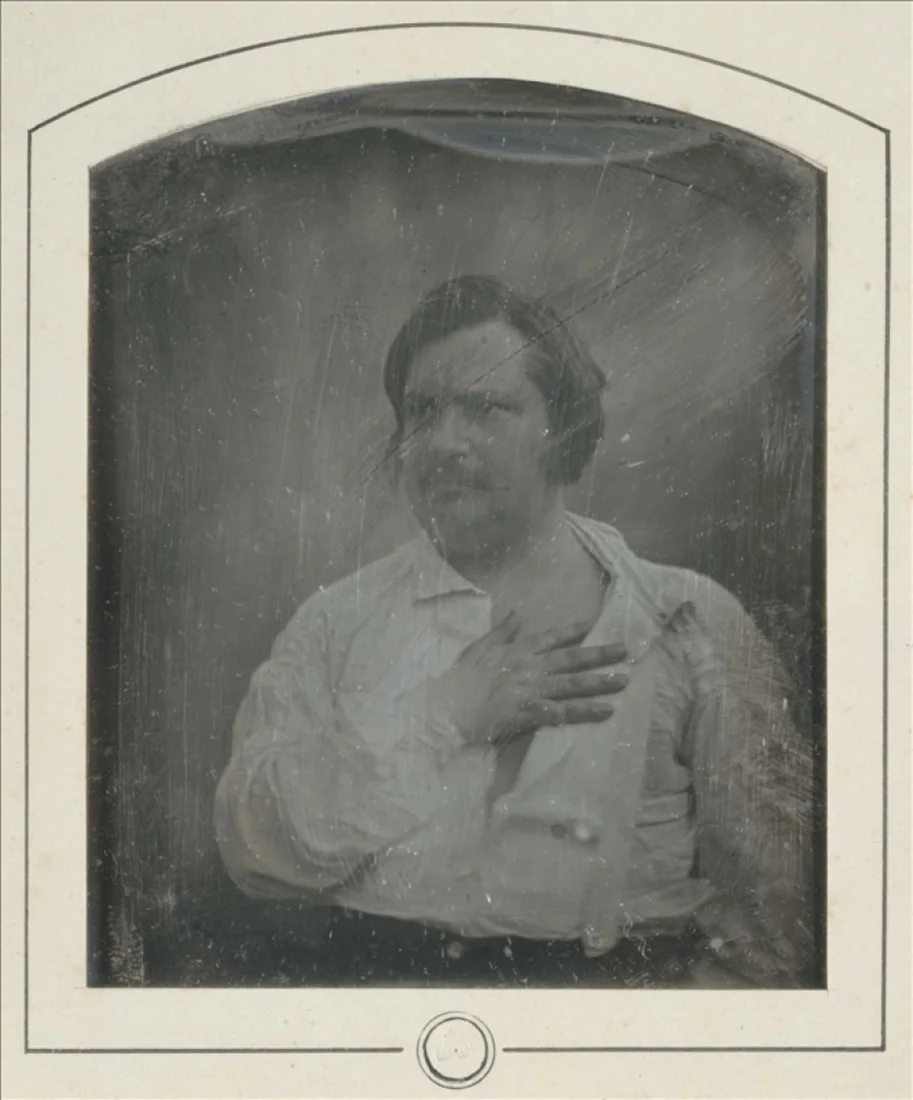
The Musée Rodin describes the final choice as Balzac in his dressing gown. Its interpretation emphasizes an attempt to convey the writer’s essence through the sculptural form. You can compare that approach with the reproduced daguerreotype attributed to Louis-Auguste Bisson and dated 1842. The photograph and the monument are different kinds of representation, and neither should be used as a simple substitute for the other.
Separate the rejection of 1898 from the installation of 1939
Rodin presented his final version at the Salon of the Société Nationale des Beaux-Arts in 1898. The commissioning society rejected it, and the plaster remained with the sculptor. The City of Paris records the controversy surrounding a work that departed from a conventional likeness. Its later familiarity in the street should not erase that difficult reception.
The Paris monument was finally installed in 1939 at the meeting of boulevards Raspail and Montparnasse. That date matters when imagining the neighborhood’s past. It should not be placed in a scene set during a writer’s early Paris years simply because the street names match. The same attention to different people and periods helps when following the two histories of Shakespeare and Company.
Let the monument add another layer to Montparnasse
Balzac’s figure offers a reason to pause within Montparnasse and ask how a city chooses to remember its writers. The subject belongs to the nineteenth century, the rejected model to its closing years, and the street installation to the twentieth. Those layers make the place richer than one single image of literary Paris. Continue with Hemingway’s Paris beyond the famous cafés to explore another strand of the neighborhood’s associations.
An outdoor monument can also complement a day of indoor collections, as discussed in visiting Paris museums without spending the whole vacation indoors. The Immmersiv Hemingway experience offers a professional actor’s interpretation within its published route. This article does not promise a stop at Balzac’s monument or a historical encounter between the writers. Consult what to expect from an Immmersiv experience and the current itinerary for practical details.
Discover an Immmersiv Experience
Explore Explore Hemingway’s Paris with a professional actor embodying Ernest Hemingway. This article provides background for your curiosity. It does not promise stops or access beyond the published experience route. Consult the current experience page for its route and practical details.