Caillebotte’s Rainy Paris: The Study behind the Famous Street
A couple approaches beneath an umbrella, and a broad Paris street opens around them. Caillebotte’s rainy Paris can feel like a scene you have just stepped into, with another pedestrian about to cross your path. Yet this apparently passing moment was carefully constructed. A smaller preparatory painting offers a particularly inviting way to discover the decisions behind the famous picture.
Start with the smaller painting in Paris
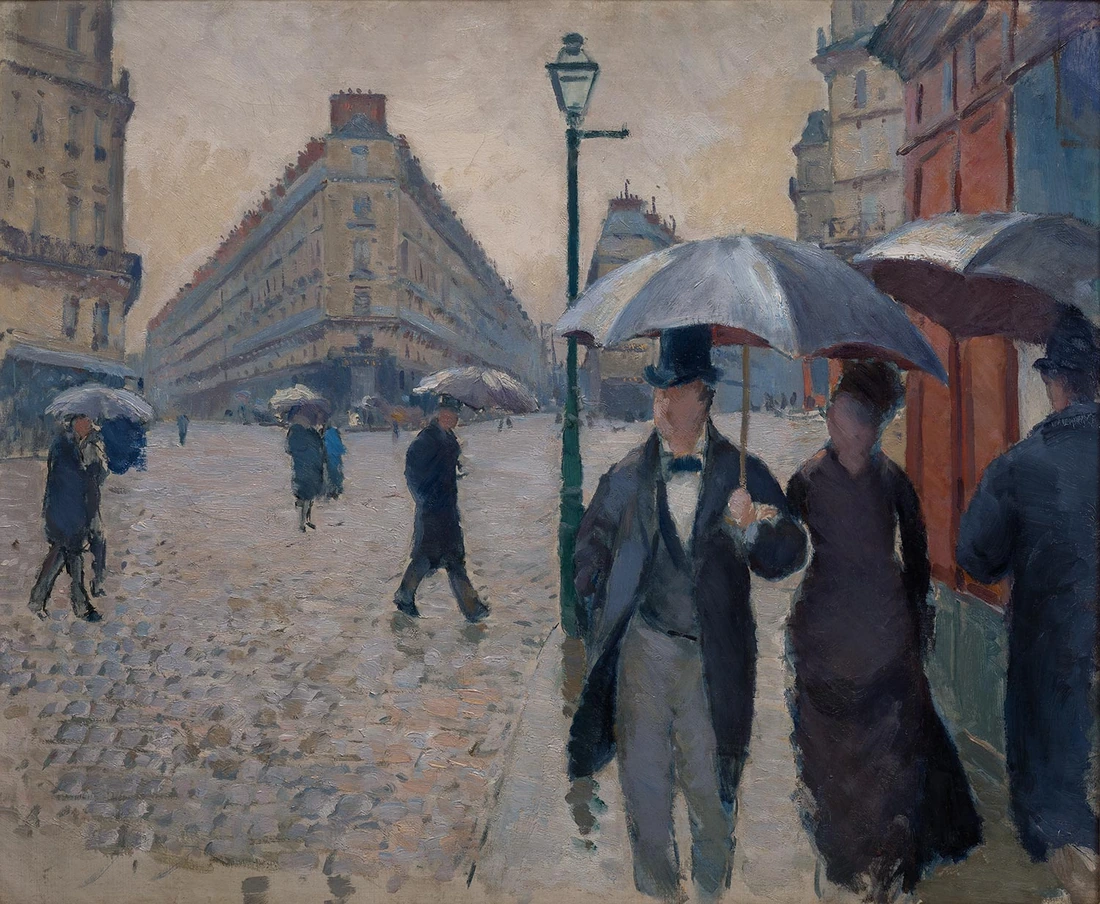
The work reproduced here is an oil study from 1877 in the Musée Marmottan Monet, measuring 54 by 65 centimeters. It prepares the much larger Paris Street; Rainy Day in the Art Institute of Chicago. The museum places the view at the meeting of rue de Turin and rue de Moscou, near place de l’Europe. Keeping the two canvases separate matters: this freely handled study is a work with its own surface, scale, and history.
Begin with the patches of gray and brown rather than expecting the crisp finish of the larger painting. The couple already occupies the right side, while smaller pedestrians recede into the distance. Edges soften and brushwork remains visible across the damp-looking street. You can enjoy the study as a painting while also asking how its arrangement prepares a more expansive scene.
Follow the street toward the distance
A lamppost divides the composition, giving your eye a fixed upright against the spreading streets. Building fronts and paving lead away from you along different diagonals. The open space can seem as important as the pedestrians themselves. Try covering one side of the reproduction with your hand, then uncovering it, to notice how the two halves balance each other.
This spacious intersection belongs to the changing city explored in Haussmann’s reconstruction of Paris. The Marmottan connects the study with the residential districts created during that transformation. Caillebotte makes the new setting something you experience through distances between people and buildings. Compare that outward movement with the floorboard lines in his Floor Scrapers, where the viewpoint brings you close to indoor labor.
An ordinary afternoon becomes an exhibition picture
The finished Paris Street; Rainy Day appeared at the third Impressionist exhibition in April 1877. The Art Institute’s account emphasizes the contrast between an ordinary modern subject and the artist’s deliberate organization of it. An apparently casual encounter can therefore carry the structure of a carefully arranged scene. You need not choose between enjoying the illusion of a passing moment and noticing the work that makes it convincing.
Caillebotte also helped fund and organize that exhibition, according to the Art Institute. His connection with the group involved practical support as well as the paintings he showed. The Marmottan records another connection: he gave this oil study to Monet, who still kept it in his bedroom at the end of his life. An image of strangers in a street thus also preserves a quieter story of friendship between painters.
Carry the painter’s questions into your Paris day
Our article on Monet’s Gare Saint-Lazare paintings follows another artist looking at the modern city. Compare the railway’s steam with Caillebotte’s broad spaces, then ask how each changes your sense of movement. The point is to sharpen your attention rather than search for a single recipe called Impressionism. Even a familiar Paris scene becomes less predictable when you notice where a painter has chosen to place you.
The Montmartre guide opens another chapter in the artistic city, away from this painted intersection. Immmersiv’s Impressionists of Montmartre experience approaches that world through Père Tanguy, embodied by a professional actor. The experience format explains how the encounter unfolds. Take one question with you from the study: what can an artist make you feel simply by changing the space between two people?
Discover an Immmersiv Experience
Explore The Impressionists of Montmartre with a professional actor embodying Père Tanguy. This article provides background for your curiosity. It does not promise stops or access beyond the published experience route. Consult the current experience page for its route and practical details.