Caillebotte’s Floor Scrapers: The Work beneath Elegant Paris
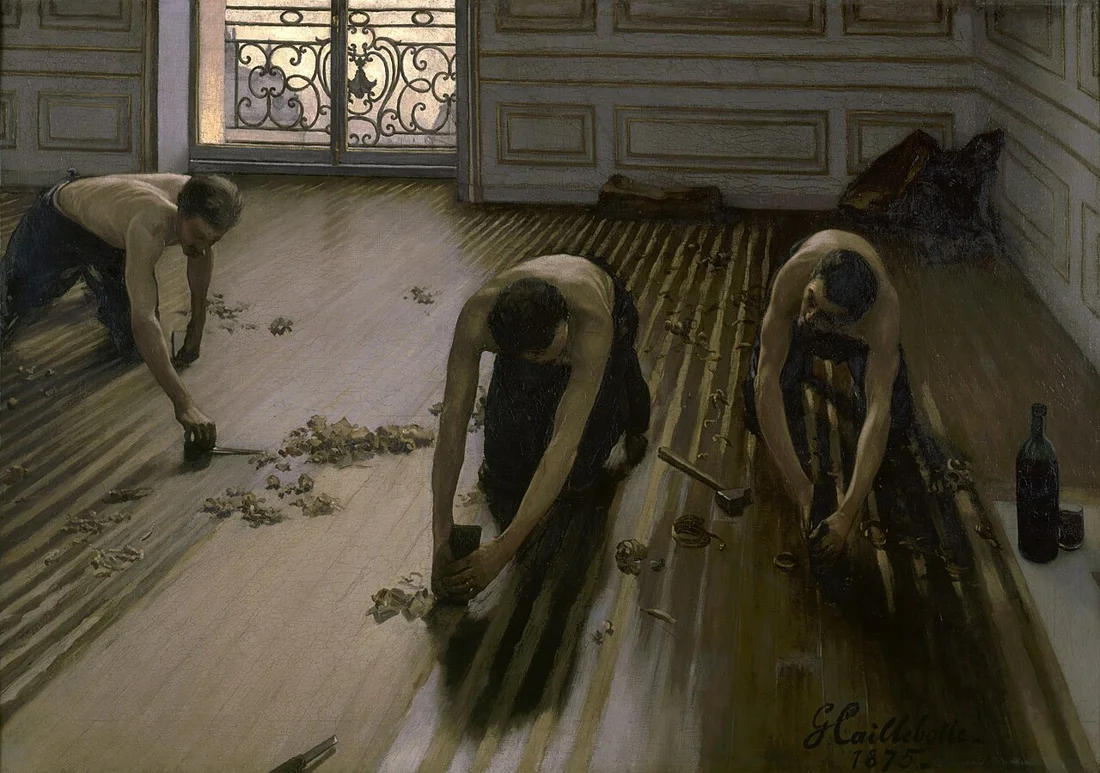
A polished Paris interior begins with somebody doing the work. Gustave Caillebotte’s Floor Scrapers directs your attention toward three men close to the ground, surrounded by boards and curls of wood. The room is impressive, but the workers hold the center of the story. This is a useful painting for travelers who want to look beyond elegant façades and consider how a modern city was made and maintained.
Begin at floor level in a painting from 1875
The Musée d’Orsay dates Les Raboteurs de parquet to 1875. The title identifies a skilled manual task: scraping a wooden floor rather than simply sweeping a finished room. Follow the workers’ bent backs down toward their hands, then notice the pale shavings gathered on the boards. These details make the surface beneath them an active place of labor rather than a neutral background for a portrait.
The museum identifies the painting as an early representation of urban workers within this period’s art. Its account also records the rejection of the canvas by the Salon jury in 1875 and its appearance at the second Impressionist exhibition in 1876. The sequence matters because it places this carefully constructed interior inside a changing exhibition culture. It does not require us to invent what any individual juror said or what the workers themselves thought of the picture.
Let the boards lead your eye through the room
The floorboards create strong lines that draw your gaze away from the foreground. The viewpoint gives you a broad area of floor before your attention reaches the window at the far end. Look at the contrast between that firm geometry and the curves of shoulders, arms, and wood shavings. The composition feels spacious because those different shapes give the eye several ways to move through the same room.
Pause over the men’s different positions instead of turning them into a single symbol of work. One figure leans toward another, while the arrangement of their hands makes the task feel specific and repeated. You can describe what is visible without assigning names, wages, or a conversation that the painting cannot supply. That restraint leaves more room to notice how much a gesture can communicate before a historian adds an explanation.
Compare an interior with a modern street
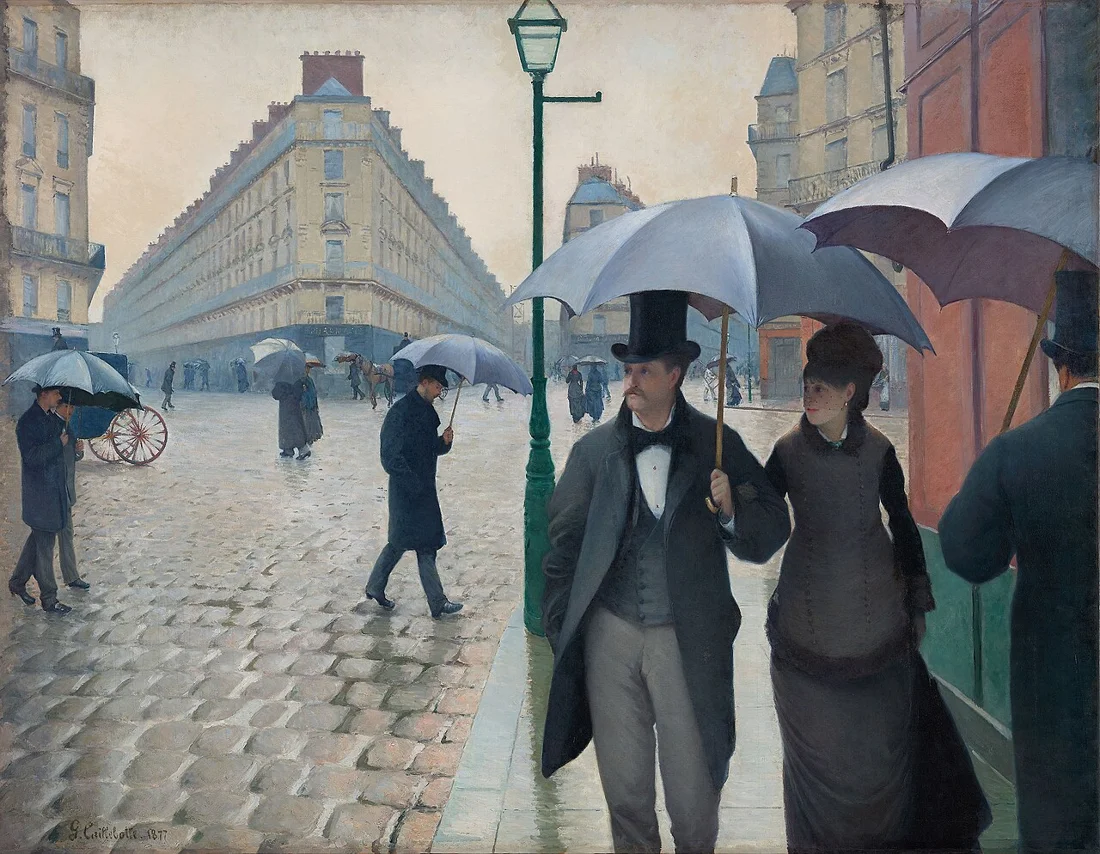
Caillebotte’s Paris Street, Rainy Day of 1877 offers a useful comparison. The Art Institute of Chicago’s account connects that painting with the city’s broad new streets and the third Impressionist exhibition. In the reproduction, umbrellas, paving stones, and building fronts organize the space around passing pedestrians. Both pictures ask you to follow designed lines through a modern setting, although the floor workers and the street crowd occupy very different kinds of space.
The wider setting is explored in the story of Haussmann’s modern Paris. Another angle appears in Monet’s paintings of Gare Saint-Lazare, where steam and rail infrastructure become subjects for painting. These connections help place the room among other ways artists looked at contemporary life. They do not turn three different paintings into interchangeable illustrations of a single, uniform Impressionist style.
Bring a question about work into an art-led Paris day
You might pair this picture with Berthe Morisot’s The Cradle and ask who receives sustained attention in each interior. A worker’s bent arm and a mother’s attentive gaze need very different explanations, yet both reward time spent with an ordinary gesture. The Montmartre landmark guide offers another setting for exploring the artistic city. It does not identify this painted room or promise that the canvas belongs to a particular walking route.
The published Impressionists of Montmartre experience uses a character-led approach to the artists’ world. This article is background for that curiosity, rather than a claim that Caillebotte’s workers appear in the experience. Read what to expect for the practical format. Wherever you encounter the reproduction, start with the hands and the boards before letting a movement’s familiar name decide what you see.
Discover an Immmersiv Experience
Explore The Impressionists of Montmartre with a professional actor embodying Père Tanguy. This article provides background for your curiosity. It does not promise stops or access beyond the published experience route. Consult the current experience page for its route and practical details.