Aître Saint-Maclou: Reading Rouen’s Carved Cemetery Galleries
A quiet courtyard in Rouen carries a history that is easy to miss at first glance. Look more closely at the galleries of the Aître Saint-Maclou and decorative forms become reminders of bones, burial, and mortality. The buildings did a practical job as well as carrying a religious message. Their story also leads somewhere less expected: into classrooms and the everyday life of generations of students.
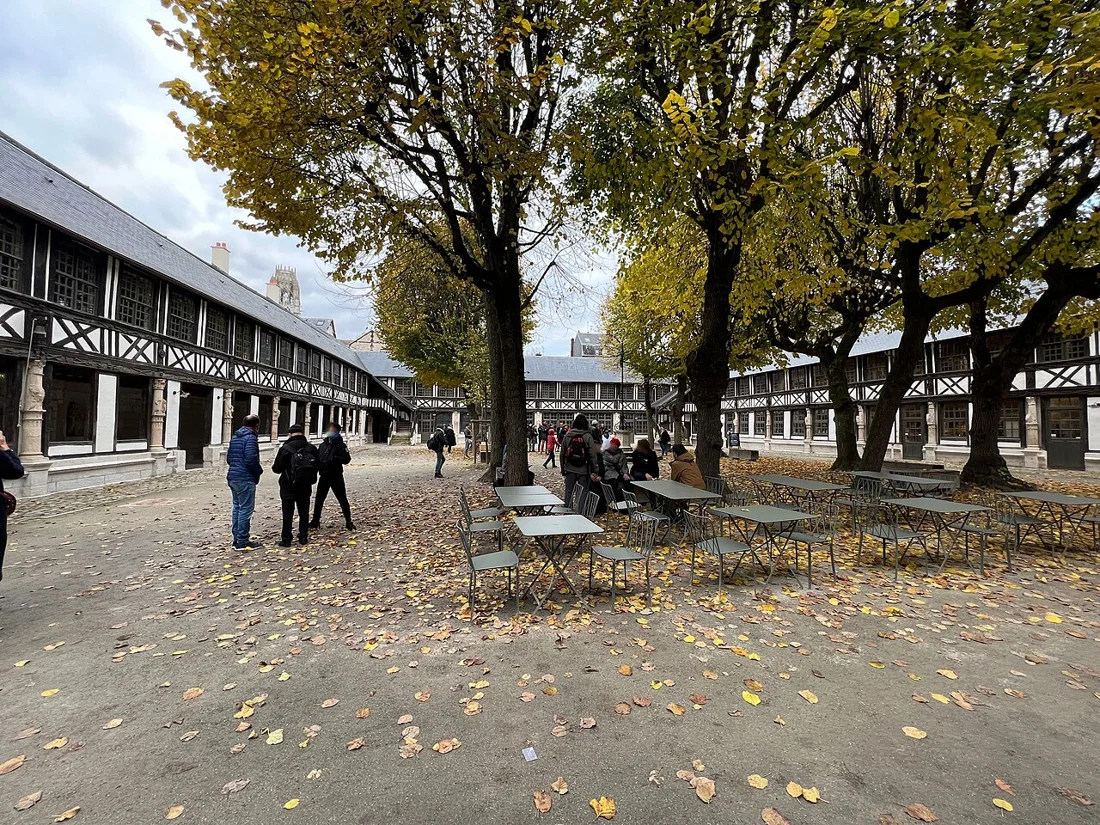
A cemetery came before the familiar galleries
The city of Rouen traces the cemetery’s origins to the Black Death of 1348. The site’s own historical account explains how the parish’s earlier burial ground became insufficient during a period of heavy mortality. A new cemetery was established in the middle of the fourteenth century. The galleries that now give the courtyard its distinctive appearance belong to a later stage of the story.
That gap matters when looking at an old city. The age of a place’s first use does not automatically date every building around it. Rouen’s account places three ossuary galleries between 1526 and 1533. Keep that distinction in mind beside the history behind the name of Joan of Arc’s tower, where a familiar label can also conceal a more complicated chronology.
The architecture made room for remembrance
The parish decided to construct three galleries in 1526. According to the monument’s history, older bones were removed from the burial ground and placed in the upper spaces to make room for further burials. An ossuary is a place for keeping human bones. Understanding that function changes the galleries from a picturesque frame around an empty court into part of the organization of a crowded parish cemetery.
The building’s history still contains uncertainties, and the official account acknowledges unanswered archaeological questions about its early appearance and access to the upper spaces. An attractive reconstruction should therefore be read as a proposal rather than a surviving photograph of the sixteenth century. What the galleries preserve is already enough to prompt careful looking. Form, decoration, and practical use belong together, even when every detail of their original operation cannot be recovered.
Carved figures make mortality a shared story
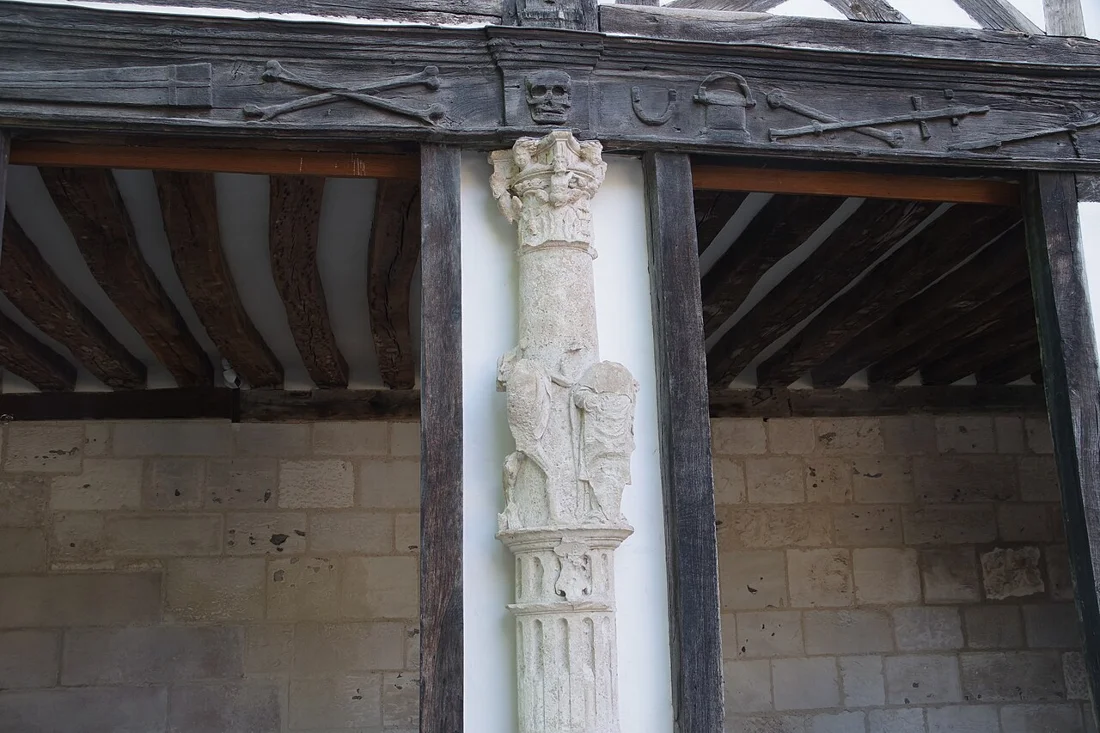
The stone columns carry a danse macabre, a dance of death in which living figures encounter the dead. The monument’s interpretation identifies secular ranks on the west gallery and church figures on the east. Its explanation places the imagery within a Christian message about mortality and judgment. Social position might distinguish the figures in life, but it did not remove them from that shared human horizon.
The wooden structure carries a related vocabulary of carved bones and implements associated with burials. Look for how an individual detail belongs within the larger setting rather than treating every shape as an isolated mystery. Reading the Gros-Horloge’s symbols offers another way to practice that patient approach in Rouen. Both settings reward attention to what images meant within a particular use and historical culture.
A place of burial also became a place of learning
A fourth wing closed the southern side of the court in 1652, and a school for poor boys of the parish opened in 1661. The site’s history explains that schooling and burial continued alongside one another for more than a century. The cemetery closed in 1790, and much later the Rouen art school occupied the site from 1940 until 2014. These changes give the courtyard several histories rather than one permanent identity.
The Rouen landmark guide and the two proceedings in Joan of Arc’s story help place different chapters of the city beside one another. Immmersiv’s Joan of Arc experience in Rouen uses a professional actor to embody the historical character. Read what to expect from the format and consult its published route; this article does not add the Aître as a promised stop. Joan’s fifteenth-century story precedes the carved galleries, an important distinction to carry through a city where several centuries can share a short stretch of street.
Discover an Immmersiv Experience
Explore Joan of Arc: A False Trial or Truly Guilty? with a professional actor embodying Joan of Arc. This article provides background for your curiosity. It does not promise stops or access beyond the published experience route. Consult the current experience page for its route and practical details.