Van Gogh’s Doctor Gachet: From Painted Portrait to Etched Line
The man leaning on his hand in Van Gogh’s Doctor Gachet seems absorbed in a thought we cannot hear. His expression invites attention before we even know his name. Paul-Ferdinand Gachet was the physician associated with Van Gogh’s final stay in Auvers-sur-Oise, but medicine was only one part of their connection. Set a painted portrait beside an etched one, and another relationship emerges: two people brought together by the making of art.
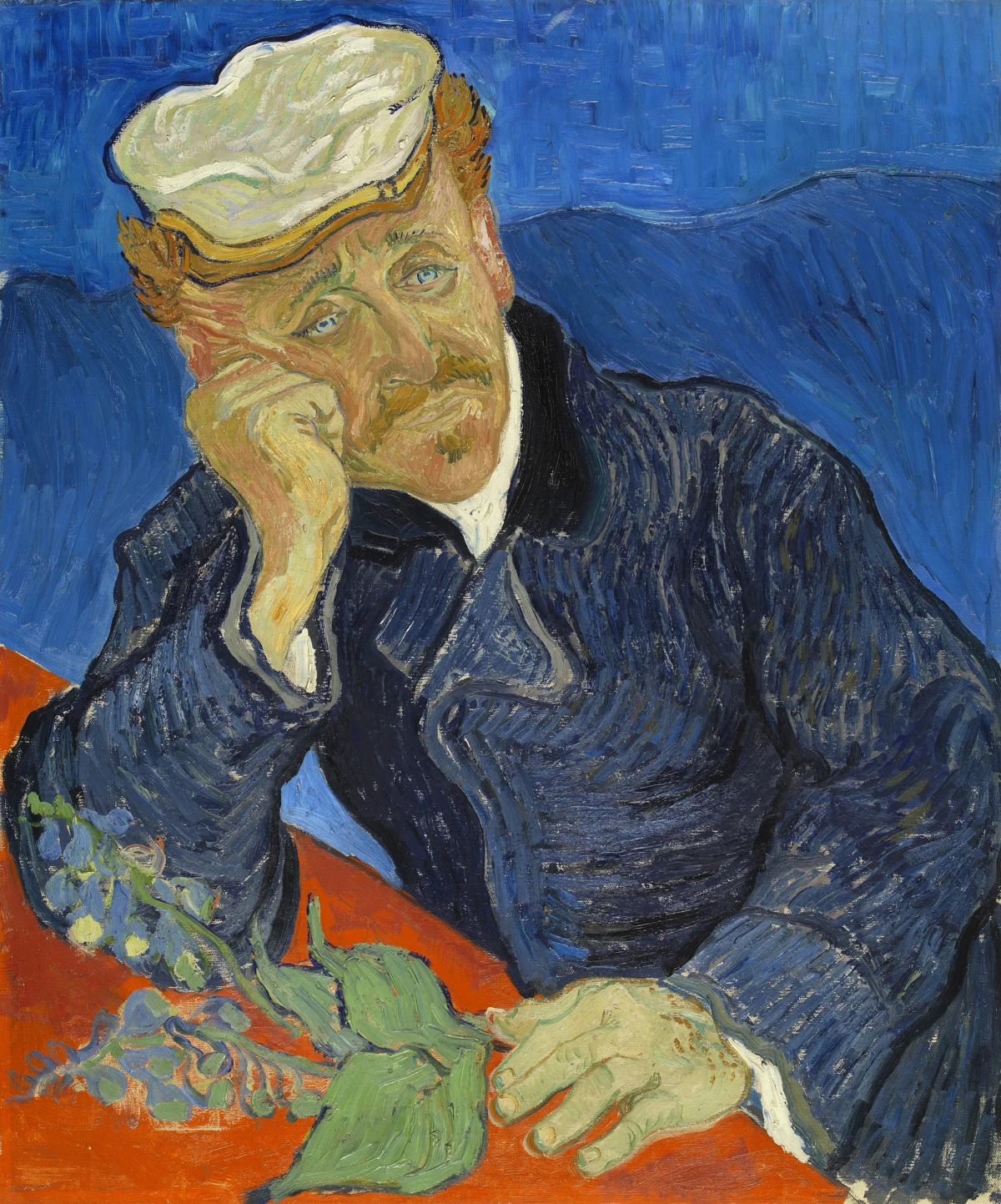
Meet a doctor who also made prints
Van Gogh moved from Saint-Rémy to Auvers-sur-Oise in May 1890. Gachet, who cared for him there, was also a collector and an amateur artist. He made etchings under the name Van Ryssel and had a printing press at home. This practical involvement with pictures helps explain why he became both a subject for Van Gogh and a partner in a new artistic experiment.
A painter’s circle can include people who supply materials, encouragement, or a place to work. That is one reason the story of Père Tanguy’s paint shop and portrait belongs beside this one. The relationships are different, but each turns attention toward the people around the artist. Gachet’s press gives that broader idea a particularly tangible form: a machine in a house could open a new artistic possibility.
Look carefully at the painted portrait
Van Gogh painted Gachet twice in oil, and the version reproduced here belongs to the Musée d’Orsay. Dated 1890, it entered the French national collections through a gift from Paul and Marguerite Gachet in 1949. The doctor rests his head against his hand, with a sprig of foxglove nearby. The museum interprets the pose as melancholy and the plant as a reference to its medicinal associations.
Notice how the leaning body, repeated blues, and downward movement of the face work together. You can describe what the painter placed on the canvas before deciding what emotion it suggests to you. A portrait can convey a mood without supplying a complete medical or personal history. Comparing this approach with Van Gogh’s Church at Auvers also shows how differently a person and a familiar building can be transformed into a painted image.
A different portrait emerged from copper and ink
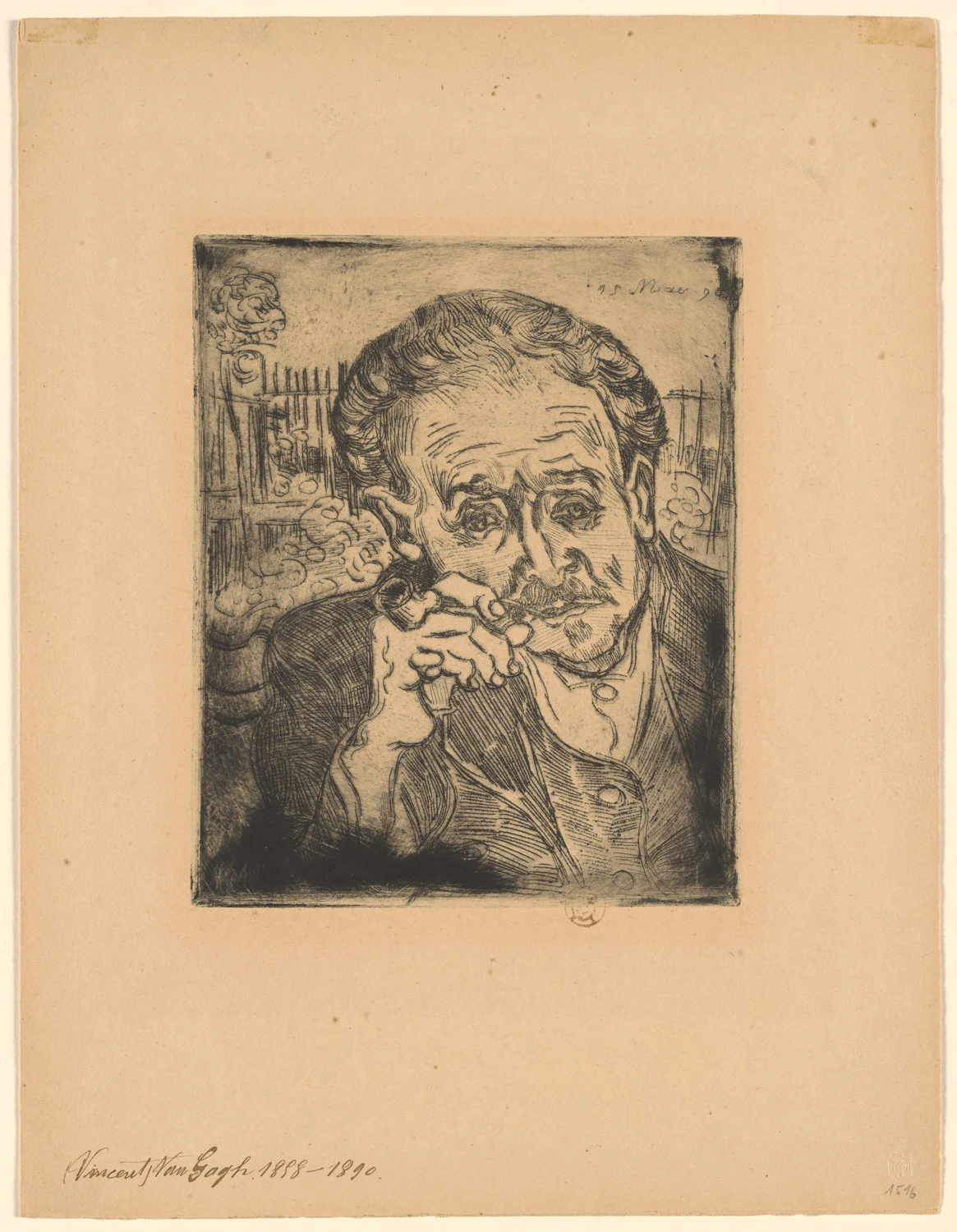
At Gachet’s house, Van Gogh made the only etching of his career. The doctor provided a plate and needle, as well as access to his press. The resulting portrait is commonly called Man with a Pipe, and the Met’s impression identifies Gachet as its printer. This is another artwork, with its own composition and materials, rather than a small photographic reproduction of the oil painting.
In the printed portrait, dark lines and the white of the paper replace the painted portrait’s broad areas of color. Look at the head, the pipe, and the accumulation of marks around them. The INHA’s account connects the print with correspondence about Gachet’s press and Van Gogh’s hopes of making further etchings. The possibility of producing impressions gave the artist a different way to think about how an image might circulate beyond a single painted canvas.
Carry the comparison into an Auvers visit
An artwork’s collection record can separate several roles that are easily folded into one famous name. Here the painter made the image, the sitter provided its subject, and the printer helped bring an impression into being. Gachet occupied more than one of those roles. The wider story of artists who changed Paris becomes richer when you leave room for the relationships and technical work behind celebrated pictures.
For an encounter with the artist’s story in the village, explore Van Gogh’s last days in Auvers-sur-Oise. Keep the documented artworks distinct from the theatrical interpretation offered by a professional actor. Our guide to the experience format explains that approach, while Montmartre’s cultural setting offers a separate Paris chapter for a wider itinerary. Let the painted face and the etched lines remain two different invitations to look, rather than illustrations that can be exchanged without changing the story.
Discover an Immmersiv Experience
Explore Van Gogh’s last days in Auvers-sur-Oise with a professional actor embodying Vincent van Gogh. This article provides background for your curiosity. It does not promise stops or access beyond the published experience route. Consult the current experience page for its route and practical details.