Renoir’s Moulin de la Galette: Finding Your Way through the Crowd
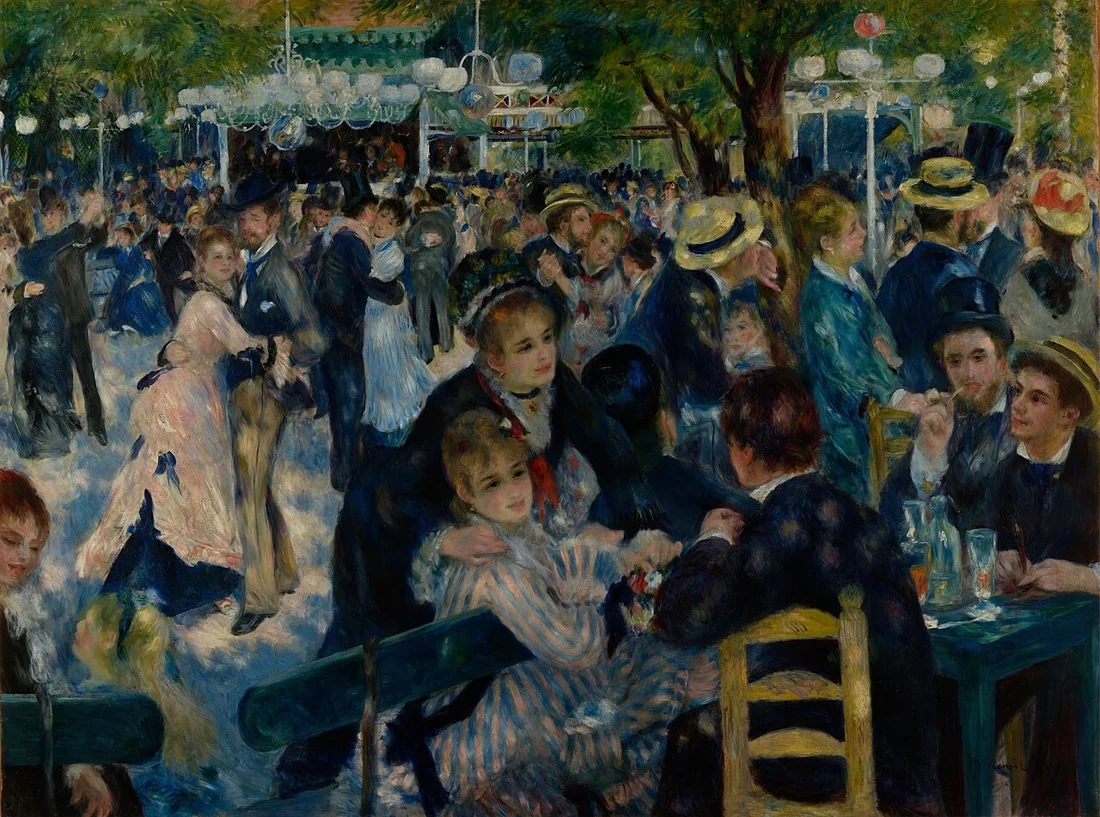
A crowded painting can make you feel that you have arrived halfway through a conversation. Renoir’s Moulin de la Galette gives that sensation a whole dance garden to inhabit. Some people sit at a table, others turn toward companions, and a dancing crowd opens behind them. Instead of trying to recognize everyone at once, begin with one face and follow the small connections that carry you farther into the scene.
Enter a Montmartre dance garden in 1876
The Musée d’Orsay dates Bal du moulin de la Galette to 1876 and records its appearance at the Impressionist exhibition of 1877. The subject is a popular dance garden on the Butte Montmartre, with some of Renoir’s friends among the figures. That setting gives the picture a particular social geography. It is a painted gathering in a named neighborhood, rather than a timeless costume party detached from the city around it.
The foreground table gives you a place to begin. Notice the figures who sit close enough to talk, then follow a turned head toward someone just beyond the table. Farther back, the dancing couples create smaller groups within the larger crowd. The picture offers several possible paths through these encounters, so your first impression of bustle gradually becomes a series of more intimate arrangements.
Watch light cross clothing and faces
The patches of pale color on jackets and dresses do more than describe their fabric. They connect surfaces that might otherwise seem separate, carrying a flickering rhythm across the people in front of you. Follow a bright patch on a shoulder toward another on the ground or a hat. This is a simple looking exercise that lets the handling of paint become as noticeable as the recognizable dancers.
The museum’s account emphasizes the combination of a moving crowd and light in the dance garden. A reproduction cannot give you the scale or physical surface of the original canvas, but it can still show how hard edges give way to softer passages. Try looking first at one figure, then at the whole image from a little farther away. The shift can reveal how an individual person also becomes part of a larger arrangement of color.
A quieter comparison: The Swing
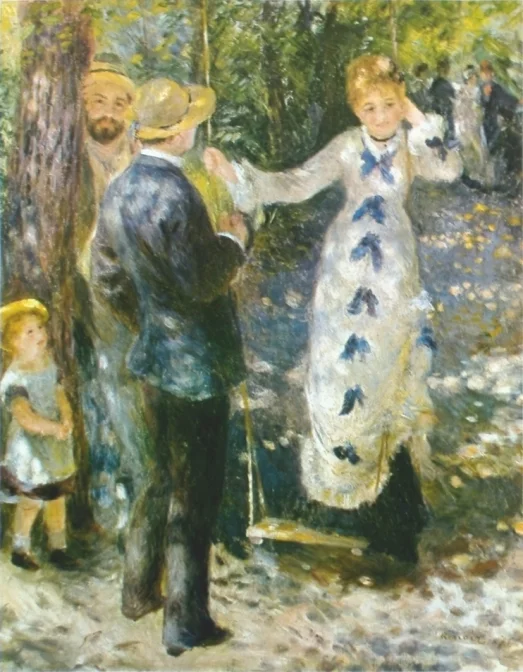
Renoir painted The Swing during the same summer of 1876, according to the Musée d’Orsay. Its smaller gathering exchanges the dance garden’s crowd for a conversation beneath trees. The museum identifies the woman as Jeanne, a young Montmartre resident, and also names Renoir’s brother Edmond and the painter Norbert Goeneutte among the models. Several of those people also appear in the larger dance scene, linking the two paintings through more than a shared season.
Look at the pale dress and its scattered marks of sunlight, then compare them with the bright interruptions across the dancers’ clothing. In The Swing, the upright ropes and tree give a quieter structure to the exchange of looks. In the Moulin de la Galette, relationships spread across a much wider field. The comparison lets you notice a related visual problem without treating the second picture as merely a smaller copy of the first.
Take the neighborhood beyond a familiar postcard
The neighborhood behind the painting has many histories, explored in the hidden history of Montmartre. You can also follow Père Tanguy’s paint shop for a different kind of meeting place, or Morisot’s The Cradle for another scale of human attention. These stories give you useful comparisons rather than a checklist of identical attractions. The Montmartre landmark guide can help connect that curiosity with the place.
For a character-led introduction, consult The Impressionists of Montmartre and its published route. The experience format guide explains how the encounter works before you make plans. This article does not establish access to a dance garden or guarantee that the original paintings are on display during your visit. What you can bring anywhere is the habit of entering a crowded image through one small conversation.
Discover an Immmersiv Experience
Explore The Impressionists of Montmartre with a professional actor embodying Père Tanguy. This article provides background for your curiosity. It does not promise stops or access beyond the published experience route. Consult the current experience page for its route and practical details.