Josephine Baker’s Resistance Work: From Public Fame to Secret Intelligence
A famous performer can be easy to recognize and difficult to see in full. Josephine Baker’s Resistance work belongs to a history that began before German troops occupied Paris. Her public career opened doors, while her wartime commitments required activities that were not meant for an audience. Following the dates helps connect those different roles without reducing a complex life to a glamorous spy legend.
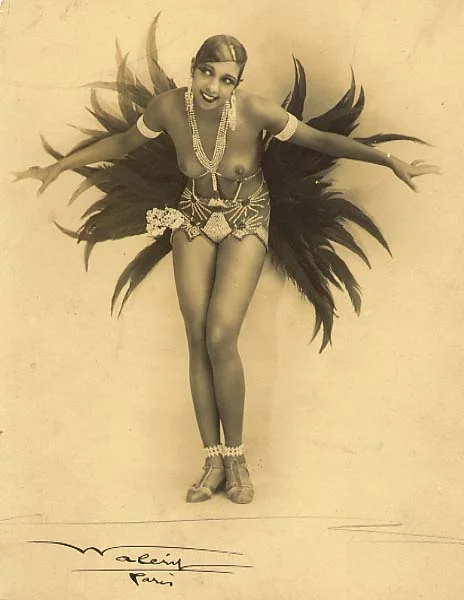
Begin in 1939, rather than after the fall of Paris
The Musée de la Résistance en ligne places Baker’s recruitment in September 1939. Through an introduction to Captain Jacques Abtey of the French army’s Deuxième Bureau, she began working in intelligence at the opening of the war. The Ordre de la Libération likewise records her service to French counterintelligence from 1939. This matters because the beginning of that work preceded both the occupation of Paris and the later development of the Free French movement.
Her international celebrity allowed her to attend social occasions where useful information might circulate. That practical advantage connected a public profession with a discreet wartime task. It should not make us imagine that every performance was a secret mission or that every guest was an informant. The 1927 photograph reproduced here documents her earlier stage persona; it is not an image of intelligence gathering, wartime travel, or military service.
A touring career could provide a cover
The museum’s account describes Baker leaving occupied Paris and later traveling by way of Spain and Portugal to North Africa. Abtey worked under an assumed identity as her assistant. The same account describes intelligence carried in coded or invisible-ink writing on musical scores. Those details help explain how the ordinary paperwork of an artist’s profession could serve another purpose without requiring an invented scene at a particular border or hotel.
A musical score is a useful reminder to look at what an object was expected to be. For a traveling performer, carrying music would not in itself be surprising. For a historian, however, the existence of that method does not identify the contents of every message or the outcome of every journey. Holding those limits in mind leaves the documented work impressive without supplying conversations, close escapes, or individual secrets that the sources do not provide.
Read military service and later honors on their own dates
Baker’s wartime contribution also included concerts and fundraising for French forces. The Ordre de la Libération records her engagement in the Formations féminines de l’Air in May 1944 and her demobilization in September 1945. These are different stages from the intelligence work begun in 1939. Reading them in sequence avoids making a later uniform stand in for every earlier form of service.
The institution records the award of the French Resistance Medal with rosette by decree of October 5, 1946. The Archives nationales distinguish her1957 appointment as a knight of the Legion of Honor from the1961 presentation of its insignia. An award date, a ceremony, and the actions being recognized can therefore belong to different years. That is a valuable habit when reading a memorial plaque: recognition is evidence of remembrance, not a substitute for the chronology of the work itself.
Carry that chronology into a Paris encounter
Our account of Baker’s Panthéon tribute examines a later national act of remembrance, while Josephine Baker’s Paris offers a wider introduction. The context of Paris during World War II helps place her choices alongside the city’s wartime history. The Opéra landmark guide introduces the setting associated with the Immmersiv encounter. None of these locations should be treated as proof that a particular clandestine event happened at every stop.
The published Josephine Baker’s Paris and the Occupation experience introduces the story through a professional actor. Read what to expect from the theatrical format for its practical framework. The historical record provides context, while the experience page defines the actual route and encounter. A useful question to bring is how an artist’s visibility could create opportunities for work that, by its nature, had to remain unseen.
Discover an Immmersiv Experience
Explore Josephine Baker’s Paris & the Occupation with a professional actor embodying Josephine Baker. This article provides background for your curiosity. It does not promise stops or access beyond the published experience route. Consult the current experience page for its route and practical details.