The Diamond Necklace Affair: How a Fraud Damaged Marie-Antoinette
A spectacular necklace can dominate a story even when the queen never bought it. The Diamond Necklace Affair turned a private fraud into a public scandal in the years before the French Revolution. Marie-Antoinette was its famous target, rather than its secret customer. Following the surviving evidence reveals how imagined access to a powerful person could become disastrously persuasive.
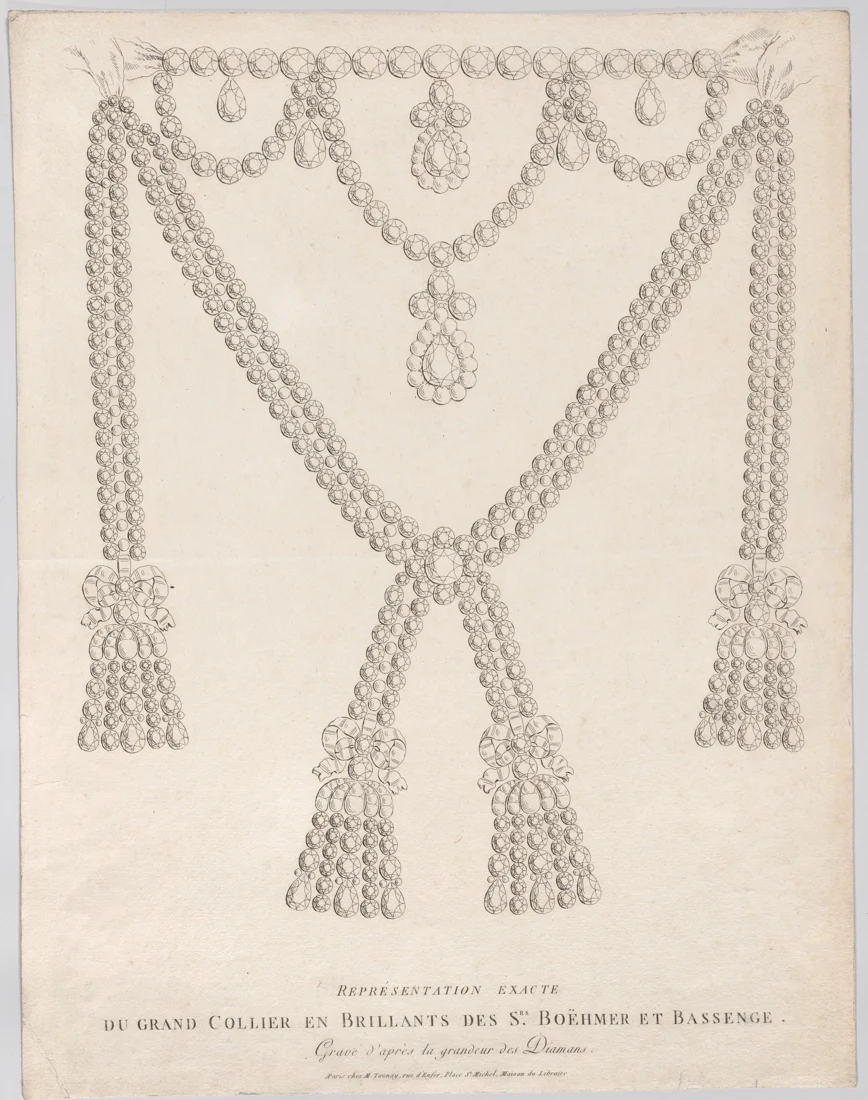
A royal name made an impossible sale seem possible
The jewelers Böhmer and Bassenge had an expensive necklace they could not sell. According to the Metropolitan Museum’s account, the piece originated in a commission intended for Madame du Barry under Louis XV. After the king’s death, they offered it to Marie-Antoinette, who declined it. The later fraud depended on persuading them that the queen had changed her mind.
An eighteenth-century print now at the Met shows the necklace as an elaborate arrangement of linked ornaments and hanging strands. Let your eye follow its symmetry before thinking about its price. This is a representation of the historic jewel, not a photograph of an intact necklace surviving today. The museum explains that later reconstructions have drawn on this print, which makes its status as evidence especially important.
A meeting in the shadows supplied the illusion
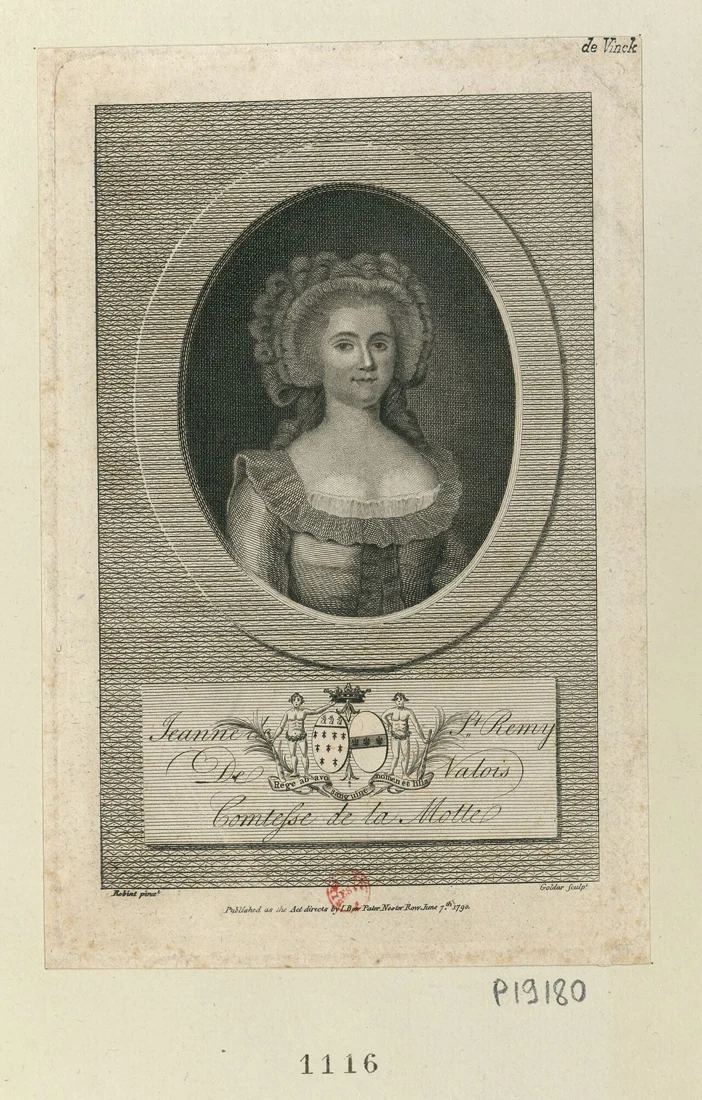
Cardinal de Rohan wanted to recover the queen’s favor. Jeanne de La Motte claimed that she could help him through her supposed connection with Marie-Antoinette. Versailles dates a staged nighttime meeting in the Queen’s Grove to August 11, 1784. The woman Rohan took to be the queen was an impersonator, and the reassurance he received was part of the deception.
The cardinal later acted as intermediary in the necklace’s purchase. On February 1, 1785, the jewelers delivered it to him, and it passed to La Motte. Their expectation of royal payment did not mean the queen had authorized the transaction. That difference adds a concrete episode to Marie-Antoinette’s broader biography, where reputation and documented action must be considered separately.
Read the claim as carefully as the object
A 1786 memorandum reproduced by George Mason University’s history project presents the jewelers’ side of the affair. The editors describe it as supposedly written by them, a qualification worth retaining. Its account follows meetings, proposals, assurances, and the wait for payment. It shows how people described their dealings afterward, rather than providing a neutral transcript of everything that happened.
The queen’s ignorance of the purchase became clear when the missing payment was pursued. Rohan was arrested at Versailles in August 1785; the Parlement de Paris acquitted him the following year. The scandal nevertheless damaged Marie-Antoinette’s public image. Compare that hostile public story with the family image constructed in a royal portrait, and you begin to see how many competing versions of one person could circulate.
Bring better questions to Versailles
The affair makes Versailles more interesting without requiring an invented secret passage or a recovered jewel. Ask who claimed to speak for the queen, who believed the claim, and which surviving object supports each part of the story. Those questions are useful for younger travelers as well as adults. They also complement the quieter evidence of the queen’s library, where ownership and personal preference are not automatically the same thing.
For a character-centered continuation, Marie Antoinette, Rebel Queen presents the historical figure through a professional actor. The necklace episode is context for your curiosity, not a promised scene, interior visit, or included grove stop. The experience overview explains the theatrical format. Keep the print, the memorandum, and the later interpretation distinct, and an extravagant object becomes a lesson in how a story gains authority.
Discover an Immmersiv Experience
Explore Marie Antoinette, Rebel Queen with a professional actor embodying Marie-Antoinette. This article provides background for your curiosity. It does not promise stops or access beyond the published experience route. Consult the current experience page for its route and practical details.