Napoleon’s Coronation as a Public Spectacle: Look into Boilly’s Crowd
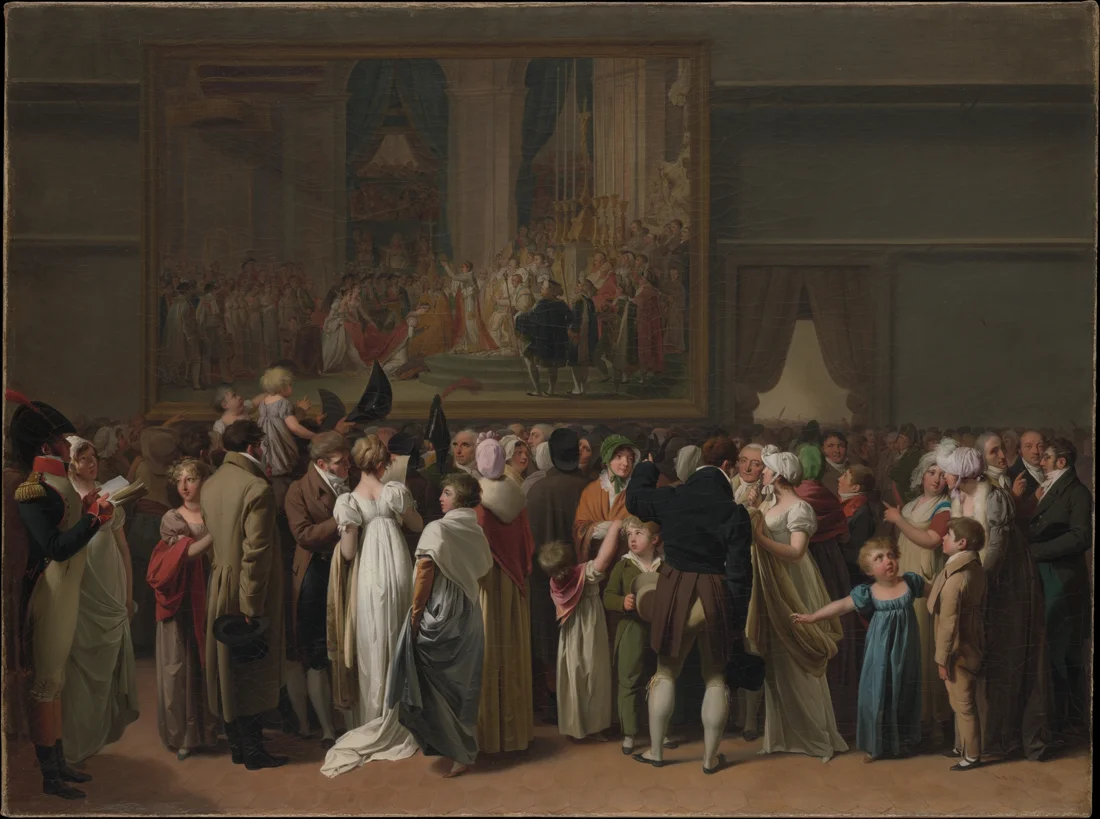
The emperor is on the wall, but the visitors are stealing the scene. In Louis Léopold Boilly’s painting of a public viewing at the Louvre, children peer between adults and a uniformed man consults a book. Jacques-Louis David’s Coronation rises above them as a picture inside a picture. Boilly’s crowd makes a familiar imperial image feel newly approachable by asking you to look at the people looking at it.
The ceremony and the exhibition are different events
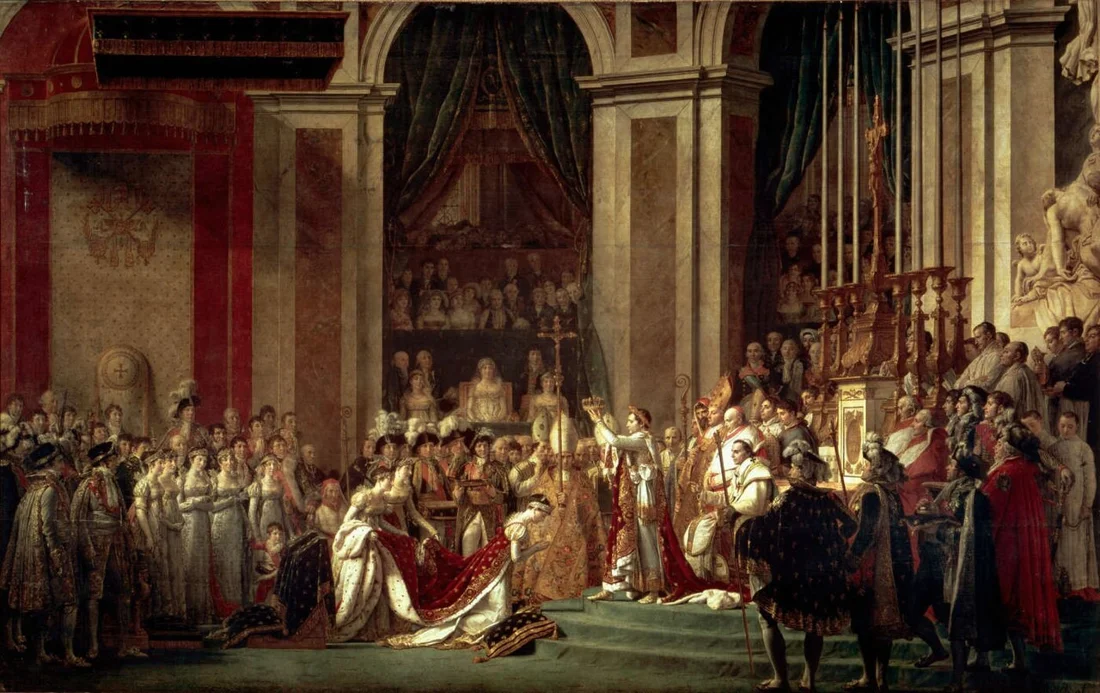
David’s great canvas depicts the ceremony at Notre-Dame in Paris on December 2, 1804. The Louvre’s collection record dates the painting to 1807. Boilly’s scene belongs to a later moment again: the Metropolitan Museum dates it to 1810. Keeping those dates separate prevents a view of an exhibition from being mistaken for a view of the ceremony itself.
The Met explains that David’s painting was publicly shown at the Louvre on three occasions between 1808 and 1810. Its interpretation places those spectacles within the celebration of Napoleon’s claim to power. A large historical painting could therefore do political work beyond the event it represented. This is a different question from the route through places associated with Napoleon’s Paris: here, the subject is how an image meets its audience.
Read the smaller picture inside the larger one
In David’s composition, Napoleon holds a crown above the kneeling Joséphine. The ceremony has been arranged into a monumental image with a clear center of attention. In Boilly’s painting, you encounter that scene again, but at a distance and above a busy room. Your attention can move between the imperial group on the canvas and the people assembled in front of it.
Try following that movement before trying to name every historical figure. The painting within the painting provides an elevated focus, while the foreground offers faces, clothing, and gestures at a more intimate scale. Boilly has made the act of viewing into something worth viewing. It is a useful reminder that the history of a famous artwork includes encounters with audiences, as well as the story of its maker and commission.
A book,a hat,and the problem of seeing
At the left, a military man holds an open printed book. The Met identifies such guidebooks as aids for deciphering the participants in David’s crowded composition. Nearby, adults and children occupy different levels and turn their attention in different directions. Rather than imagining a perfectly silent audience receiving one message, you can watch a room full of separate encounters unfold.
The museum notes that hats are being removed, but leaves room for different explanations: deference or better visibility. That uncertainty is worth keeping. A gesture may be visible while the exact intention behind it remains open to interpretation. The same habit of distinguishing evidence from a tidy explanation helps when reading Napoleon beyond a simplified legend.
Take a viewer’s question into the city
A family can approach this painting without beginning with a list of imperial dignitaries. Ask who has the best view, who needs help seeing, and who seems interested in something beyond the canvas. Those are observations a child and an adult can compare. Then place that history of looking beside the surviving traces of Napoleon’s Paris and the Arc de Triomphe landmark guide, where images and monuments make claims in different ways.
For another chapter in Paris’s artistic life,The Montmartre of the Impressionists introduces Père Tanguy through a professional actor embodying the character. The experience format guide explains how that encounter works. Consult the current experience page for its actual route. Boilly leaves you with a question that can accompany many cultural discoveries: how does the way people gather around an image change what that image means?
Discover an Immmersiv Experience
Explore The Montmartre of the Impressionists with a professional actor embodying Père Tanguy. This article provides background for your curiosity. It does not promise stops or access beyond the published experience route. Consult the current experience page for its route and practical details.