A 3-Day Immersive Paris Itinerary
A three-day immersive Paris itinerary should reveal a different layer of the city each day without turning culture into a race. Begin with artistic neighborhoods, move toward public power and memory, then finish where Paris first took shape along the Seine. The rhythm below combines private story-led encounters with independent museums, streets, meals, and pauses. Confirm current routes, languages, access, availability, and prices before fixing any reservation.
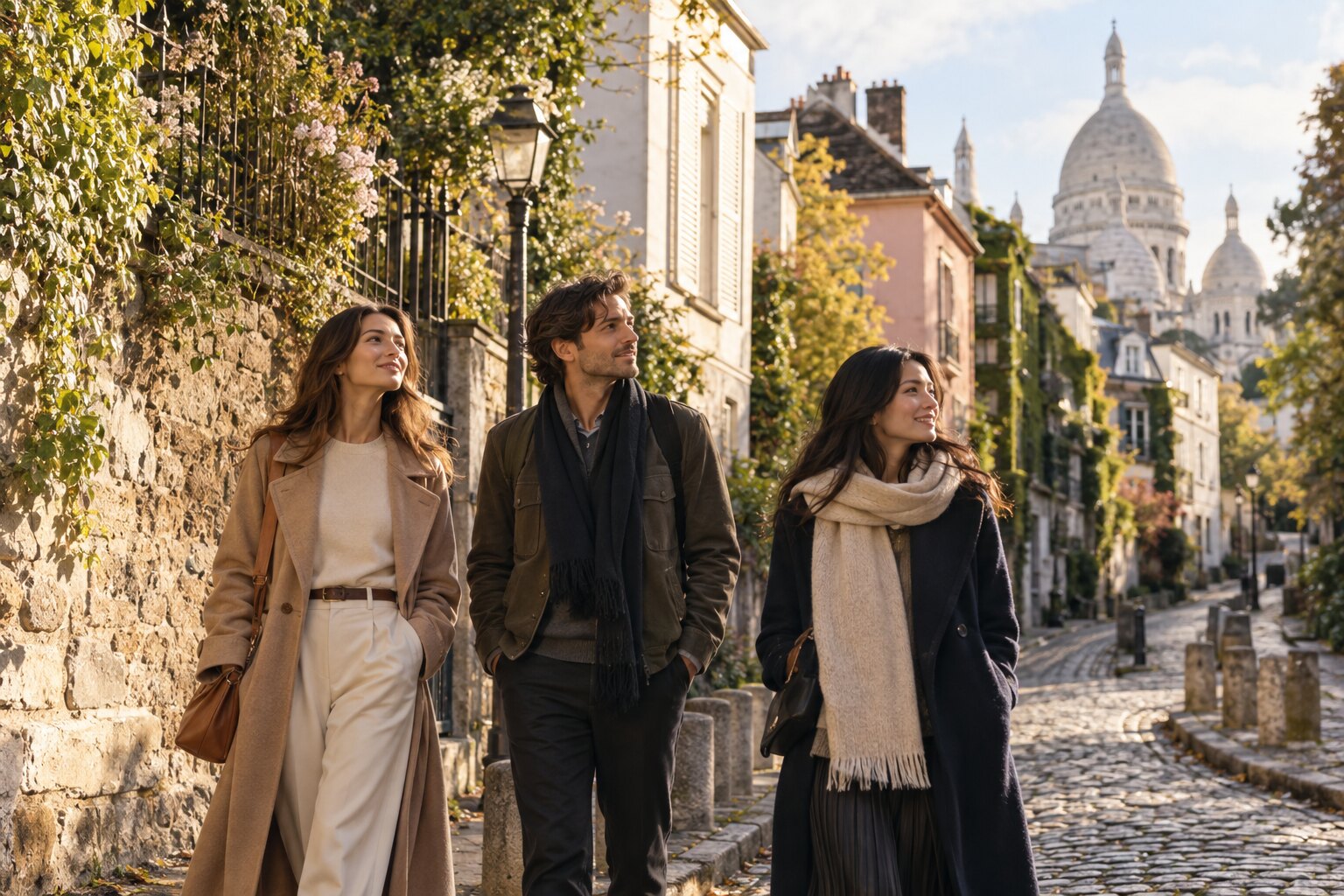
Day one: enter Paris through its artists
Start in Montmartre, not because it is a checklist neighborhood, but because its steep streets make artistic ambition visible at human scale. Build the morning around one confirmed encounter or a carefully chosen walk, then leave time to notice studios, changing viewpoints, and the distance between the postcard and the working district. A professional actor embodying a historical character can give the neighborhood an interpretive voice, while the streets and collections provide evidence of their own. Keep lunch nearby so that the first day develops as one continuous story rather than a sequence of transfers.
Use the afternoon for a single museum or artist-linked place that deepens the morning instead of repeating it. The Musée de Montmartre, the collections around Impressionism, or an independent walk toward Pigalle can each work, depending on opening hours and the interests of the group. Give everyone a small question to carry through the visit, such as who was able to become an artist, who paid for the work, and which parts of the neighborhood have disappeared. End early enough to preserve energy, because immersion depends on attention more than endurance.
Day two: read power in the cityscape
Shift the second day from artistic community to public image by choosing a district shaped by ceremony, fashion, or political ambition. Place Vendôme, the Opéra district, and the axis toward the Arc de Triomphe offer distinct ways to ask how Paris presents authority. Choose one principal lens and keep the route compact, because crossing the city repeatedly weakens the narrative. A character-led encounter should be treated as a researched performance that invites questions, not as a substitute for documented history.
After the encounter, connect the theme to one independently visited monument, exhibition, or public space. Allow enough time for security lines, timed entries, and the simple pleasure of sitting where the architecture can be observed slowly. If the group chooses the Arc de Triomphe, verify access conditions and mobility needs before arrival; if it chooses fashion or the Opéra, check current exhibitions rather than assuming a permanent display. The goal is to compare how power is staged across different settings, not to collect the largest number of famous addresses.
Day three: follow memory back to the Seine
Use the final day to move from monumental Paris toward the older city around Île de la Cité, the river, and the Left Bank. Begin with one clearly bounded historical question, then trace it through streets, façades, and institutional collections that can support or challenge the story. Separate documented events from later legend whenever a place has accumulated romantic retellings. This makes the final day feel deeper, not darker, and gives travelers a method they can continue using after the itinerary ends.
Keep the afternoon deliberately spacious for a return visit, a river walk, or a small museum chosen from questions raised during the previous two days. Do not force every theme into a final summary, because unresolved details are part of what makes a city worth revisiting. Ask each traveler to name one place that changed meaning and one story they now want to verify further. Finish beside the Seine at a pace that lets the three days connect in memory rather than collapse into one long list.
Make the three days work as one journey
Reserve only the experiences that truly anchor each day, and group everything else by geography. Check travel time from the accommodation, meal constraints, museum closures, seasonal daylight, and the energy level of every traveler before finalizing the order. One substantial encounter and one complementary cultural stop per day are often enough when the surrounding neighborhood is allowed to participate in the story. Build in a contingency for rain or fatigue so that a change of plan does not feel like failure.
A good three-day immersive Paris itinerary moves from artistic life to public power and then to urban memory, while leaving room for surprise. It uses professional performance, museums, monuments, and ordinary streets as different kinds of cultural evidence. Verify every practical condition close to travel, particularly private-experience availability and the current terms of any Pass. The result should feel like three chapters of the same journey, each changing the way the next one is seen.
Continue the story with Immmersiv
The Impressionists of Montmartre features a professional actor embodying Père Tanguy, while The Chanel Mystery in Paris features a professional actress embodying Coco Chanel. These encounters can anchor days one and two when their current availability, language, meeting point, route, and practical conditions are confirmed directly. They are researched performances and do not claim that the historical personalities have literally returned. Review the current experience pages before placing either encounter into a fixed itinerary.